



Page 6
Page 6
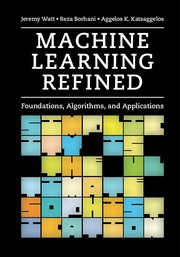
Machine learning refined : Foundations, algorithms, and applications
Providing a unique approach to machine learning, this text contains fresh and intuitive, yet rigorous, descriptions of all fundamental concepts necessary to conduct research, build products, tinker, and play. By prioritizing geometric intuition, algorithmic thinking, and practical real world applications in disciplines including computer vision, natural language processing, economics, neuroscience, recommender systems, physics, and biology, this text provides readers with both a lucid understanding of foundational material as well as the practical tools needed to solve real-world problems. With in-depth Python and MATLAB/OCTAVE-based computational exercises and a complete treatment of cutting edge numerical optimization techniques, this is an essential resource for students and an ideal reference for researchers and practitioners working in machine learning, computer science, electrical engineering, signal processing, and numerical optimization

Machine Learning for Multimodal Interaction ; 5th International Workshop, MLMI 2008, Utrecht, The Netherlands, September 8-10, 2008. Proceedings
The 12 revised full papers and 15 revised poster papers presented together with 5 papers of a special session on user requirements and evaluation of multimodal meeting browsers/assistants were carefully reviewed and selected from 47 submissions. The papers cover a wide range of topics related to human-human communication modeling and processing, as well as to human-computer interaction, using several communication modalities. Special focus is given to the analysis of non-verbal communication cues and social signal processing, the analysis of communicative content, audio-visual scene analysis, speech processing, interactive systems and applications.
Machine Learning for Audio, Image and Video Analysis : Theory and Applications
The book is organized in four parts: The first focuses on technical aspects, basic mathematical notions and elementary machine learning techniques. The second provides an extensive survey of most relevant machine learning techniques for media processing, while the third part focuses on applications and shows how techniques are applied in actual problems. The fourth part contains detailed appendices that provide notions about the main mathematical instruments used throughout the text

Machine Learning : ECML 2005 ; 16th European Conference on Machine Learning, Porto, Portugal, October 3-7, 2005, Proceedings
The European Conference on Machine Learning (ECML) and the European Conference on Principles and Practice of Knowledge Discovery in Databases (PKDD) were jointly organized this year for the ?fth time in a row, after some years of mutual independence before. After Freiburg (2001), Helsinki (2002), Cavtat (2003) and Pisa (2004), Porto received the 16th edition of ECML and the 9th PKDD in October 3–7. Having the two conferences together seems to be working well: 585 di?erent paper submissions were received for both events, which maintains the high s- mission standard of last year. Of these, 335 were submitted to ECML only, 220 to PKDD only and 30 to both. Such a high volume of scienti?c work required a tremendous e?ort from Area Chairs, Program Committee members and some additional reviewers. On average, PC members had 10 papers to evaluate, and Area Chairs had 25 papers to decide upon. We managed to have 3 highly qualified independent reviews per paper (with very few exceptions) and one additional overall input from one of the Area Chairs. After the authors’ responses and the online discussions for many of the papers, we arrived at the ?nal selection of 40 regular papers for ECML and 35 for PKDD. Besides these, 32 others were accepted as short papers for ECML and 35 for PKDD. This represents a joint acceptance rate of around 13% for regular papers and 25% overall.

Logic for Programming, Aritficial Intelligence, and Reasoning ; 13th International Conference, LPAR 2006, Phnom Penh, Cambodia, November 13-17, 2006, Proceedings
This book constitutes the refereed proceedings of the 13th International Conference on Logic for Programming, Artificial Intelligence, and Reasoning, LPAR 2006, held in Phnom Penh, Cambodia in November 2006. The 38 revised full papers presented together with one invited talk were carefully reviewed and selected from 96 submissions.

LATIN 2008 : Theoretical Informatics ; 8th Latin American Symposium, Búzios, Brazil, April 7-11, 2008. Proceedings
The Latin American Theoretical INformatics Symposium (LATIN) is becoming a traditional and high-quality conference on the Theory of Computing. Previous conferences havebeen organized twiceinBrazil: SaoPaulo (1992) and Campinas (1998); twice in Chile: Valpara so (1995) and Valdivia (2006); once in Uruguay: Punta del Este (2000); once in Mexico: Cancun (2002); and once in Argentina: Buenos Aires (2004). This volume contains the proceedings of the 8th Latin American Theore- cal INformatics Symposium (LATIN 2008), which was held in Buzio s, Rio de Janeiro, Brazil, April 7 11, 2008.

Job Scheduling Strategies for Parallel Processing ; Vol. 3834 : 11th International Workshop, JSSPP 2005, Cambridge, MA, USA, June 19, 2005, Revised Selected Papers
Constitutes the refereed postproceedings of the 11th International Workshop on Job Scheduling Strategies for Parallel Processing, 2005, held in conjunction with the 19th ACM International Conference on Supercomputing. This book covers a range of parallel architectures, from distributed grids, through clusters, to massively-parallel supercomputers.

Complex Motion ; 1st International Workshop, IWCM 2004, Günzburg, Germany, October 12-14, 2004, Revised Papers
The world we live in is a dynamic one: we explore it by moving through it, and many of the objects which we are interested in are also moving. Trafic, for instance, is an example of a domain where detecting and processing visual motion is of vital interest, both in a metaphoric as well as in a purely literal sense. Visual communication is another important example of an area of science which is dominated by the need to measure, understand, and represent visual motion in an eficient way. Visual motion is a subject of research which forces the investigator to deal with complexity; complexity in the sense of facing efiects of motion in a very large diversity of forms, starting from analyzing simple motion in a changing envir- ment (illumination, shadows, . . . ), under adverse observation conditions, such as bad signal-to-noiseratio (low illumination, small-scaleprocesses, low-dosex-ray, etc. ), covering also multiple motions of independent objects, occlusions, and - ing as far as dealing with objects which are complex in themselves (articulated objects such as bodies of living beings). The spectrum of problems includes, but does not end at, objects which are not ‘bodies’ at all, e. g. , when anal- ing fiuid motion, cloud motion, and so on. Analyzing the motion of a crowd in a shopping mall or in an airport is a further example that implies the need to struggle against the problems induced by complexity.
Competitive Programming in Python : 128 Algorithms to Develop your Coding Skills
Learn all the algorithmic techniques and programming skills you need from two experienced coaches, problem setters, and jurors for coding competitions. The authors highlight the versatility of each algorithm by considering a variety of problems and show how to implement algorithms in simple and efficient code. What to expect: * Master 128 algorithms in Python. * Discover the right way to tackle a problem and quickly implement a solution of low complexity.

Classification of covid-19 in lung images
The novel coronavirus 2019 (COVID-2019), which first appeared in Wuhan city of China in December 2019, spread rapidly around the world and became a pandemic. It has caused a devastating effect on both daily lives, public health, and the global economy. It is critical to detect the positive cases as early as possible so as to prevent the further spread of this epidemic and to quickly treat affected patients. The need for auxiliary diagnostic tools has increased as there are no accurate automated toolkits available. Recent findings obtained using radiology imaging techniques suggest that such images contain salient information about the COVID-19 virus. Application of advanced artificial intelligence (AI) techniques coupled with radiological imaging can be helpful for the accurate detection of this disease, and can also be assistive to overcome the problem of a lack of specialized physicians in remote villages.
Boundary Representation Modelling Techniques
Boundary representation is the principle solid modelling method used in modern CAD/CAM systems. There have been a long series of developments on which currently available systems are based, full details of which are only partially known. Ian Stroud’s thorough coverage of these developments puts this technology in perspective. Ian Stroud started working with boundary representation solid modelling in 1977. Since then he has researched and is researching a wide variety of topics in and around this field. The information in the book comes from the results of this research.

Boosting Collaborative Networks 4.0 ; 21st IFIP WG 5.5 Working Conference on Virtual Enterprises, PRO-VE 2020, Valencia, Spain, November 23–25, 2020, Proceedings
This book constitutes the refereed proceedings of the 21st IFIP WG 5.5 Working Conference on Virtual Enterprises, PRO-VE 2020, held in Valencia, Spain, in November 2020. The conference was held virtually. The 53 full papers were carefully reviewed and selected from 135 submissions. They provide a comprehensive overview of major challenges and recent advances in various domains related to the digital transformation and collaborative networks and their applications with a strong focus on the following areas related to the main theme of the conference: collaborative business ecosystems; collaborative business models; collaboration platform; data and knowledge services; blockchain and knowledge graphs; maintenance, compliance and liability; digital transformation; skills for organizations of the future

Blind smart helmet
The Smart Helmet for the Blind is a project aimed at providing solutions for the challenges faced by blind individuals in their daily lives. The problem of detecting objects, identifying obstacles and distances, knowing the current location, and using a mobile application is a common issue for blind people. To address these problems, the Smart Helmet project was created, utilizing advanced technology and artificial intelligence to provide real-time assistance to the wearer. The helmet is connected to a Raspberry Pi 4, which processes information from the helmet's cameras and AI algorithms to analyze and predict the surrounding environment for a blind person.

Bioinspired optimization methods and their applications ; 9th International conference, BIOMA 2020, Brussels, Belgium, November 19–20, 2020, Proceedings
This book constitutes the refereed proceedings of the 9th International Conference on Bioinspired Optimization Methods and Their Applications, BIOMA 2020, held in Brussels, Belgium, in November 2020. The 24 full papers presented in this book were carefully reviewed and selected from 68 submissions. The papers in this BIOMA proceedings specialized in bioinspired algorithms as a means for solving the optimization problems and came in two categories: theoretical studies and methodology advancements on the one hand, and algorithm adjustments and their applications on the other.

Bio-inspired computing and communication ; 1st Workshop on Bio-inspired design of networks, BIOWIRE 2007 Cambridge, UK, April 2-5, 2007 Revised Selected Papers
The book constitutes the thoroughly refereed post-workshop proceedings of the First Workshop on Bio-Inspired Design of Networks, BIOWIRE 2007, held in Cambridge, UK, in April 2007.

Big data analysis of nanoscience bibliometrics, patent, and funding data (2000-2019)
Presents an evaluation of nanotechnologies outputs (academic outputs and patents) and their impact from 2000-2019. The evaluation uses Elsevier’s Scopus (the largest abstract and citation database of peer-reviewed literature), SciVal (a scientific research analysis platform), Funding Institutional (a funding database), and PatentSight (a patent analysis platform). It covers four key topics regarding nanoscience research, including: 1) An overview of nano-related scholarly output, 2) Nanoscience and its contribution to basic science, 3) Nanoscience and its impact on and collaboration with industry partners, and 4) Key factors that promote the development of nanoscience.
Beyond the Worst-Case Analysis of Algorithms
There are no silver bullets in algorithm design, and no single algorithmic idea is powerful and flexible enough to solve every computational problem. Nor are there silver bullets in algorithm analysis, as the most enlightening method for analyzing an algorithm often depends on the problem and the application. However, typical algorithms courses rely almost entirely on a single analysis framework, that of worst-case analysis, wherein an algorithm is assessed by its worst performance on any input of a given size. The purpose of this book is to popularize several alternatives to worst-case analysis and their most notable algorithmic applications, from clustering to linear programming to neural network training. Forty leading researchers have contributed introductions to different facets of this field, emphasizing the most important models and results, many of which can be taught in lectures to beginning graduate students in theoretical computer science and machine learning.

Beyond Cartesian Dualism : Encountering affect in the teaching and learning of science.
There is surprisingly little known about affect in science education. Despite periodic forays into monitoring students’ attitudes-toward-science, the effect of affect is too often overlooked. Beyond Cartesian Dualism gathers together contemporary theorizing in this axiomatic area. In fourteen chapters, senior scholars of international standing use their knowledge of the literature and empirical data to model the relationship between cognition and affect in science education. Their revealing discussions are grounded in a broad range of educational contexts including school classrooms, universities, science centres, travelling exhibits and refugee camps, and explore an array of far reaching questions. What is known about science teachers’ and students’ emotions? How do emotions mediate and moderate instruction? How might science education promote psychological
Beginning Ubuntu Linux
Beginning Ubuntu Linux, the award–winning and best–selling Ubuntu book for beginners, is now in its third edition, presenting readers with an up–to–the–minute introduction to the world of Linux and the open source community. A detailed overview of Ubuntu's installation and configuration process encourages you to take the plunge and switch to Linux, and from there you'll learn how to wield total control over your newly installed operating system. Guided through the most commonly desired tasks such as printer configuration, listening to audio CDs and MP3s, watching movies, performing office and Internet–related tasks, as well as general system maintenance matters, authors Keir Thomas and Jaime Sicam will soon have you using and enjoying Ubuntu Linux and never looking back.
Beginning Google Maps Applications with PHP and Ajax : From novice to professional
Until recently, building interactive web-based mapping applications has been a cumbersome affair. This changed when Google released its powerful Maps API. Beginning Google Maps Applications with PHP and Ajax was written to help you take advantage of this technology in your own endeavorswhether you're an enthusiast playing for fun or a professional building for profit. This book covers version 2 of the API, including Google's new Geocoding service. As well as providing hands-on examples of real mapping projects, this book supplies a complete reference for the Maps API, along with the relevant aspects of JavaScript, CSS, PHP, and SQL. Visit the authors' website for additional tips and advice.
