



Page 5
Page 5

Computer Aided Verification ; 19th International Conference, CAV 2007, Berlin, Germany, July 3-7, 2007, Proceedings
This volume contains advancement of the theory and practice of computer-assisted formal analysis methods for software and hardware systems. covers the spectrum from theoretical - sults to concrete applications, with an emphasis on practical verification tools and the algorithms and techniques that are needed for their implementation.

Computational methods in systems biology ; 6th International Conference CMSB 2008, Rostock, Germany, October 12-15, 2008. Proceedings
This book constitutes the refereed proceedings of the 6th International Conference on Computational Methods in Systems Biology, CMSB 2008, held in Rostock, Germany, in September 2008.

Computational intelligence and security ; Vol. 3801 ; International Conference, CIS 2005, Xi'an, China, December 15-19, 2005, Proceedings, Part I
The two volume set LNAI 3801 and LNAI 3802 constitute the refereed proceedings of the annual International Conference on Computational Intelligence and Security, CIS 2005, held in Xi'an, China, in December 2005. The 338 revised papers presented - 254 regular and 84 extended papers - were carefully reviewed and selected from over 1800 submissions. The first volume is organized in topical sections on learning and fuzzy systems, evolutionary computation, intelligent agents and systems, intelligent information retrieval, support vector machines, swarm intelligence, data mining, pattern recognition, and applications.
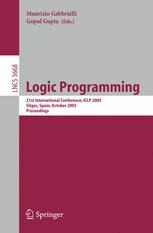
Logic Programming ; Vol. 3668 : 21st International Conference, ICLP 2005, Sitges, Spain, October 2-5, 2005, Proceedings
This volume contains the proceedings of the 21st International Conference on Logic Programming which was held in Sitges (Barcelona), Spain, from October 2nd to 5th, 2005. The conference was colocated with the International Conf- ence on ConstraintProgramming(CP 2005)and the following 6 post-conference workshops: – CICLOPS 2005: Colloquium on Implementation of Constraint and Logic Programming Systems – CSLP 2005: Constraint Solving and Language Processing – WCB 2005: Constraint Based Methods for Bioinformatics – WLPE 2005: Logic-Based Methods in Programming Environments – MoVeLog 2005: Mobile Code Safety and Program Veri?cation Using C- putational Logic Tools – CHR 2005: Constraint Handling Rules The conferencecoincided with a solareclipse

Logic for Programming, Artificial Intelligence, and Reasoning ; Vol. 3835 : 12th International Conference, LPAR 2005, Montego Bay, Jamaica, December 2-6, 2005, Proceedings
Constitutes the refereed proceedings of the 12th International Conference on Logic for Programming, Artificial Intelligence, and Reasoning, LPAR 2005. This book presents 46 revised papers with 3 abstracts, addressing issues in logic programming, logic-based program manipulation, formal method, automated reasoning, and various kinds of AI logics.

Leveraging applications of formal methods, verification and validation : Verification Principles ; 9th International Symposium on Leveraging Applications of Formal Methods, ISoLA 2020, Rhodes, Greece, October 20–30, 2020, Proceedings, Part I
Constitutes the refereed proceedings of the 9th International Symposium on Leveraging Applications of Formal Methods, ISoLA 2020, which was planned to take place during October 20–30, 2020, on Rhodes, Greece. The papers presented were carefully reviewed and selected for inclusion in the proceedings. Each volume focusses on an individual topic with topical section headings within the volume : Part I, Verification Principles : Modularity and (De-)Composition in Verification ; X-by-Construction: Correctness meets Probability ; 30 Years of Statistical Model Checking ; Verification and Validation of Concurrent and Distributed Systems.

Leveraging applications of formal methods, verification and validation : Applications ; 9th International Symposium on Leveraging Applications of Formal Methods, ISoLA 2020, Rhodes, Greece, October 20–30, 2020, Proceedings, Part III
The three-volume set LNCS 12476 - 12478 constitutes the refereed proceedings of the 9th International Symposium on Leveraging Applications of Formal Methods, ISoLA 2020, which was planned to take place during October 20–30, 2020, on Rhodes, Greece. The event itself was postponed to 2021 due to the COVID-19 pandemic. The papers presented were carefully reviewed and selected for inclusion in the proceedings. Each volume focusses on an individual topic with topical section headings within the volume: Part III, Applications: Reliable Smart Contracts: State-of-the-art, Applications, Challenges and Future Directions; Automated Verification of Embedded Control Software; Formal methods for DIStributed COmputing in future RAILway systems.

Leveraging Applications of Formal Methods ; 1st International Symposium, ISoLA 2004, Paphos, Cyprus, October 30 - November 2, 2004, Revised Selected Papers
This book constitutes the thoroughly refereed post-proceedings of the First International Symposium on Leveraging Applications of Formal Methods, ISoLA 2004, held in Paphos, Cyprus in October/November 2004. The 12 revised full papers presented were carefully selected from more than 70 submissions. The papers discuss issues related to the adoption and use of rigorous tools and methods for the specification, analysis, verification, certification, construction, test, and maintenance of systems. In particular, by discussing common problems, requirements, algorithms, methodologies, and practices, ISoLA aims at supporting researchers in their quest to improve the utility, reliability, flexibility, and efficiency of tools for building systems, and users in their search for adequate solutions to their problems.
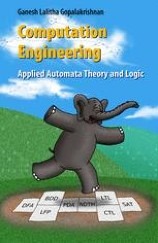
Computation Engineering : Applied Automata Theory and Logic
This book covers automata in depth, providing good intuitions along the way, and culminating with applications that are used every day in the field. In this respect, it is a departure from the conventional textbooks on complexity and computability, although these 'tradtional' aspects remain well represented.

Compiler construction ; Vol. 3923 : 15th International Conference, CC 2006, Held as Part of the Joint European Conferences on Theory and Practice of Software, ETAPS 2006, Vienna, Austria, March 30-31, 2006, Proceedings
ETAPS 2006 was the ninth instance of the European Joint Conferences on Theory and Practice of Software. ETAPS is an annual federated conference that was established in 1998 by combining a number of existing and new conferences. The events that comprise ETAPS address various aspects of the system devel- ment process, including speci?cation, design, implementation, analysis and impro- ment. The languages, methodologies and tools which support these activities are all well within its scope. Di?erent blends of theory and practice are represented, with an inclination towards theory with a practical motivation on the one hand and soundly based practice on the other.

Communicating sequential processes : The first 25 years : Symposium on the Occasion of 25 Years of CSP, London, UK, July 7-8, 2004. Revised Invited Papers
This volume, like the symposium CSP25 which gave rise to it, commemorates the semi-jubilee of Communicating Sequential Processes. 1 Tony Hoare’s paper “Communicating Sequential Processes” is today widely regarded as one of the most in?uential papers in computer science. To comm- orate it, an event was organized under the auspices of BCS-FACS (the British Computer Society’s Formal Aspects of Computing Science specialist group). CSP25 was one of a series of such events organized to highlight the use of formal methods, emphasize their relevance to modern computing and promote their wider application.
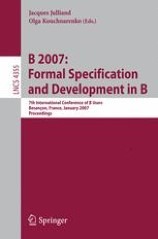
B 2007 : Formal Specification and Development in B ; 7th International Conference of B Users, Besancon, France, January 7-19, 2007, Proceedings
These proceedingsrecordthe papers presented at the Seventh InternationalC- ference of B Users (B 2007), held in the city of Besan¸ con in the east of France. All the submitted papers in these proceedings were peer reviewed by at least three reviewers drawn from the B committee, depending on the subject matter of the paper. The authorsof the papersforB 2007werefrom Australia,Canada, Finland, Germany, France, Switzerland, and the UK. The conference featured a rangeof contributions by distinguished invited speakers drawn from both ind- try and academia.

Automated technology for verification and analysis ; 6th International Symposium, ATVA 2008, Seoul, Korea, October 20-23, 2008. Proceedings
This book constitutes the refereed proceedings of the 6th International Symposium on Automated Technology for Verification and Analysis, ATVA 2008, held in Seoul, Korea, in October 2008.

Automated technology for verification and analysis ; 5th International Symposium, ATVA 2007 Tokyo, Japan, October 22-25, 2007 Proceedings
This book presented theoretical methods to achieve correct software or hardware systems, including both functional and non functional aspects

Automated technology for verification and analysis ; 4th International Symposium, ATVA 2006, Beijing, China, October 23-26, 2006, Proceedings
The Automated Technology for Veri?cation and Analysis (ATVA) international symposium series was initiated in 2003, The main topics of the symposium include th- ries useful for providing designers with automated support for obtaining correct software or hardware systems, as well as the implementation of such theories in tools or their application. In the end, 35 papers were selected for inclusion in the program. ATVA 2006 had three keynote speeches given respectively by Thomas Ball, Jin Yang, and Mihalis Yannakakis. The main symposium was preceded by a tutorial day, consisting of three two-hourlectures given by the keynotespeakers.

Automated technology for verification and analysis ; 3rd International Symposium, ATVA 2005, Taipei, Taiwan, October 4-7, 2005, Proceedings
The Automated Technology for Veri?cation and Analysis (ATVA) international symposium series was initiated in 2003, responding to a growing interest in formal veri?cation spurred by the booming IT industry, particularly hardware design and manufacturing in East Asia. Its purpose is to promote research on automated veri?cation and analysis in the region by providing a forum for int- action between the regional and the international research/industrial commu- ties of the ?eld. ATVA 2005, the third of the ATVA series, was held in Taipei, Taiwan, 2005. The main theme of the symposium encompasses - sign, complexities, tools, and applications of automated methods for veri?cation and analysis. This book constitutes the refereed proceedings of the symposium .

Automated technology for verification and analysis ; 18th International Symposium, ATVA 2020, Hanoi, Vietnam, October 19–23, 2020, Proceedings
This book constitutes the refereed proceedings of the 18th International Symposium on Automated Technology for Verification and Analysis, ATVA 2020, held in Hanoi, Vietnam, in October 2020. The 27 regular papers presented together with 5 tool papers and 2 invited papers were carefully reviewed and selected from 75 submissions.

Automated Reasoning with Analytic Tableaux and Related Methods ; 16th International Conference, TABLEAUX 2007, Aix en Provence, France, July 3-6, 2007, Proceedings
It covers the wide range of logics, from intuitionistic and substructural logics to modal logics (including temporal and dynamic logics), from many-valued logics to nonmonotonic logics, and from classical first-order logic to description logics.

Automated deduction – CADE-21 ; 21st International Conference on automated deduction, Bremen, Germany, July 17-20, 2007, Proceedings
All current aspects of automated deduction are addressed, ranging from theoretical and methodological issues to presentation and evaluation of theorem provers and logical reasoning systems. The papers are organized in topical sections on higher-order logic, description logic, intuitionistic logic, satisfiability modulo theories, induction, rewriting, and polymorphism, first-order logic, model checking and verification, termination, as well as tableaux and first-order systems.

Automated deduction – CADE 28 ; 28th International Conference on automated deduction, Virtual Event, July 12–15, 2021, Proceedings
This book constitutes the proceeding of the 28th International Conference on Automated Deduction, CADE 28, held virtually in July 2021. The 29 full papers and 7 system descriptions presented together with 2 invited papers were carefully reviewed and selected from 76 submissions. CADE is the major forum for the presentation of research in all aspects of automated deduction, including foundations, applications, implementations, and practical experience. The papers are organized in the following topics: Logical foundations; theory and principles; implementation and application; ATP and AI; and system descriptions.
