



Page 5
Page 5

Framing global mathematics : The international mathematical union between theorems and politics
This book is about the shaping of international relations in mathematics over the last two hundred years. It focusses on institutions and organizations that were created to frame the international dimension of mathematical research. Today, striking evidence of globalized mathematics is provided by countless international meetings and the worldwide repository ArXiv. The text follows the sinuous path that was taken to reach this state, from the long nineteenth century, through the two wars, to the present day. International cooperation in mathematics was well established by 1900, centered in Europe. The first International Mathematical Union, IMU, founded in 1920 and disbanded in 1932, reflected above all the trauma of WW I. Since 1950 the current IMU has played an increasing role in defining mathematical excellence, as is shown both in the historical narrative and by analyzing data about the International Congresses of Mathematicians. For each of the three periods discussed, interactions are explored between world politics, the advancement of scientific infrastructures, and the inner evolution of mathematics. Readers will thus take a new look at the place of mathematics in world culture, and how international organizations can make a difference. Aimed at mathematicians, historians of science, scientists, and the scientifically inclined general public.

Fractional-in-time semilinear parabolic equations and applications
This book provides a unified analysis and scheme for the existence and uniqueness of strong and mild solutions to certain fractional kinetic equations. This class of equations is characterized by the presence of a nonlinear time-dependent source, generally of arbitrary growth in the unknown function, a time derivative in the sense of Caputo and the presence of a large class of diffusion operators. The global regularity problem is then treated separately and the analysis is extended to some systems of fractional kinetic equations, including prey-predator models of Volterra–Lotka type and chemical reactions models, all of them possibly containing some fractional kinetics.

Fractional calculus—theory and applications
Fractional calculus has led to tremendous progress in various areas of science and mathematics. New definitions of fractional derivatives and integrals have been uncovered, extending their classical definitions in various ways. Moreover, rigorous analysis of the functional properties of these new definitions has been an active area of research in mathematical analysis. Systems considering differential equations with fractional-order operators have been investigated thoroughly from analytical and numerical points of view, and potential applications have been proposed for use in sciences and in technology. The purpose of this Special Issue is to serve as a specialized forum for the dissemination of recent progress in the theory of fractional calculus and its potential applications.

Foundations of software science and computation structures ; 25th International conference, FOSSACS 2022, Held as Part of the European joint conferences on theory and practice of software, ETAPS 2022, Munich, Germany, April 2–7, 2022, proceedings
This book constitutes the proceedings of the 25th International Conference on Foundations of Software Science and Computational Structures, FOSSACS 2022, which was held during April 4-6, 2022, in Munich, Germany, as part of the European Joint Conferences on Theory and Practice of Software, ETAPS 2022. They deal with research on theories and methods to support the analysis, integration, synthesis, transformation, and verification of programs and software systems.

Foundations of software science and computation structures ; 23rd International conference, FOSSACS 2020, Held as part of the European joint conferences on theory and practice of software, ETAPS 2020, Dublin, Ireland, April 25–30, 2020, proceedings
This book constitutes the proceedings of the 23rd International Conference on Foundations of Software Science and Computational Structures, FOSSACS 2020, which took place in Dublin, Ireland, in April 2020, and was held as Part of the European Joint Conferences on Theory and Practice of Software, ETAPS 2020.

Foundations of software science and computation structures ; 22nd International conference, FOSSACS 2019, Held as part of the European joint conferences on theory and practice of software, ETAPS 2019, Prague, Czech Republic, April 6–11, 2019, proceedings
This book constitutes the proceedings of the 22nd International Conference on Foundations of Software Science and Computational Structures, FOSSACS 2019, which took place in Prague, Czech Republic, in April 2019, held as part of the European Joint Conference on Theory and Practice of Software, ETAPS 2019. The 29 papers presented in this volume were carefully reviewed and selected from 85 submissions. They deal with foundational research with a clear significance for software science.

Foundations of information and knowledge systems ; 5th International Symposium, FoIKS 2008, Pisa, Italy, February 11-15, 2008. Proceedings
This book constitutes the refereed proceedings of the 5th International Symposium on Foundations of Information and Knowledge Systems, FoIKS 2008 held in Pisa, Italy, in February 2008. The 13 revised full papers presented together with 9 revised short papers and 3 invited lectures were carefully selected during two rounds of reviewing and improvement from from 79 submissions. The papers deal with any foundational aspect of information and knowledge systems, including submissions from researchers working in fields such as discrete mathematics, logic and algebra, model theory, information theory, complexity theory, algorithmics and computation, geometry, analysis, statistics and optimisation who are interested in applying their ideas, theories and methods to research on information and knowledge systems.

Foundations of information and knowledge systems ; 4th International Symposium, FoIKS 2006, Budapest, Hungary, February 14-17, 2006, Proceedings
This book constitutes the refereed proceedings of the 4th International Symposium on Foundations of Information and Knowledge Systems, held in February 2006. The 14 revised full papers presented together with three revised short papers and one invited paper were carefully reviewed and selected from 54 submissions. Among the topics covered are the theoretical foundations of information and knowledge systems, as well as mathematical fields such as discrete mathematics, combinatorics, logics and finite model theory, and applications thereof for research on database and knowledge base theory.

Foundations of genetic algorithms ; 8th International Workshop, FOGA 2005, Aizu-Wakamatsu City, Japan, January 5-9, 2005, Revised Selected Papers
The8thWorkshopontheFoundationsofGeneticAlgorithms,FOGA-8,washeld at the University of Aizu in Aizu-Wakamatsu City, Japan, January 5–9, 2005. This series of workshops was initiated in 1990 to encourage further research on the theoretical aspects of genetic algorithms, and the workshops have been held biennially ever since. The papers presented at these workshops are revised, edited and published as volumes during the year following each workshop. This series of (now eight) volumes provides an outstanding source of reference for the theoretical work in this ?eld. At the same time this series of volumes provides a clear picture of how the theoretical research has grown and matured along with the ?eld to encompass many evolutionary computation paradigms including evolution strategies (ES), evolutionary programming (EP), and genetic programming (GP), as well as the continuing growthininteractionswith other ?elds suchas mathematics,physics, and biology.

Foundations of generic optimization : Vol.1 : A combinatorial approach to epistasis
This is a comprehensive overview of the basics of fuzzy control, which also brings together some recent research results in soft computing, in particular fuzzy logic using genetic algorithms and neural networks. This book offers researchers not only a solid background but also a snapshot of the current state of the art in this field.

Foundation Mathematics for Computer Science : A Visual Approach
In this second edition of Foundation Mathematics for Computer Science, John Vince has reviewed and edited the original book and written new chapters on combinatorics, probability, modular arithmetic and complex numbers. These subjects complement the existing chapters on number systems, algebra, logic, trigonometry, coordinate systems, determinants, vectors, matrices, geometric matrix transforms, differential and integral calculus. During this journey, the author touches upon more esoteric topics such as quaternions, octonions, Grassmann algebra, Barrycentric coordinates, transfinite sets and prime numbers.

Formal concept analysis ; Vol. 3403 ; 3rd International Conference, ICFCA 2005, Lens, France, February 14-18, 2005, Proceedings
This book constitutes a comprehensive and systematic presentation of the state of the art of formal concept analysis and its applications. The first part of the book is devoted to foundational and methodological topics. The contributions in the second part demonstrate how formal concept analysis is successfully used outside of mathematics, in linguistics, text retrieval, association rule mining, data analysis, and economics. The third part presents applications in software engineering.

Formal Concept Analysis ; 6th International Conference, ICFCA 2008, Montreal, Canada, February 25-28, 2008. Proceedings
Formal Concept Analysis (FCA) is a mathematical theory of concepts and c- ceptual hierarchyleadingto methods for conceptually analyzing data and kno- edge. The theory itselfstronglyreliesonorder and lattice theory,whichhasbeen studied by mathematicians over decades. FCA proved itself highly relevant in several applications from the beginning , and, over the last years, the range of application shaskept growing. The mainreasonfor this comesfromthe fact that our modern society has turned into an “information” society. After years and years of using computers, companies realized they had stored gigantic amounts of data.

Forecasting and Assessing Risk of Individual Electricity Peaks
The overarching aim of this open access book is to present self-contained theory and algorithms for investigation and prediction of electric demand peaks. A cross-section of popular demand forecasting algorithms from statistics, machine learning and mathematics is presented, followed by extreme value theory techniques with examples.

Finite Elements III : First-Order and Time-Dependent PDEs
Volume III is divided into 28 chapters. The first eight chapters focus on the symmetric positive systems of first-order PDEs called Friedrichs' systems. This part of the book presents a comprehensive and unified treatment of various stabilization techniques from the existing literature. It discusses applications to advection and advection-diffusion equations and various PDEs written in mixed form such as Darcy and Stokes flows and Maxwell's equations. The remainder of Volume III addresses time-dependent problems: parabolic equations (such as the heat equation), evolution equations without coercivity (Stokes flows, Friedrichs' systems), and nonlinear hyperbolic equations (scalar conservation equations, hyperbolic systems). It offers a fresh perspective on the analysis of well-known time-stepping methods. The last five chapters discuss the approximation of hyperbolic equations with finite elements. Here again a new perspective is proposed.
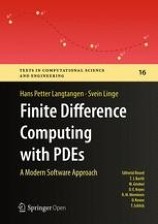
Finite Difference Computing with PDEs : A Modern Software Approach
This easy-to-read book introduces the basics of solving partial differential equations by means of finite difference methods. Unlike many of the traditional academic works on the topic, this book was written for practitioners. Accordingly, it especially addresses: the construction of finite difference schemes, formulation and implementation of algorithms, verification of implementations, analyses of physical behavior as implied by the numerical solutions, and how to apply the methods and software to solve problems in the fields of physics and biology.

Finite Difference Computing with Exponential Decay Models
This text provides a very simple, initial introduction to the complete scientific computing pipeline: models, discretization, algorithms, programming, verification, and visualization. The pedagogical strategy is to use one case study – an ordinary differential equation describing exponential decay processes – to illustrate fundamental concepts in mathematics and computer science. The book is easy to read and only requires a command of one-variable calculus and some very basic knowledge about computer programming. Contrary to similar texts on numerical methods and programming, this text has a much stronger focus on implementation and teaches testing and software engineering in particular.

Fast software encryption ; 15th International Workshop, FSE 2008, Lausanne, Switzerland, February 10-13, 2008, Revised Selected Papers
Constitutes the thoroughly refereed proceedings of the 15th International Workshop on Fast Software Encryption, FSE 2008, held in Lausanne, Switzerland in February 2008.The 26 revised full papers presented together with 4 short papers were carefully reviewed and selected from 72 submissions. The papers address all current aspects of fast and secure primitives for symmetric cryptology and are organized in topical sections on SHA collisions, new hash function designs, block cipher cryptanalysis, implementation aspects, hash function cryptanalysis, stream cipher cryptanalysis, security bounds, and entropy.

Experimental and Efficient Algorithms ; 4th International Workshop, WEA 2005, Santorini Island, Greece, May 10-13, 2005, Proceedings
This proceedings volume contains the accepted papers and invited talks p- sented at the 4th International Workshop of E?cient and Experimental Al- rithms (WEA 2005), that was held May 10–13, on Santorini Island, Greece. The WEA events are intended to be an international forum for research on the design, analysis and especially the experimental implementation, evaluation and engineering of algorithms, as well as on combinatorial optimization and its applications. The?rstthreeworkshopsinthisserieswereheldinRiga(2001),MonteVerita (2003) and Rio de Janeiro (2004). Thisvolumecontains3invitedpapersrelatedtocorrespondingkeynotetalks.

Experimental Algorithms ; 7th International Workshop, WEA 2008 Provincetown, MA, USA, May 30-June 1, 2008 Proceedings
The Workshop on Experimental Algorithms, WEA, is intended to be an international forum for research on the experimental evaluation and engineering of algorithms, as well as in various aspects of computational optimization and its applications. The emphasis of the workshop is the use of experimental me- ods to guide the design, analysis, implementation, and evaluation of algorithms, heuristics, and optimization programs. WEA 2008 was held at the Provincetown Inn, Provincetown, MA, USA, on May 30 – June 1, 2008. This was the seventh workshop of the series.
