



Page 4
Page 4

Hexagonal image processing : A practical approach
Hexagonal Image Processing provides an introduction to the processing of hexagonally sampled images, includes a survey of the work done in the field, and presents a novel framework for hexagonal image processing (HIP) based on hierarchical aggregates. Digital image processing is currently dominated by the use of square sampling lattices, however, hexagonal sampling lattices can also be used to define digital images. The strengths offered by hexagonal lattices over square lattices are considerable: • higher packing density, • uniform connectivity of points (pixels) in the lattice, • better angular resolution by virtue of having more nearest neighbours, and • superlative representation of curves. The utility of the HIP framework is demonstrated by implementing several basic image processing techniques (for the spatial and frequency domain) and some applications. The HIP framework serves as a tool for comparing processing of images defined on a square vs hexagonal grid, to determine their relative merits and demerits. The theory and algorithms covered are supplemented by attention to practical details such as accommodating hardware that support only images sampled on a square lattice. Including a Foreword written by Professor Narendra Ahuja, an eminent researcher in the field of Image Processing and Computer Vision, the book’s fresh approach to the subject offers insight and workable know-how to both researchers and postgraduates.

Handbook on Craniofacial Superimposition : The MEPROCS Project
This book is the first comprehensive guide to a new soft computing technique which is used in complex forensic cases. The chapters include detailed technical and practical overviews, and discussions about the latest tools, open problems and ethical and legal issues involved. The book will be of interest to researchers and practitioners in forensic medicine and computational intelligence.

Guide to Advanced Empirical Software Engineering
Empirical studies have become an integral element of software engineering research and practice. This unique text/reference includes chapters from some of the top international empirical software engineering researchers and focuses on the practical knowledge necessary for conducting, reporting and using empirical methods in software engineering.
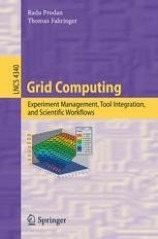
Grid computing : Experiment management, Tool Integration, and Scientific Workflows
Grid computing has become a topic of significant interest in the scientific community as a means of enabling application developers to aggregate resources scattered around the globe for solving large-scale scientific problems. This monograph addresses four critical software development aspects for the engineering and execution of applications on parallel and Grid architectures.

Grammatical Inference ; Algorithms and Applications : 9th International Colloquium, ICGI 2008 Saint-Malo, France, September 22-24, 2008 Proceedings
This book constitutes the refereed proceedings of the 9th International Colloquium on Grammatical Inference, ICGI 2008, held in Saint-Malo, France, in September 2008.The 21 revised full papers and 8 revised short papers presented were carefully reviewed and selected from 36 submissions. The topics of the papers presented vary from theoretical results of learning algorithms to innovative applications of grammatical inference, and from learning several interesting classes of formal grammars to applications to natural language processing.

Grammatical Inference : Algorithms and Applications ; 8th International Colloquium, ICGI 2006, Tokyo, Japan, September 20-22, 2006, Proceedings
The topics discussed range from theoretical results of learning algorithms to innovative applications of grammatical inference and from learning several interesting classes of formal grammars to applications to natural language processing.

Global optimization and constraint satisfaction ; 2nd International Workshop, COCOS 2003, Lausanne, Switzerland, Nevember 18-21, 2003, Revised Selected Papers
Theformulationofmanypracticalproblemsnaturallyinvolvesconstraintsonthe variables entering the mathematical model of a real-life situation to be analyzed. It is of great interest to ?nd the possible scenarios satisfying all constraints, and, iftherearemanyofthem,eitherto?ndthebestsolution,ortoobtainacompact, explicit representation of the whole feasible set. The 2nd Workshop on Global Constrained Optimization and Constraint S- isfaction, COCOS 2003, which took place during November 18–21, 2003 in L- sanne, Switzerland, was dedicated to theoretical, algorithmic, and application oriented advances in answering these questions. Here global optimization refers to ?nding the absolutely best feasible point, while constraint satisfaction refers to?ndingallpossiblefeasiblepoints.AsinCOCOS2002,the?rstsuchworkshop (see the proceeedings [1]), the emphasis was on complete solving techniques for problems involving continuous variables that provide all solutions with full rigor, and on applications which, however, were allowed to have relaxed standards of rigor.
Geographic Information Science ; 4th International Conference, GIScience 2006, Münster, Germany, September 20-23, 2006, Proceedings
The GIScience conference series (www. giscience. org) was created as a forum for all researchers who are interested in advancing research in the fundam- tal aspects of geographic information science.The conferences focus on emerging topics and basic research ?ndings across all s- tors of geographic information science. After three highly successful conferences in the United States, this year’s GIScience conference was held in Europe for the ?rst time. The GIScience conferences have been a meeting point for researchers coming from various disciplines, including cognitive science, computer science, engine- ing, geography,information science, mathematics, philosophy, psychology,social science, and statistics. The advancement of geographic information science - quiressuchinterdisciplinarybreadth,andthisisalsowhatmakestheconferences so exciting. In order to account for the di?erent needs of the involved scienti?c disciplines with regard to publishing their research results.
Generative programming and component engineering ; 4th International conference, GPCE 2005, Tallinn, Estonia, September 29 - October 1, 2005, Proceedings
Generative Programming and Component Engineering (GPCE) is a leading - searchconferenceonautomaticprogrammingandcomponentengineering.These approaches to software engineering have the potential to revolutionize software development as automation and components revolutionized manufacturing. The conference brings together researchers and practitioners interested in adva- ing automation for software development. It is also a premier forum for cro- fertilization between the programming language and software engineering - search communities. GPCEaroseasajointconference, mergingthepriorconferenceonGenerative and Component-Based Software Engineering (GCSE) and the Workshop on - mantics, Applications, andImplementationofProgramGeneration(SAIG). The proceedingsofthepreviousGPCEconferenceswerepublishedintheLNCSseries of Springer as volumes2487,2830, and 3286.In 2005 GPCE wasco-locatedwith the International Conference on Functional Programming (ICFP) and the s- posium on Trends in Functional Programming (TFP), re?ecting the vigorous interaction between the functional programming and generative programming research communities. GPCE and ICFP are both sponsored by the Association for Computing Machinery. The quality and breadth of the papers submitted to GPCE 2005 was impr- sive. All 86 papers, including 5 papers for tool demonstrations, were rigorously reviewed by 17 highly quali?ed Program Committee members. The members of the Program Committee ?rst provided in-depth individual reviews of the s- mitted papers, and then debated the merits of the papers through an extended electronicProgramCommitteemeeting.After much(friendly) argument,25r- ular papers and 2 tool demonstration papers were selected for publication. The ProgramCommittee provided extensive technical feedback to the authors of the submittedpapers.Theconferenceprogramwascomplementedwiththreeinvited talks, three extended tutorials, and three all-day workshops.

Fuzzy Systems Engineering : Theory and Practice
This book is devoted to reporting innovative and significant progress in fuzzy system engineering. Given the maturation of fuzzy logic, this book is dedicated to exploring the recent breakthroughs in fuzziness and soft computing in favour of intelligent system engineering. This monograph presents novel developments of the fuzzy theory as well as interesting applications of the fuzzy logic exploiting the theory to engineer intelligent systems.

Fundamentals of Artificial Intelligence
Fundamentals of Artificial Intelligence introduces the foundations of present day AI and provides coverage to recent developments in AI such as Constraint Satisfaction Problems, Adversarial Search and Game Theory, Statistical Learning Theory, Automated Planning, Intelligent Agents, Information Retrieval, Natural Language & Speech Processing, and Machine Vision. The book features a wealth of examples and illustrations, and practical approaches along with the theoretical concepts. It covers all major areas of AI in the domain of recent developments. The book is intended primarily for students who major in computer science at undergraduate and graduate level but will also be of interest as a foundation to researchers in the area of AI.

Functional imaging and modeling of the heart ; 3rd International workshop, FIMH 2005, Barcelona, Spain, June 2-4, 2005, Proceedings
The FIMH conference was the ?rst attempt to agglutinate researchers from several complementary but often i- lated ?elds: cardiac imaging, signal and image processing, applied mathematics and physics, biomedical engineering and computer science, cardiology, radi- ogy, biology, and physiology. In the ?rst two editions, the conference received an enthusiastic acceptance by experts of all these communities. FIMH was ori- nally started as a European event and has increasingly attracted more and more people from the US and Asia. This edition of FIMH received the largest number of submissions so far with a result of 47 papers being accepted as either oral presentations or posters. There were a number of submissions from non-EU institutions which con?rms the growing interest in this series of meetings. All papers were reviewed by up to four reviewers. The accepted contributions were organized into 8 oral sessions and 3 poster sessions complemented by a number of invited talks. This year we tried to allocate as many papers as possible as oral presentations to facilitate more active participation and to stimulate multidisciplinary discussions.

From brows to trust : Evaluating embodied conversational agents
This book will help experts and designers in the specification and development of applications incorporating ECAs. Part 1 provides guidelines for evaluation methodologies and the identification of design and evaluation parameters. Part 2 demonstrates the importance of considering the user's perspective and interaction experience. Part 3 addresses issues in fine-tuning design parameters of ECAs and verifying the perceived effect. Finally, in Part 4 lessons learned from a number of application case studies are presented. The book is intended for both ECA researchers in academia and industry, and developers and designers interested in applying the technology.

Fractals in Engineering : New Trends in Theory and Applications
The strong potential of this research can be seen in real industrial situations with recent progress being made in areas such as chemical engineering, internet traffic, physics and finance. Image processing continues to be a major field of application for fractal analysis and is well-represented here. Consisting of papers written by a world-wide pool of experts, the multidisciplinary approach of this third volume will be of particular interest to industrial researchers and practitioners as well as to academics from many backgrounds.

Founders at Work : Stories of Startups' Early Days
These stories are exceptionally interesting, because they're about the early stages, when the founders were younger and inexperienced. Most readers know startup founders only as confident millionaires.

Foundations of Object-Oriented Programming Using .NET 2.0 Patterns
Foundations of Object-Oriented Programming Using .NET 2.0 Patterns solves the object-oriented and pattern-programming problem by mixing the two—the book teaches object-oriented concepts using patterns, or a solutions-based approach. The book's material is organized around tasks and patterns, and illustrated through development problems and solutions that include persistence, code efficiency, and good design. This book is of special interest to those who want to learn how to use .NET 2.0 Generics in conjunction with patterns. This unique book is based on the author's lectures, and the information unfolds in a practical manner.

Foundations of information and knowledge systems ; 5th International Symposium, FoIKS 2008, Pisa, Italy, February 11-15, 2008. Proceedings
This book constitutes the refereed proceedings of the 5th International Symposium on Foundations of Information and Knowledge Systems, FoIKS 2008 held in Pisa, Italy, in February 2008. The 13 revised full papers presented together with 9 revised short papers and 3 invited lectures were carefully selected during two rounds of reviewing and improvement from from 79 submissions. The papers deal with any foundational aspect of information and knowledge systems, including submissions from researchers working in fields such as discrete mathematics, logic and algebra, model theory, information theory, complexity theory, algorithmics and computation, geometry, analysis, statistics and optimisation who are interested in applying their ideas, theories and methods to research on information and knowledge systems.

Formal Modeling and Analysis of Timed Systems ; Vol.4202 ; 4th International Conference, FORMATS 2006, Paris, France, September 25-27, 2006, Proceedings
The aim of FORMATS is to promote the study of fundamental and practical aspects of timed systems, and to bring together researchers from di?erent d- ciplines that share interests in modelling and analysis of timed systems. In this volume, there are articles on: – Foundations and Semantics: contributions to the theoretical foundations of timed systems and timed formal languages as well as comparison between di?erentmodelsusedbydi?erentcommunities(timedautomata,timedPetri nets, timed MSCs, hybrid automata, timed process algebra, timed temporal logics, timed abstract state machines, as well as probabilistic models). – Methods and Tools: techniques, algorithms, data structures, and software toolsforanalyzingtimedsystemsandresolvingtemporalconstraints(mod- checking, simulation, robustness analysis, scheduling, etc).
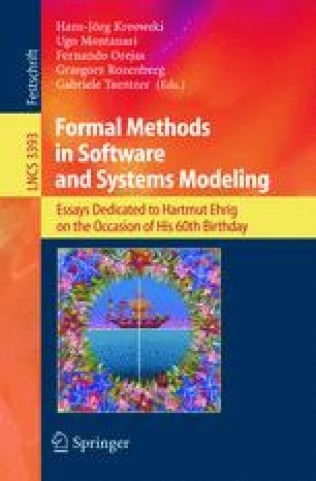
Formal Methods in Software and Systems Modeling : Essays Dedicated to Hartmut Ehrig on the Occasion of His 60th Birthday
By presenting state-of-the-art research results on various aspects of formal and visual modeling of software and systems, this book commemorates the 60th birthday of Hartmut Ehrig. The 24 invited reviewed papers are written by students and collaborators of Hartmut Ehrig who are established researchers in their fields. Reflecting the scientific interest and work of Hartmut Ehrig, the papers fall into three main parts on graph transformation, algebraic specification and logic, and formal and visual modeling.
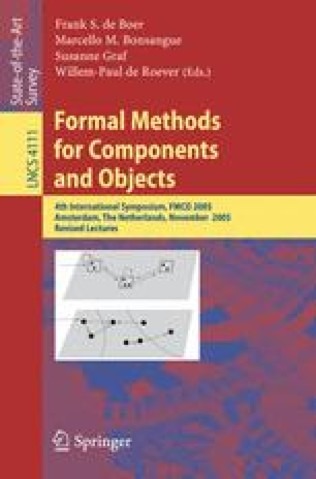
Formal Methods for Components and Objects ; Vol. 4111 ; 4th International Symposium, FMCO 2005, Amsterdam, The Netherlands, November 1-4, 2005, Revised Lectures
This book presents 19 revised invited keynote lectures and revised tutorial lectures given by top-researchers at the 4th International Symposium on Formal Methods for Components and Objects, FMCO 2005, held in Amsterdam, Netherlands, in November 2005. The book provides a unique combination of ideas on software engineering and formal methods that reflect the current interest in the application or development of formal methods for large scale software systems such as component-based systems and object systems.
