



Page 39
Page 39

Automatic Quantum Computer Programming : A Genetic Programming Approach
Computer science will be radically transformed if ongoing efforts to build large-scale quantum computers eventually succeed and if the properties of these computers meet optimistic expectations. Nevertheless, computer scientists still lack a thorough understanding of the power of quantum computing, and it is not always clear how best to utilize the power that it is understood. This dilemma exists because quantum algorithms are difficult to grasp and even more difficult to write. Despite large-scale international efforts, only a few important quantum algorithms are documented, leaving many essential questions about the potential of quantum algorithms unanswered.
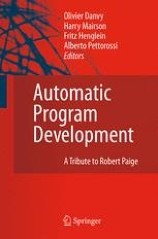
Automatic program development : A tribute to Robert Paige
This work, a tribute to renowned researcher Robert Paige, is a collection of revised papers published in his honor in the Higher-Order and Symbolic Computation Journal in 2003 and 2005. The book also includes some papers by members of the IFIP Working Group 2.1 of which Bob was an active member.
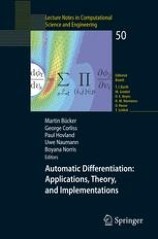
Automatic Differentiation : Applications, Theory, and Implementations
This collection covers the state of the art in automatic differentiation theory and practice. Practitioners and students will learn about advances in automatic differentiation techniques and strategies for the implementation of robust and powerful tools. Computational scientists and engineers will benefit from the discussion of applications, which provide insight into effective strategies for using automatic differentiation for design optimization, sensitivity analysis, and uncertainty quantification.
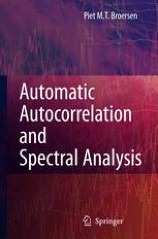
Automatic Autocorrelation and Spectral Analysis
It takes advantage of greater computing power and robust algorithms to produce enough candidate models to be sure of providing a suitable candidate for given data. Improved order selection quality guarantees that one of the best (and often the best) will be selected automatically. The data themselves suggest their best representation. Should the analyst wish to intervene, alternatives can be provided. Written for graduate signal processing students and for researchers and engineers using time series analysis for practical applications ranging from breakdown prevention in heavy machinery to measuring lung noise for medical diagnosis.

Automated technology for verification and analysis ; 6th International Symposium, ATVA 2008, Seoul, Korea, October 20-23, 2008. Proceedings
This book constitutes the refereed proceedings of the 6th International Symposium on Automated Technology for Verification and Analysis, ATVA 2008, held in Seoul, Korea, in October 2008.

Automated technology for verification and analysis ; 4th International Symposium, ATVA 2006, Beijing, China, October 23-26, 2006, Proceedings
The Automated Technology for Veri?cation and Analysis (ATVA) international symposium series was initiated in 2003, The main topics of the symposium include th- ries useful for providing designers with automated support for obtaining correct software or hardware systems, as well as the implementation of such theories in tools or their application. In the end, 35 papers were selected for inclusion in the program. ATVA 2006 had three keynote speeches given respectively by Thomas Ball, Jin Yang, and Mihalis Yannakakis. The main symposium was preceded by a tutorial day, consisting of three two-hourlectures given by the keynotespeakers.
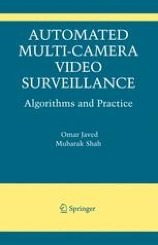
Automated multi-camera surveillance : Algorithms and practice
This book discusses and proposes techniques for development of an automated multi-camera surveillance system for outdoor environments, while identifying the important issues that a system needs to cope with in realistic surveillance scenarios. The goal of the research presented in this book is to build systems that can deal effectively with these realistic surveillance needs.

Automated deduction in Geometry ; 6th International Workshop, ADG 2006, Pontevedra, Spain, August 31-September 2, 2006, Revised Papers
The book show the lively variety of topics and methods and the current applicability of automated deduction in geometry to different branches of mathematics and to other sciences and technologies.

Automated deduction – CADE-20 ; 20th International Conference on automated deduction, Tallinn, Estonia, July 22-27, 2005, Proceedings
This book constitutes the refereed proceedings of the 20th International Conference on Automated Deduction, CADE-20, held in Tallinn, Estonia, in July 2005. The 25 revised full papers and 5 system descriptions presented were carefully reviewed and selected from 78 submissions. All current aspects of automated deduction are addressed, ranging from theoretical and methodological issues to presentation and evaluation of theorem provers and logical reasoning systems.

Automata, languages and programming ; Vol. 4052 : 33rd International Colloquium, ICALP 2006, Venice, Italy, July 10-14, 2006, Proceedings, Part II
a series of annual conferences of the European Association for Theoretical Computer Science (EATCS) which frsttookplacein 1972.Thisyear,. ICALP 2006 consisted of four invited lectures and the contributed papers. This volume of the proceedings contains all contributed papers presented at the conference in Track A, together with the paper by the invited speaker Noga Alon , A companion volume contains all contributed papers presented inTrack Band TrackCtogetherwiththepapersbytheinvited speakers Cynthia Dwork (Microsoft Research, USA) and Prakash Panangaden (Mc Gill University, Canada). The programhad an additional invited lecture by Simon Peyton Jones (Microsoft Research, UK), which does not appear in the proceedings.

Automata, languages and programming ; Vol. 4051 : 33rd International Colloquium, ICALP 2006, Venice, Italy, July 10-14, 2006, Proceedings, Part I
ICALP is a series of annual conferences of the European Association for Theoretical Computer Science (EATCS) which frsttookplacein1972 .Thisyear, ICALP 2006 consisted of four invited lectures and the contributed papers. This volume of the proceedings contains all contributed papers presented at the conference in Track A, together with the paper by the invited speaker Noga Alon (Tel Aviv University, Israel). A companion volume contains all contributed paper spresentedinTrackBandTrackCtogetherwiththepapersbytheinvited speakers Cynthia Dwork (Microsoft Research, USA) and Prakash Panangaden (Mc Gill University, Canada).

Automata, languages and programming ; Vol. 3580 ; 32nd International Colloquim, ICALP 2005, Lisbon, Portugal, July 11-15, 2005, Proceedings
This book constitutes the refereed proceedings of 32nd International Colloquium on Automata, Languages and Programming ICALP 2005, Lisbon, Portugal, July 11-15, 2005. including Topics Computer Science, general Mathematical Logic and Foundations Theory of Computation Software Engineering/Programming and Operating Systems Data Structures and Information Theory Data Structures

Automata, languages and programming ; 35th International Colloquium, ICALP 2008, Reykjavik, Iceland, July 7-11, 2008, Proceedings, Part II
The two-volume set LNCS 5125 and LNCS 5126 constitutes the refereed proceedings of the 35th International Colloquium on Automata, Languages and Programming, ICALP 2008, held in Reykjavik, Iceland, in July 2008.

Automata, Languages and Programming ; 35th International Colloquium, ICALP 2008, Reykjavik, Iceland, July 7-11, 2008, Proceedings, Part I
The two-volume set LNCS 5125 and LNCS 5126 constitutes the refereed proceedings of the 35th International Colloquium on Automata, Languages and Programming, ICALP 2008, held in Reykjavik, Iceland, in July 2008.

Automata, languages and programming ; 34th International Colloquium, ICALP 2007, Wroclaw, Poland, July 9-13, 2007, Proceedings
This volume presented three major tracks covering algorithms, automata, complexity, and games
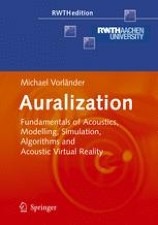
Auralization : Fundamentals of acoustics, modelling, simulation, algorithms and acoustic virtual reality
"Auralization" is the technique of creation and reproduction of sound on the basis of computer data. With this tool is it possible to predict the character of sound signals which are generated at the source and modified by reinforcement, propagation and transmission in systems such as rooms, buildings, vehicles or other technical devices. This book is organized as a comprehensive collection of the basics of sound and vibration, acoustic modelling, simulation, signal processing and audio reproduction. Implementations of the auralization technique are described using examples drawn from various fields in acoustic’s research and engineering, architecture, sound design and virtual reality.

Attendnce system during covid-19
Authentication system has become a hot topic in the field of security, one of the most interested methods of authentication systems is the radio frequency identity (RFID) which is used in this project to build a smart record attendance system that contains many features, one of it to determine whether the student is wearing a mask or not by using Deep Learning algorithms, another feature is the student's temperature measurement through an electronic sensor. The results obtained are processed and stored by the processing unit which is the Raspberry pi then display the data on a mobile application.

AsiaSim 2007 ; Asia Simulation Conference 2007, Seoul, Korea, October 10-12, 2007, Proceedings
This book contains modeling, simulation, and their applications.It also contains e-business, supply chain management, general and engineering applications, manufacturing, medical, military,networks, transportation, traffic and virtual reality.

Asian Digital Libraries. Looking Back 10 Years and Forging New Frontiers ; 10th International Conference on Asian Digital Libraries, ICADL 2007, Hanoi, Vietnam, December 10-13, 2007. Proceedings
The theme reflects upon the growth of the digital libraries community and explores new areas that the community could delve into in the coming years.

Artificial neural networks in Pattern Recognition ; 9th IAPR TC3 Workshop, ANNPR 2020, Winterthur, Switzerland, September 2–4, 2020, Proceedings
This book constitutes the refereed proceedings of the 9th IAPR TC3 International Workshop on Artificial Neural Networks in Pattern Recognition, ANNPR 2020, held in Winterthur, Switzerland, in September 2020. The conference was held virtually due to the COVID-19 pandemic. The 22 revised full papers presented were carefully reviewed and selected from 34 submissions. The papers present and discuss the latest research in all areas of neural network-and machine learning-based pattern recognition. They are organized in two sections: learning algorithms and architectures, and applications.
