



Page 2
Page 2

Knowledge Discovery in Inductive Databases ; 5th International Workshop, KDID 2006 Berlin, Germany, September 18th, 2006 Revised Selected and Invited Papers
Constitutes the thoroughly refereed joint postproceedings of the 5th International Workshop on Knowledge Discovery in Inductive Databases, KDID 2006. The papers address various current topics in knowledge discovery and data mining in the framework of inductive databases such as constraint-based mining, database technology and inductive querying.

Knowledge discovery in databases : PKDD 2006 ; 10th European Conference on Principles and practice of knowledge discovery in databases, Berlin, Germany, September 18-22, 2006, Proceedings
The European Conference on Principles and Practice of Knowledge Discovery in Databases celebrates its tenth anniversary ; the first PKDD took place in 1997 in Trondheim, Norway. Over the years, the ECML/PKDD series has evolved into one of the largest and most selective international conferences in these areas, the only one that provides a common forum for the two closely related ?elds. In 2006, the 6th collocated ECML/PKDD took place during September 18-22, when the Humboldt-Universität zu Berlin hosted the 17th European Conference on Machine Learning (ECML) and the 10th European Conference on Principles and Practice of Knowledge Discovery in Databases (PKDD). The successful model of a hierarchical reviewing process that was introduced last year for the ECML/PKDD 2005 in Porto has been taken over in 2006.

Knowledge Discovery in Databases : PKDD 2005 ; 9th European Conference on Principles and Practice of Knowledge Discovery in Databases, Porto, Portugal, October 3-7, 2005, Proceedings
585 different paper submissions were received for both events, which maintains the high s- mission standard of last year. Of these, 335 were submitted to ECML only, 220 to PKDD only and 30 to both. Such a high volume of scientific work required a tremendous effort from Area Chairs, Program Committee members and some additional reviewers. On average, PC members had 10 papers to evaluate, and Area Chairs had 25 papers to decide upon. We managed to have 3 highly qua- ?ed independent reviews per paper (with very few exceptions)and one additional overall input from one of the Area Chairs. After the authors’ responses and the online discussions for many of the papers, we arrived at the final selection of 40 regular papers for ECML and 35 for PKDD. Besides these, 32 others were accepted as short papers for ECML and 35 for PKDD. This represents a joint acceptance rate of around 13% for regular papers and 25% overall. We thank all involved for all the e?ort with reviewing and selection of papers. Besides the core technical program, ECML and PKDD had 6 invited speakers, 10 workshops, 8 tutorials and a Knowledge Discovery Challenge.
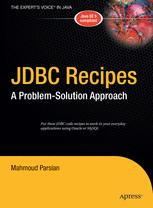
JDBC Recipes : A Problem-Solution Approach
JDBC Recipes provides easy-to-implement, usable solutions to problems in relational databases that use JDBC. You will be able to integrate these solutions into your web-based applications, such as Java servlets, JavaServer Pages, and Java server-side frameworks. This handy book allows you to cut and paste the solutions without any code changes. This book focuses on topics that have been ignored in most other JDBC books, such as database and result set metadata. It will help you develop database solutions, like adapters, connectors, and frameworks using Java/JDBC. The insightful solutions will enable you to handle all data types, including large binary objects. A unique feature of the book is that it presents JDBC solutions (result sets) in XML.
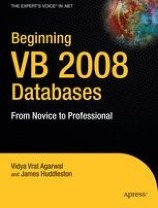
Beginning VB 2008 Databases : From novice to professional
Beginning VB 2008 Databases teaches you everything you need to know about relational databases, SQL, and ADO.NET 2.0, giving you a sound start in developing console and Windows database applications. The book also includes chapters on the SQL Server XML data type and the LINQ enhancements to the next version of Visual Basic. In addition to teaching you database basics like using SQL to communicate with databases, this book provides you with detailed, code-practical techniques to access data in Visual Basic 2008 across a range of coding situations. Code-heavy and full of practical detail, this book has been fully revised and upgraded for .NET 3.5 and offers you the best contemporary practice in this core programming area, so that you'll find yourself using it in nearly all your .NET projects.
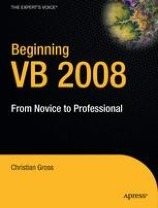
Beginning VB 2008 : From novice to professional
This book is for anyone who wants to write good Visual Basic 2008 code, even if you have never programmed before. Writing good code can be a challenge, there are so many options, especially in a language like Visual Basic. If you want to really get the best from a programming language you need to know which features work best in which situations and understand their strengths and weaknesses. It is this understanding that makes the difference between coding and coding well.
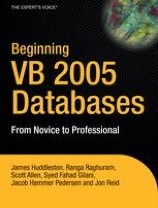
Beginning VB 2005 Databases : From novice to professional
Beginning Visual Basic 2005 Databases teaches you everything you need to know about relational databases, SQL, and ADO.NET 2.0, giving you a sound start in developing console and Windows database applications. The book also includes chapters on the new SQL Server XML data type and the forthcoming LINQ enhancements to the next version of Visual Basic.
Beginning SQL Server 2008 for Developers : From novice to professional
SQL Server 2008 is a first–rate database management system. It offers more capability than any previous release of SQL Server. More than just a classic relational database management system, SQL Server 2008 includes exciting and powerful features that make it useful for everything from large corporate data warehouses to ad hoc departmental databases. You'll find enhanced support for XML, new support for spatial data, transparent data encryption, a policy–based management system, and more.
Beginning SQL Server 2005 for Developers : From novice to professional
SQL Server 2005 will increase your programming options, productivity, analysis, and database management. If you have some basic knowledge of relational databases and want to start a career as a developer using SQL Server, then this book is your ideal first step. It explains the core jobs and roles for developing a database in both SQL Server 2000 and 2005. This book features practical steps to help you overcome issues youre likely to encounter. You'll learn to use SQL for querying, inserting, updating, and deleting data. You'll also learn how to back up and restore databases for basic administration in SQL Server.
Beginning SQL Queries : From novice to professional
Clare Churcher's Beginning SQL Queries is your guide to mastering the lingua franca of the database industry: the SQL language. Good knowledge of SQL is crucial to anyone working with databases, because it is with SQL that you retrieve data, manipulate data, and generate business results. Knowing how to write good queries is the foundation for all work done in SQL, and it is a foundation that Clare lays well in her book.
Beginning relational data modeling
Data storage design, and awareness of how data needs to be utilized within an organization, is of prime importance in ensuring that company data systems work efficiently. 'Beginning Data Modeling' leads readers you step by step through the process of developing an effective logical data model for a relational database model.
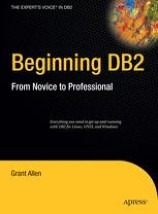
Beginning DB2 : From novice to professional
IBM’s DB2 Express Edition is one of the most capable of the free database platforms available in today’s marketplace. In Beginning DB2, author Grant Allen gets you started using DB2 Express Edition for web sites, desktop applications, and more. The author covers the basics of DB2 for developers and database administrators, shows you how to manage data in both XML and relational form, and includes numerous code examples so that you are never in doubt as to how things work.
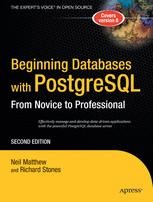
Beginning Databases with PostgreSQL : From novice to professional
The book continues with a complete tutorial on PostgreSQL features and functions and include information on database construction and administration. Key features such as transactions, stored procedures and triggers are covered, along with many of the capabilities new to version 8. To help you get started quickly, step-by-step instructions on installing PostgreSQL on Windows and Linux/UNIX systems are included. In the remainder of the book, we show you how to make the most of PostgreSQL features in your own applications using a wide range of programming languages, including C, Perl, PHP, Java and C#. Many example programs are presented in the book, and all are available for download from the Apress web site. By the end of the book you will be able to install, use, and effectively manage a PostgreSQL server, design and implement a database, and create and deploy your own database applications.
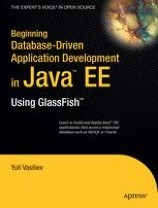
Beginning Database-Driven Application Development in Java EE : Using GlassFish™
The book explains in detail how you can organize your Java EE solution into a multilayer architecture, placing most emphasis on how to implement the persistence and database tiers of an application. Through many examples, this book shows how you can efficiently use the Java Persistence features available in the Java EE platform. Find out how you can greatly simplify the task of building the persistence layer of your Java EE application by moving some application logic into the underlying database, utilizing database views, stored programs, and triggers. The book also explains how to deploy Java EE applications to GlassFish, a free, open source Java EE 5–compliant application server.
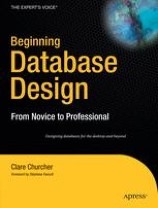
Beginning Database Design : From novice to professional
Beginning Database Design: From Novice to Professional provides short, easy-to-read explanations of how to get database design right the first time. Through the help of use cases and class diagrams modeled in the UML, youll learn how to discover and represent the details and scope of the problem in question.
Beginning ASP.NET 2.0 Databases : From novice to professional
Beginning ASP.NET 2.0 Databases: From Novice to Professional is a comprehensive introduction to connecting a website to many different data sourcesnot just databases. You'll learn how to build a relational database, use SQL to communicate with it, and leverage both in your web applications. You'll also learn about the new features of ADO.NET and ASP.NET in .NET 2.0. The authors cover mission-critical issues, such as design, transactions, error handling, optimization, and scalability. They examine SQL Server, Jet, and MySQL databases, and highlight the differences among them.
Applied Mathematics for Database Professionals
The math that you'll learn in this book will put you above the level of understanding of most database professionals today. You'll better understand the technology and be able to apply it more effectively. You'll avoid data anomalies like redundancy and inconsistency. Understanding whats in this book will take your mastery of relational technology to heights you may not have thought possible.
Advances in XML information retrieval and Evaluation ; 4th International workshop of the initiative for the evaluation of XML retrieval, INEX 2005, Dagstuhl Castle, Germany, November 28-30, 2005. Revised and Selected Papers
Content-oriented XML retrieval has been receiving increasing interest due to the widespread use of eXtensible Markup Language (XML), which is becoming a standard document format on the Web, in digital libraries,and publishing. By exploiting the enriched source of syntactic and semantic information that XML markup provides, XML information retrieval (IR) systems aim to implement a more focused retrieval strategy and return document components, so-called XML elements – instead of complete documents – in response to a user query. This focused retrieval approach is of particular bene?t for collections containing long documents or documents covering a wide variety of topics (e.g., books, user manuals, legal documents, etc.), where users’ e?ort to locate relevant content can be reduced by directing them to the most relevant parts of the documents.

Advances in knowledge discovery and data mining ; Vol. 3918 : 10th Pacific-Asia Conference, PAKDD 2006, Singapore, April 9-12, 2006, Proceedings
The Pacific-Asia Conference on Knowledge Discovery and Data Mining (PAKDD) is a leading international conference in the area of data mining and knowledge discovery. This year marks the tenth anniversary of the successful annual series of PAKDD conferences held in the Asia Pacific region. It was with pleasure that we hosted PAKDD 2006 in Singapore again, since the inaugural PAKDD conference was held in Singapore in 1997. PAKDD 2006 continues its tradition of providing an international forum for researchers and industry practitioners to share their new ideas, original research results and practical development experiences from all aspects of KDD data mining, including data cleaning, data warehousing, data mining techniques, knowledge visualization, and data mining applications.
Advances in information system development : New methods and practice for the networked society ; Vol. 2
These volume on Information Systems Development examine the exchange of ideas between academia and industry and aims to explore new solutions. The field of Information Systems Development (ISD) progresses rapidly, continually creating new challenges for the professionals involved. New concepts, approaches and techniques of systems development emerge constantly in this field.
