



Page 2
Page 2

Neural Preprocessing and Control of Reactive Walking Machines: Towards Versatile Artificial Perception-Action Systems
This book presents biologically inspired walking machines interacting with their physical environment. It describes how the designs of the morphology and the behavior control of walking machines can benefit from biological studies. The purpose of this book is to develop a modular structure of neural control generating different reactive behaviors of the physical walking machines, to analyze the neural mechanisms underlying the reactive behaviors, and to demonstrate the sensor fusion technique leading to smooth switching between appropriate behaviors, like obstacle avoidance and sound tropism.
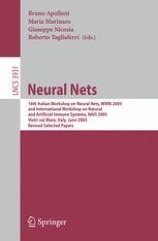
Neural Nets ; 16th Italian Workshop on Neural Nets, WIRN 2005, International workshop on natural and artificial immune systems, NAIS 2005, Vietri sul Mare, Italy, June 8-11, 2005, Revised Selected Papers
This book constitutes the thoroughly refereed postproceedings of the 16th Italian Workshop on Neural Nets, WIRN 2005, as well as the satellite International Workshop on Natural and Artificial Immune Systems, NAIS 2005, held in Vietri sul Mare, Italy in June 2005. The 41 revised papers presented together with a lecture by the winner of the Premio Caianiello award were carefully reviewed and improved during two rounds of selection and refereeing.

Neural Information Processing ; Vol. 4234 ; 13th International Conference, ICONIP 2006, Hong Kong, China, October 3-6, 2006, Proceedings, Part III
This book and its companion volumes constitute the Proceedings of the 13th - ternationalConferenceonNeuralInformationProcessing(ICONIP2006)heldin Hong Kong during October 3–6,2006. ICONIP is the annual ?agship conference oftheAsiaPaci?cNeuralNetworkAssembly(APNNA)withthepasteventsheld in Seoul (1994), Beijing (1995), Hong Kong (1996), Dunedin (1997), Kitakyushu (1998), Perth(1999), Taejon(2000), Shanghai(2001), Singapore(2002), Istanbul (2003), Calcutta(2004), andTaipei(2005). Overtheyears, ICONIPhasmatured into a well-established series of international conference on neural information processing and related ?elds in the Asia and Paci?cregions. Following the tra- tion, ICONIP 2006 provided an academic forum for the participants to diss- inate their new research ?ndings and discuss emerging areas of research.

Neural Information Processing ; Vol. 4233 ; 13th International Conference, ICONIP 2006, Hong Kong, China, October 3-6, 2006, Proceedings, Part II
The three volume set LNCS 4232, LNCS 4233, and LNCS 4234 constitutes the refereed proceedings of the 13th International Conference on Neural Information Processing, ICONIP 2006, held in Hong Kong, China in October 2006. The 386 revised full papers presented were carefully reviewed and selected from 1175 submissions.

Neural Information Processing ; Vol. 4232 ; 13th International Conference, ICONIP 2006, Hong Kong, China, October 3-6, 2006, Proceedings, Part I
This book and its companion volumes constitute the Proceedings of the 13th - ternationalConferenceonNeuralInformationProcessing(ICONIP2006)heldin Hong Kong during October 3–6,2006. ICONIP is the annual ?agship conference oftheAsiaPaci?cNeuralNetworkAssembly(APNNA)withthepasteventsheld in Seoul (1994), Beijing (1995), Hong Kong (1996), Dunedin (1997), Kitakyushu (1998), Perth(1999), Taejon(2000), Shanghai(2001), Singapore(2002), Istanbul (2003), Calcutta(2004), andTaipei(2005). Overtheyears, ICONIPhasmatured into a well-established series of international conference on neural information processing and related ?elds in the Asia and Paci?cregions. Following the tra- tion, ICONIP 2006 provided an academic forum for the participants to diss- inate their new research ?ndings and discuss emerging areas of research.

Neural Information Processing ; 14th International Conference, ICONIP 2007, Kitakyushu, Japan, November 13-16, 2007, Revised Selected Papers, Part II
The 228 revised full papers presented were carefully reviewed and selected from numerous ordinary paper submissions and 15 special organized sessions. The 116 papers of the first volume are organized in topical sections on computational neuroscience, learning and memory, neural network models ,supervised /unsupervised/reinforcement learning, statistical learning algorithms, optimization algorithms, novel algorithms, as well as motor control and vision. The second volume contains 112 contributions related to statistical and pattern recognition algorithms, neuromorphic hardware and implementations, robotics, data mining and knowledge discovery, real world applications, cognitive and hybrid intelligent systems, bioinformatics, neuroinformatics, brain-conputer interfaces, and novel approaches.

Neural Information Processing ; 14th International Conference, ICONIP 2007, Kitakyushu, Japan, November 13-16, 2007, Revised Selected Papers, Part I
The 228 revised full papers presented were carefully reviewed and selected from numerous ordinary paper submissions and 15 special organized sessions. The 116 papers of the first volume are organized in topical sections on computational neuroscience, learning and memory, neural network models, supervised/unsupervised/reinforcement learning, statistical learning algorithms, optimization algorithms, novel algorithms, as well as motor control and vision. The second volume contains 112 contributions related to statistical and pattern recognition algorithms, neuromorphic hardware and implementations, robotics, data mining and knowledge discovery, real world applications, cognitive and hybrid intelligent systems, bioinformatics, neuroinformatics, brain-conputer interfaces, and novel approaches.

Network-Centric Service-Oriented Enterprise
Network-Centric Service-Oriented Enterprise (NSCOE) is seen as heralding the next generation of mainstream Enterprise-business information collaboration solution that can enforce information and decision superiority in the decentralized, loosely-coupled, and highly interoperable service environments. Network-Centric Service Oriented Enterprise establishes a system-of-systems (SoS) view of information technologies, offering a synergistic combination of data and information-processing capacity upon an innovative networked-management framework.

Network-Centric Collaboration and Supporting Frameworks ; IFIP TC 5 WG 5.5, Seventh IFIP Working Conference on Virtual Enterprises, 25-27 September 2006, Helsinki, Finland
This book contains a number of selected articles from PRO-VE’06, the seventh working conference on virtual enterprises held in Helsinki, Finland, which was sponsored by the International Federation for Information Processing (IFIP) and the Society of Collaborative Networks (SOCOLNET). Being recognized as the most focused scientific and technical conference on Collaborative Networks, PRO-VE continues offering the opportunity for presentation and discussion of both the latest research developments as well as the practical application case studies. Following the vision of IFIP and SOCOLNET, the PRO-VE conference offers a forum for collaboration and knowledge exchange among experts from different regions of the world.

Network control and engineering for QoS, security and mobility, V ; IFIP 19th World Computer Congress,TC-6, 5th IFIP International conference on network control and engineering for QoS, security, and mobility, August 20-25, 2006, Santiago, Chile
International Federation for Information Processing The IFIP series publishes state-of-the-art results in the sciences and technologies of information and communication. The scope of the series includes: foundations of computer science; software theory and practice; education; computer applications in technology; communication systems; systems modeling and optimization; information systems; computers and society; computer systems technology; security and protection in information processing systems; artificial intelligence; and human-computer interaction. Proceedings and post-proceedings of referred international conferences in computer science and interdisciplinary fields are featured. These results often precede journal publication and represent the most current research. The principal aim of the IFIP series is to encourage education and the dissemination and exchange of information about all aspects of computing.

Nearest Neighbor Search : A Database Perspective
Modern applications are both data and computationally intensive and require the storage and manipulation of voluminous traditional (alphanumeric) and nontraditional data sets (images, text, geometric objects, time-series). Examples of such emerging application domains are: Geographical Information Systems (GIS), Multimedia Information Systems, CAD/CAM, Time-Series Analysis, Medical Information Sstems, On-Line Analytical Processing (OLAP), and Data Mining. These applications pose diverse requirements with respect to the information and the operations that need to be supported. From the database perspective, new techniques and tools therefore need to be developed towards increased processing efficiency. This monograph explores the way spatial database management systems aim at supporting queries that involve the space characteristics of the underlying data, and discusses query processing techniques for nearest neighbor queries. It provides both basic concepts and state-of-the-art results in spatial databases and parallel processing research, and studies numerous applications of nearest neighbor queries.

Nature Inspired Problem-Solving Methods in Knowledge Engineering ; 2nd International Work-Conference on the Interplay Between Natural and Artificial Computation, IWINAC 2007, La Manga del Mar Menor, Spain, June 18-21, 2007, Proceedings, Part II
The second of a two-volume set, this book constitutes the refereed proceedings of the Second International Work-Conference on the Interplay between Natural and Artificial Computation, IWINAC 2007, held in La Manga del Mar Menor, Spain in June 2007.

Natural Language Processing and Text Mining
Natural Language Processing and Text Mining not only discusses applications of certain NLP techniques to certain Text Mining tasks, but also the converse, i.e., use of Text Mining to facilitate NLP. It explores a variety of real-world applications of NLP and text-mining algorithms in comprehensive detail, placing emphasis on the description of end-to-end solutions to real problems, and detailing the associated difficulties that must be resolved before the algorithm can be applied and its full benefits realized.

Natural Language Processing and Information Systems ; Vol. 3999 ; 11th International Conference on Applications of Natural Language to Information Systems, NLDB 2006, Klagenfurt, Austria, May 31 - June 2, 2006, Proceedings
This book constitutes the refereed proceedings of the 11th International Conference on Applications of Natural Language to Information Systems, NLDB 2006, held in Klagenfurt, Austria in May/June 2006 as part of UNISCON 2006. The book presents 17 revised full papers and 5 revised short papers, organized in topical sections on concepts extraction and ontology, ontologies and task repository utilization, query processing, information retrieval and dialog processing, and NLP techniques.

Natural Language Processing and Information Systems ; Vol. 3513 ; 10th International Conference on Applications of Natural Language to Information Systems, NLDB 2005, Alicante, Spain, June 15-17, Proceedings
The development and convergence of computing, telecommunications and information systems has already led to a revolution in the way that we work, communicate with each other, buy goods and use services, and even in the way that we entertain and educate ourselves.The revolution continues, and one of its results is that large volumes of information will increasingly be held in a form which is more natural for users than the data presentation formats typical of computer systems of the past. Natural language processing (NLP) is crucial in solving these problems, and language technologies will make an indispensable contribution to the success of information systems. We hope that NLDB 2005 was a modest contribution to this goal. NLDB 2005 contributed to advancing the goals and the high international standing of these conferences, largely due to its Program Committee, composed of renowned researchers in the field of natural language processing and inf- mation system engineering. Papers were reviewed by three reviewers from the Program Committee. This clearly contributed to the significant number of - pers submitted (95). Twenty-nine were accepted as regular papers, while 18 were accepted as short papers.

Natural language processing and information systems ; 12th International Conference on Applications of Natural Language to Information Systems, NLDB 2007, Paris, France, June 27-29, 2007, Proceedings
NLP techniques may substantially enhance most phases of the information system lifecycle, starting with requirement analysis, specification and validation, and going up to conflict resolution, result processing and presentation.

Natural Language Processing and Chinese Computing ; 9th CCF International Conference, NLPCC 2020, Zhengzhou, China, October 14–18, 2020, Proceedings, Part II
This two-volume set of LNAI 12340 and LNAI 12341 constitutes the refereed proceedings of the 9th CCF Conference on Natural Language Processing and Chinese Computing, NLPCC 2020, held in Zhengzhou, China, in October 2020. The 70 full papers, 30 poster papers and 14 workshop papers presented were carefully reviewed and selected from 320 submissions. They are organized in the following areas: Conversational Bot/QA; Fundamentals of NLP; Knowledge Base, Graphs and Semantic Web; Machine Learning for NLP; Machine Translation and Multilinguality; NLP Applications; Social Media and Network; Text Mining; and Trending Topics.

Natural language processing and chinese computing ; 9th CCF International conference, NLPCC 2020, Zhengzhou, China, October 14–18, 2020, Proceedings, Part I
This two-volume set of LNAI 12340 and LNAI 12341 constitutes the refereed proceedings of the 9th CCF Conference on Natural Language Processing and Chinese Computing, NLPCC 2020, held in Zhengzhou, China, in October 2020. The 70 full papers, 30 poster papers and 14 workshop papers presented were carefully reviewed and selected from 320 submissions. They are organized in the following areas: Conversational Bot/QA; Fundamentals of NLP; Knowledge Base, Graphs and Semantic Web; Machine Learning for NLP; Machine Translation and Multilinguality; NLP Applications; Social Media and Network; Text Mining; and Trending Topics.

Natural Language Processing – IJCNLP 2005 ; 2nd International Joint Conference, Jeju Island, Korea, October 11-13, 2005, Proceedings
The Theme of IJCNLP 2005: “NLP with Kimchee”, a Conference with a Unique Flavor Welcometo IJCNLP 2005,thesecondannualconferenceof theAsian Federation ofNaturalLanguageProcessing(AFNLP). Followingthesuccessofthe?rstc- ference held in the beautiful cityof Sanya,Hainan Island,China, in March2004, IJCNLP 2005 is held in yet another attractive Asian resort, namely Jeju Island in Korea, on October 11–13, 2005

Natural Language Processing – IJCNLP 2004 ; 1st International Joint Conference, Hainan Island, China, March 22-24, 2004, Revised Selected Papers
This book constitutes the thoroughly refereed post-proceedings of the First International Joint Conference on Natural Language Processing, IJCNLP 2004, held in Hainan Island, China in March 2004. The 84 revised full papers presented in this volume were carefully selected during two rounds of reviewing and improvement from 211 papers submitted. The papers are organized in topical sections on dialogue and discourse; FSA and parsing algorithms; information extractions and question answering; information retrieval; lexical semantics, ontologies, and linguistic resources; machine translation and multilinguality; NLP software and applications, semantic disambiguities; statistical models and machine learning; taggers, chunkers, and shallow parsers; text and sentence generation; text mining; theories and formalisms for morphology, syntax, and semantics; word segmentation; NLP in mobile information retrieval and user interfaces; and text mining in bioinformatics.
