



Page 18
Page 18

Groupware : Design, implementation, and use ; 13th International Workshop, CRIWG 2007, Bariloche, Argentina, September 16-20, 2007, Proceedings
This volume constitutes the proceedings of the 13th International Workshop on Groupware (CRIWG 2007). This workshop aims at providing a forum for academic researchers and professionals to exchange their experiences and their ideas about problems and solutions related to the design, development and use of groupware applications.

Grippers in Motion : The Fascination of Automated Handling Tasks
This book shows you how to ensure process reliability on the basis of combining the right components with advanced application know-how. By explaining basic preconditions of the gripping process and highlighting the milestones of automation history, we guide you all the way through to the center of the handling process – the workpiece. Its ambient conditions and setup are clearly defined as well as the process of setting grippers in motion. Starting with simple linear movements up to multi-axis kinematics, you are provided with the details for practical solutions.

Grid Middleware and Services : Challenges and Solutions
This book aims to strengthen and advance scientific and technological excellence in the area of Grid Computing. The main focus in this volume is on Grid middleware and service level agreement.Grid middleware and Grid services are two pillars of grid computing systems and applications. This book includes high-level contributions by leading researchers in both areas and presents current solutions together with future challenges. This volume includes sections on knowledge and data management on grids, Grid resource management and scheduling, Grid information, resource and workflow monitoring services, and service level agreements.

Grid computing in life science ; 1st International Workshop on Life Science Grid, LSGRID 2004 Kanazawa, Japan, May 31-June 1, 2004, Revised Selected and Invited Papers
Researchers in the ?eld of life sciences rely increasingly on information te- nology to extract and manage relevant knowledge. The complex computational and data management needs of life science research make Grid technologies an attractive support solution. However, many important issues must be addressed before the Life Science Grid becomes commonplace. The 1st International Life Science Grid Workshop (LSGRID 2004) was held in Kanazawa Japan, May 31–June 1, 2004. This workshop focused on life s- ence applications of grid systems especially for bionetwork research and systems biology which require heterogeneous data integration from genome to phenome, mathematical modeling and simulation from molecular to population levels, and high-performance computing including parallel processing, special hardware and grid computing.

Grid Computing : Software Environments and Tools
The book provides: • Discussion of software engineering and modelling tools for the Grid • Analysis of issues inherent in enabling distributed computing across the Grid • Consideration of the software engineering support necessary for managing Grid applications • Proposal of a posited software engineering lifecycle to support application development for Grid Environments (along with associated tools). • Identification of novel concepts, methods and tools within Grid computing which can be put to work in the context of existing experiments and application case studies
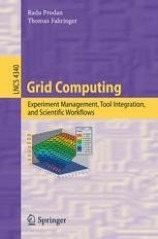
Grid computing : Experiment management, Tool Integration, and Scientific Workflows
Grid computing has become a topic of significant interest in the scientific community as a means of enabling application developers to aggregate resources scattered around the globe for solving large-scale scientific problems. This monograph addresses four critical software development aspects for the engineering and execution of applications on parallel and Grid architectures.

Grid and cooperative computing - GCC 2005 ; 4th International Conference, Beijing, China, November 30 -- December 3, 2005, Proceedings
This volume presents the accepted papers for the 4th International Conference on Grid and Cooperative Computing (GCC2005),held in Beijing, China, during November 30 – December 3, 2005.The conferenceseries of GCC aims to provide an international forum for the presentation and discussion of research trends on the theory, method, and design of Grid and cooperative computing as well as their scienti?c, engineering and commercial applications. It has become a major annual event in this area. The First International Conference on Grid and Cooperative Computing (GCC2002) received 168 submissions. GCC 2003 received 550 submissions, from which 176 regular papers and 173 short papers were accepted. The acceptance rate of regular papers was 32%, and the total acceptance rate was 64%. GCC 2004 received 427 main-conference submissions and 154 workshop submissions. The main conference accepted 96 regular papers and 62 short papers. The - ceptance rate of the regular papers was 23%. The total acceptance rate of the main conference was 37%. For this conference, we received 576 submissions. Each was reviewed by two independent members of the International Program Committee. After carefully evaluating their originality and quality, we accepted 57 regular papers and 84 short papers. The acceptance rate of regular papers was 10%. The total acc- tance rate was 25%.

Grey information : Theory and practical applications
he book covers the latest advances in grey information and systems research, providing a state-of-the-art overview of this important field. Covering the theoretical foundation, fundamental methods and main topics in grey information and systems research, this book includes all the elementary concepts: basic principles, grey numbers and their operations, grey equations and matrices, operators of sequences and generations of grey sequences, grey incidence analysis, grey clusters and grey statistical evaluations, grey systems modeling, grey combined models, grey prediction, grey decisions, grey programming, grey input and output and grey controls, etc.
Green, pervasive, and cloud computing ; 15th International conference, GPC 2020, Xi'an, China, November 13–15, 2020, Proceedings
This book constitutes the refereed proceedings of the 15th International Conference on Green, Pervasive, and Cloud Computing, GPC 2020, held in Xi'an, China, in November 2020. The 30 full papers presented in this book together with 8 short papers were carefully reviewed and selected from 96 submissions. They cover the following topics: Device-free Sensing; Machine Learning; Recommendation Systems; Urban Computing; Human Computer Interaction; Internet of Things and Edge Computing; Positioning; Applications of Computer Vision; CrowdSensing; and Cloud and Related Technologies.

Graph-theoretic concepts in computer science ; Vol. 4271 ; 32nd International Workshop, WG 2006, Bergen, Norway, June 22-23, 2006, Revised Papers
The workshop aims at uniting theory and practice by demonstrating how graph-theoretic concepts can be applied to various areas in computer s- ence, or by extracting new problems from applications. The goal is to present recent research results and to identify and explore directions of future research. The talks showed how recent researchresults from algorithmic graph theory can be used in computer science and which graph-theoreticquestions arisefrom new developments in computer science.

Graph-theoretic concepts in computer science ; Vol. 3787 ; 31st International Workshop, WG 2005, Metz, France, June 23-25, 2005, Revised Selected Papers
that aims to unite theory and practice by demonstrating how graph-theoretic concepts can be applied to various areas in Computer Science. This book provides results for various classes of graphs, graph computations, graph algorithms, and graph-theoretical applications in various fields.

Graph-theoretic concepts in computer science ; 33rd International workshop, WG 2007, Dornburg, Germany, June 21-23, 2007, Revised Papers
The WG conference traditionally aims at uniting theory and practice by demonstrating how graph-theoretic concepts can be applied to various areas in computer science, or by extracting new problems from applications. The goal is to present recent researchresults and to identify and exploredirections of future research.

Graph-theoretic concepts in computer science ; 30th International workshop, WG 2004, Bad Honnef, Germany, June 21-23, 2004, Revised Papers
During its 30-year existence, the International Workshop on Graph-Theoretic Concepts in Computer Science has become a distinguished and high-quality computer science event. The workshop aims at uniting theory and practice by demonstrating how graph-theoretic concepts can successfully be applied to v- ious areas of computer science and by exposing new theories emerging from applications. In this way, WG provides a common ground for the exchange of information among people dealing with several graph problems and working in various disciplines. Thereby, the workshop contributes to forming an interdis- plinary research community. The original idea of the Workshop on Graph-Theoretic Concepts in C- puter Science was ingenuity in all theoretical aspects and applications of graph concepts, wherever applied. Within the last ten years, the development has strengthened in particular the topic of structural graph properties in relation to computational complexity.
Graph Transformations ; 4th International Conference, ICGT 2008, Leicester, United Kingdom, September 7-13, 2008. Proceedings
This book constitutes the refereed proceedings of the 4th International Conference on Graph Transformations, ICGT 2008, held in Leicester, UK, in September 2008.The 27 revised full papers presented together with 5 tutorial and workshop papers and 3 invited lectures were carefully selected from 57 submissions. All current aspects in graph drawing are addressed including hypergraphs and termgraph rewriting, applications of graph transformation, execution of graph transformations, compositional systems, validation and verification, graph languages and special transformation concepts, as well as patterns and model transformations.
Graph Transformations ; 3rd International Conference, ICGT 2006, Rio Grande do Norte, Brazil, September 17-23, 2006, Proceedings
ICGT 2006 was the 3rd International Conference on Graph Transformation, following the previous two in Barcelona (2002) and Rome (2004), and a series of six international workshops between 1978 and 1998. The scope of the conference concerned graphical structures of various kinds (like graphs, diagrams and visual sentences) that are useful when describing complex structures and systems in a direct and intuitive way. These structures are often enriched with formalisms that model their evolution via suitable kinds of transformations. The ?eld of the conference was concerned with the theory, applications, and implementation issues of such formalisms. Particularemphasis wasputonmetamodelswhichcanaccommodateavarietyofgraphicalstructures within the same abstract theory.

Graph structures for knowledge representation and reasoning ; 6th International Workshop, GKR 2020, virtual event, September 5, 2020, revised selected papers
This book constitutes the thoroughly refereed post-conference proceedings of the 6th International Workshop on Graph Structures for Knowledge Representation and Reasoning, GKR 2020, held virtually in September 2020, associated with ECAI 2020, the 24th European Conference on Artificial Intelligence.

Graph drawing ; Vol. 3383 ; 12th International symposium, GD 2004, New York, NY, USA, September 29-October 2, 2004, Revised Selected Papers
This book constitutes the thoroughly refereed post-proceedings of the 12th International Symposium on Graph Drawing, GD 2004, held in New York, NY, USA in September/October 2004. The 39 revised full papers and 12 revised short papers presented together with 4 posters and a report on the graph drawing context were carefully selected during two rounds of reviewing and improvement. All current aspects in graph drawing are addressed ranging from foundational and methodological issues to applications for various classes of graphs in a variety of fields.
Graph drawing ; 14th International symposium, GD 2006, Karlsruhe, Germany, September 18-20, 2006, Revised Papers
The 33 revised full papers and 5 revised short papers presented together with 2 invited talks, 1 system demo, 2 poster papers address all current aspects in graph drawing, ranging from foundational and methodological issues to applications for various classes of graphs in a variety of fields.

Grammatical Inference ; Algorithms and Applications : 9th International Colloquium, ICGI 2008 Saint-Malo, France, September 22-24, 2008 Proceedings
This book constitutes the refereed proceedings of the 9th International Colloquium on Grammatical Inference, ICGI 2008, held in Saint-Malo, France, in September 2008.The 21 revised full papers and 8 revised short papers presented were carefully reviewed and selected from 36 submissions. The topics of the papers presented vary from theoretical results of learning algorithms to innovative applications of grammatical inference, and from learning several interesting classes of formal grammars to applications to natural language processing.

Grammatical Inference : Algorithms and Applications ; 8th International Colloquium, ICGI 2006, Tokyo, Japan, September 20-22, 2006, Proceedings
The topics discussed range from theoretical results of learning algorithms to innovative applications of grammatical inference and from learning several interesting classes of formal grammars to applications to natural language processing.
