



Page 17
Page 17

Database Systems for Advanced Applications ; 13th International Conference, DASFAA 2008, New Delhi, India, March 19-21, 2008. Proceedings
This book constitutes the refereed proceedings of the 13th International Conference on Database Systems for Advanced Applications, DASFAA 2008, held in New Delhi, India, in March 2008.

Database Schema Evolution and Meta-Modeling ; 9th International Workshop on Foundations of Models and Languages for Data and Objects FoMLaDO/DEMM 2000 Dagstuhl Castle, Germany, September 18-21, 2000 Selected Papers
The Ninth International Workshop on Foundations of Models and Languages for Data and Objects (FoMLaDO) took place in Dagstuhl Germany, Sept- ber 18{21, 2000. The topic of this workshop was Database schema Evolution and Meta-Modeling; this FoMLaDO Workshop was hence assigned the acronym DEMM 2000.

Database Programming Languages ; 8th International Workshop, DBPL 2001, Frascati, Italy, September 8-10, 2001. Revised Papers
The papers here are organized in topical sections on semistructured data OL AP and data mining systems, schema integration, and index concurrency XML spatial databases user languages and rules.

Database Programming Languages ; 11th International Symposium, DBPL 2007, Vienna, Austria, September 23-24, 2007, Revised Selected Papers
This volume contains works at the intersection of database and programming language research.It also cover algorithms, XML query languages, inconsistency handling, data provenance, emerging data models, and type checking.

Database Programming Languages ; 10th international symposium, DBPL 2005, Trondheim, Norway, August 28-29, 2005, revised selected papers
Constitutes the refereed post-proceedings of the 10th International Workshop on Database Programming Languages, DBPL 2005. This book presents papers organized in topical sections on XML languages, XML and P2P data integration, XML query languages, types and XML, grammars, automata, and tree, as well as dependencies and constraints.

Database and XMLTechnologies ; 5th International XML Database Symposium, XSym 2007, Vienna, Austria, September 23-24, 2007, Proceedings
This book discuss the use of and synergy between databases and XML. It provided theory and practice of XML data management and its applications. This volume also contains current research in XPath and XQuery processing, XML Updates, Temporal XML and Constraints.

Database and XML Technologies ; Vol. 3671 ; 3rd international XML database symposium, XSym 2005, Trondheim, Norway, August 28-29, 2005, Proceedings
Constitutes the proceedings of the Third International XML Database Symposium, XSym 2005, held in Trondheim, Norway in August 2005. The 15 papers are organized in sections on indexing support for the evaluation of XPath and XQuery; benchmarks and algorithms for XQuery and XPath evaluation; algorithms for constraint satisfaction checking, and more.

Database and Expert Systems Applications ; 18th International Conference, DEXA 2007, Regensburg, Germany, September 3-7, 2007, Proceedings
This volume represent the state of the art of - search in the domain of data, information and knowledge management, intelligent systems, and their applications.
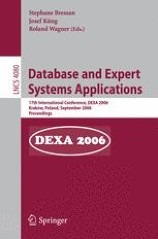
Database and expert systems and Aapplications ; 17th International Conference, DEXA 2006, Krakow, Poland, September 4-8, 2006, Proceedings
The annual international conference on Database and Expert Systems Applications (DEXA) is now well established as a reference scientific event. The reader will find in this volume a collection of scientific papers that represent the state of the art of research in the domain of data, information and knowledge management, intelligent systems, and their applications.

Database : Enterprise, skills and innovation; 22nd British national conference on databases, BNCOD 22, Sunderland, UK, July 5-7, 2005, Proceedings
The British National Conference on Databases (BNCOD) was established in 1980 as a forum for research into the theory and practice of databases. The original conference in the series took place at the University of Aberdeen. To be precise, this conference was in fact entitled ICOD which stood for International Conference on Databases. It was the intention, when the series began, that an ICOD would take place every two years, whilst a BNCOD would run in the years in between. As the record shows ICOD was only held in 1980 and 1983. The more junior conference has managed to acquire a lifetime much longer than that of its senior relative! If truth wereknown,however,BNCOD has,overthe years,growninto ICOD and although the conference is still titled “British National,” it is, in fact, an international conference that takes place on a yearly basis. Proof of this can be obtained simply by looking at the table of contents of these proceeding which clearlyshowthatthe majorityofpaperspresentedatthis year’sconferencecame from contributors whose a?liations are outside the UK. Despitetherangeofpapersono?er,BNCODstillretainsitsuniquelyBritish ?avor. The Programme Committee is drawn from UK academics and the c- ference is always held at a British university (or in earlier years a polytechnic!).

Data structures and algorithm : Analysis in C++
An advanced algorithms book that bridges the gap between traditional CS2 and Algorithms Analysis courses. As the speed and power of computers increases, so does the need for effective programming and algorithm analysis. By approaching these skills in tandem, Mark Allen Weiss teaches readers to develop well-constructed, maximally efficient programs using the C++ programming language

Data structure and algorithms using C++ : A practical implementation
Intended to flow from the basic concepts of C++ to technicalities of the programming language, its approach and debugging. The chapters of the book flow with the formulation of the problem, it's designing, finding the step-by-step solution procedure along with its compilation, debugging and execution with the output. Keeping in mind the learner’s sentiments and requirements, the exemplary programs are narrated with a simple approach so that it can lead to creation of good programs that not only executes properly to give the output, but also enables the learners to incorporate programming skills in them. The style of writing a program using a programming language is also emphasized by introducing the inclusion of comments wherever necessary to encourage writing more readable and well commented programs. As practice makes perfect, each chapter is also enriched with practice exercise questions so as to build the confidence of writing the programs for learners.

Data science in theory and practice : Techniques for big data analytics and complex data sets
Delivers a comprehensive treatment of the mathematical and statistical models useful for analyzing data sets arising in various disciplines, like banking, finance, health care, bioinformatics, security, education, and social services. Written in five parts, the book examines some of the most commonly used and fundamental mathematical and statistical concepts that form the basis of data science. The authors go on to analyze various data transformation techniques useful for extracting information from raw data, long memory behavior, and predictive modeling. Readers will also learn from topics like: Analyses of foundational theoretical subjects, including the history of data science, matrix algebra and random vectors, and multivariate analysis A comprehensive examination of time series forecasting, including the different components of time series and transformations to achieve stationarity Introductions to both the R and Python programming languages, including basic data types and sample manipulations for both languages An exploration of algorithms, including how to write one and how to perform an asymptotic analysis A comprehensive discussion of several techniques for analyzing and predicting complex data sets

Data science for economics and finance : Methodologies and applications
The book starts with an introduction on the use of data science technologies in economics and finance and is followed by thirteen chapters showing success stories of the application of specific data science methodologies, touching on particular topics related to novel big data sources and technologies for economic analysis (e.g. social media and news); big data models leveraging on supervised/unsupervised (deep) machine learning; natural language processing to build economic and financial indicators; and forecasting and nowcasting of economic variables through time series analysis.

Data science ; 6th International Conference of Pioneering Computer Scientists, Engineers and Educators, ICPCSEE 2020, Taiyuan, China, September 18-21, 2020, Proceedings, Part II
This two volume set (CCIS 1257 and 1258) constitutes the refereed proceedings of the 6th International Conference of Pioneering Computer Scientists, Engineers and Educators, ICPCSEE 2020 held in Taiyuan, China, in September 2020. The 98 papers presented in these two volumes were carefully reviewed and selected from 392 submissions. The papers are organized in topical sections: database, machine learning, network, graphic images, system, natural language processing, security, algorithm, application, and education.

Data Science ; 6th International Conference of Pioneering Computer Scientists, Engineers and Educators, ICPCSEE 2020, Taiyuan, China, September 18-21, 2020, Proceedings, Part I
This two volume set (CCIS 1257 and 1258) constitutes the refereed proceedings of the 6th International Conference of Pioneering Computer Scientists, Engineers and Educators, ICPCSEE 2020 held in Taiyuan, China, in September 2020. The 98 papers presented in these two volumes were carefully reviewed and selected from 392 submissions. The papers are organized in topical sections: database, machine learning, network, graphic images, system, natural language processing, security, algorithm, application, and education.

Data parallel C++programming accelerated systems using C++ and SYCL
Full of practical advice, detailed explanations, and code examples to illustrate key topics. SYCL enables access to parallel resources in modern accelerated heterogeneous systems. Now, a single C++ application can use any combination of devices–including GPUs, CPUs, FPGAs, and ASICs–that are suitable to the problems at hand. This book teaches data-parallel programming using C++ with SYCL and walks through everything needed to program accelerated systems. The book begins by introducing data parallelism and foundational topics for effective use of SYCL. Later chapters cover advanced topics, including error handling, hardware-specific programming, communication and synchronization, and memory model considerations.

Data parallel C++ : Mastering DPC++ for programming of heterogeneous systems using C++ and SYCL
This book teaches data-parallel programming using C++ and the SYCL standard from the Khronos Group and walks through everything needed to use SYCL for programming heterogeneous systems. The book begins by introducing data parallelism and foundational topics for effective use of SYCL and Data Parallel C++ (DPC++), the open source compiler used in this book.

Data Management. Data, Data Everywhere ; 24th British National Conference on Databases, BNCOD 24, Glasgow, UK, July 3-5, 2007, Proceedings
One of the most pressing challenges is to ?nd ways of evolving database technology to cope with its new role in underpinning the massively distributed and heterogeneous applications built on top of the Internet. This has afiected both the ways in which data has been accessed and the ways in which it is represented, with XML data management becoming an important issue and, as such, heavily represented at this conference. It has also brought back issues of performance that might have been considered largely solved by the improvements in hardware, since data now has to be managed on devices of low power and small memory as well as on standard client and powerful server machines. We therefore invited papers on all aspects of data management, particularly related to how dataisused in the ubiquitous environment of the modern Internet by complex distributed and scientific applications.

Data Management in Grids ; 1st VLDB Workshop, DMG 2005, Trondheim, Norway, September 2-3, 2005, Revised Selected Papers
This book constitutes the thoroughly refereed post-proceedings of the First International Workshop on Data Management in Grids, DMG 2005, held in Trondheim, Norway in September 2005 in conjunction with VLDB 2005. papers address all current research activities in relation to data management in dynamic, heterogeneous and cross-organizational environments, i.e. grids. They show unique expertise in the management of very large, widely distributed databases.
