



Page 15
Page 15
Adaptive Multimedia Retrieval : User, Context, and Feedback ; Third International Workshop, AMR 2005, Glasgow, UK, July 28-29, 2005, Revised Selected Papers
This book is an extended collection of revised contributions that were initially submitted to the International Workshop on Adaptive Multimedia Retrieval (AMR 2005). This workshop was organized during July 28-29, 2005, at the U- versity of Glasgow, UK, as part of an information retrieval research festival and in co-location with the 19th International Joint Conference on Arti?cial Int- ligence (IJCAI 2005). AMR 2005 was the third and so far the biggest event of the series of workshops that started in 2003 with a workshop during the 26th German Conference on Arti?cial Intelligence (KI 2003) and continued in 2004 as part of the 16th European Conference on Arti?cial Intelligence (ECAI 2004).
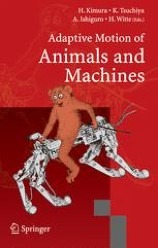
Adaptive Motion of Animals and Machines
Apparently, the ability of animals and robots to adapt in a real world cannot be explained or realized by one single function in a control system and mechanism. That is, adaptation in motion is induced at every level from the central nervous system to the musculoskeletal system.Thus,weorganized the International Symposium on Adaptive Motion in Animals and Machines (AMAM) forscientist sandengineersconcerned with adaptation on various level stobebrought together todiscussprinciplesateachleveland to investigate principles governing total systems.
Adaptive Hypermedia and Adaptive Web-Based Systems ; Second International Conference, AH 2002 Malaga, Spain, May 29 - 31, 2002 Proceedings
This book constitutes the refereed proceedings of the Second International Conference on Adaptive Hypermedia and Adaptive Web-Based Systems, AH 2002, held in Malaga, Spain, in May 2002.The 33 revised full papers and 23 short papers presented were carefully reviewed and selected from 109 submissions. Also included are three invited contributions, 30 posters, and 5 presentations given at the associated doctoral constortium. Among the topics covered are adaptive hypertext and hypermedia, user modeling, adaptive learning, adaptive tutoring systems, information retrieval, educational hypermedia systems, Web adaption, adaptive navigation, adaption and personalization.
A Practical Guide to TPM 2.0 : Using the New Trusted Platform Module in the New Age of Security
A Practical Guide to TPM 2.0: Using the Trusted Platform Module in the New Age of Security is a straight-forward primer for developers. It shows security and TPM concepts, demonstrating their use in real applications that the reader can try out. Simply put, this book is designed to empower and excite the programming community to go out and do cool things with the TPM. The approach is to ramp the reader up quickly and keep their interest.A Practical Guide to TPM 2.0: Using the Trusted Platform Module in the New Age of Security explains security concepts, describes the TPM 2.0 architecture, and provides code and pseudo-code examples in parallel, from very simple concepts and code to highly complex concepts and pseudo-code.
A High-Performance Logical Framework -- All About Maude : How to Specify, Program, and Verify Systems in Rewriting Logic
This book gives a comprehensive account of Maude, a language and system based on rewriting logic. Many examples are used throughout the book to illustrate the main ideas and features of Maude, and its many possible uses. Maude modules are rewrite theories. Computation with such modules is - cient deduction by rewriting. Because of its logical basis and its initial model semantics,aMaude module defines a precise mathematical model.This means that Maude and its formal tool environment can be used in three, mutually reinforcing ways: • as a declarative programming language; • as an executable formal specification language; and • as a formal verification system. Maude’s rewriting logic is simple, yet very expressive. This gives Maude good representational capabilities as a semantic framework to formally represent a wide range of systems, including models of concurrency, distributed al- rithms, network protocols, semantics of programming languages, and models of cell biology. Rewriting logic is also an expressive universal logic,making Maude a fiexible logical framework in which many difierent logics and - ference systems can be represented and mechanized. This makes Maude a useful metatool to build many other tools, including those in its own formal tool environment. Thanks to the logic’s simplicity and the use of advanced semi-compilation techniques, Maude has a high-performance implementation, making it competitive with other declarative programming languages.
.NET 2.0 Interoperability Recipes : A Problem-Solution Approach
.NET represents a new and improved way of developing software for the Windows platform. Given the chance, you'd probably rewrite all of your existing code in the newer managed code environment that .NET provides. But it is difficult or impossible to throw out all existing legacy code and start over when a new technology arrives. Instead, you need to find a way to move forward with new .NET development while reusing existing pieces of tested, working code. You need a way to interoperate with the existing code until you have a chance to finally rewrite all of it in .NET.
