



Page 15
Page 15

Integrating Data Science and Earth Science : Challenges and Solutions
This book presents the results of three years collaboration between earth scientists and data scientist, in developing and applying data science methods for scientific discovery. The book will be highly beneficial for other researchers at senior and graduate level, interested in applying visual data exploration, computational approaches and scientifc workflows.

Integrated Science in Digital Age ; ICIS 2019
The ICIS 2019 received roughly 50 contributions, by authors hailing from six countries. Following a peer-review process, the Scientific Committee – a multidisciplinary group of 110 experts from 38 countries around the globe – selected roughly 60% for publication. The main topics covered include: Artificial Intelligence Research; Digital Business & Finance; Educational Sciences; Health Management Informatics; Public Administration in the Digital Age; and Social Problem-solving.
Integrated formal methods ; 5th International conference, IFM 2005, Eindhoven, The Netherlands, November 29 - December 2, 2005. Proceedings
This book constitutes the refereed proceedings of the 5th International Conference on Integrated Formal Methods, IFM 2005, held in Eindhoven, The Netherlands, in November/December 2005. The 19 revised full papers presented together with 3 invited papers were carefully reviewed and selected from 40 submissions. The papers are organized in topical sections on components, state/event-based verification, system development, applications of B, tool support, non-software domains, semantics, as well as UML and statecharts.

Integrated formal methods ; 3rd International Conference, IFM 2002, Turku, Finland, May 15-18, 2002. Proceedings.
IFM 2002 explored the relations between formal methods and graphical notations, especially the industrial standard language for software design, the Unified Modeling Language (UML). The themes of IFM 2002 reflect what we believe is a growing trend in the Formal Methods and Software Engineering research communities. Over the last threedecades,computer scientists have developed a range of formalisms focusing on particular aspects of behavior or analysis, such as sequential program structures, concurrent program structures, data and information structures, temporal reasoning, deductive proof, and model checking. Much effort is now being devoted to integrating these methods in order to combine their advantages and ensure they scale up to industrial needs. Graphical notations are now widely used in software engineering and there is growing recognition of the importance of providing these with the for mal underpinnings and form alanalysis capabilities found in formal methods.
Integrated Circuit and System Design. Power and Timing Modeling, Optimization and Simulation ; Vol. 4148 ; 16th International Workshop, PATMOS 2006, Montpellier, France, September 13-15, 2006, Proceedings
Welcome to the proceedings of PATMOS 2006, the 16th in a series of international workshops. PATMOS 2006 was organized by LIRMM with CAS technical - sponsorship and CEDA sponsorship. Over the years, the PATMOS workshop has evolved into an important European event, where researchers from both industry and academia discuss and investigate the emerging challenges in future and contemporary applications, design methodologies, and tools required for the development of upcoming generations of integrated circuits and systems. The technical program of PATMOS 2006 contained state-of-the-art technical contributions, three invited talks, a special session on hearing-aid design, and an embedded tutorial. The technical program focused on timing, performance and power consumption, as well as architectural aspects with particular emphasis on modeling, design, characterization, analysis and optimization in the nanometer era. The Technical Program Committee, with the assistance of additional expert reviewers, selected the 64 papers presented at PATMOS. The papers were organized into 11 technical sessions and 3 poster sessions. As is always the case with the PATMOS workshops, full papers were required, and several reviews were received per manuscript.
Integrated Circuit and System Design. Power and Timing Modeling, Optimization and Simulation ; Vol. 3728 ; 15th International Workshop, PATMOS 2005, Leuven, Belgium, September 21-23, 2005, Proceedings
Welcome to the proceedings of PATMOS 2005, the 15th in a series of international workshops.PATMOS2005wasorganizedbyIMECwithtechnicalco-sponsorshipfrom the IEEE Circuits and Systems Society. Over the years, PATMOS has evolved into an important European event, where - searchers from both industry and academia discuss and investigate the emerging ch- lenges in future and contemporary applications, design methodologies, and tools - quired for the developmentof upcominggenerationsof integrated circuits and systems. The technical program of PATMOS 2005 contained state-of-the-art technical contri- tions, three invited talks, a special session on hearing-aid design, and an embedded - torial. The technical program focused on timing, performance and power consumption, as well as architectural aspects with particular emphasis on modeling, design, char- terization, analysis and optimization in the nanometer era. The Technical Program Committee, with the assistance of additional expert revi- ers, selected the 74 papers to be presented at PATMOS. The papers were divided into 11 technical sessions and 3 poster sessions. As is always the case with the PATMOS workshops, the review process was anonymous, full papers were required, and several reviews were carried out per paper. Beyond the presentations of the papers, the PATMOS technical program was - riched by a series of speeches offered by world class experts, on important emerging research issues of industrial relevance. Prof. Jan Rabaey, Berkeley, USA, gave a talk on “Traveling the Wild Frontier of Ulta Low-Power Design”, Dr. Sung Bae Park, S- sung, gave a presentation on “DVL (Deep Low Voltage): Circuits and Devices”, Prof.

Integer programming and combinatorial optimization ; 13th International Conference, IPCO 2008 Bertinoro, Italy, May 26-28, 2008 Proceedings
The volume contains the papers selected for presentation at IPCO 2008, the 13th International Conference on Integer Programming and Combinatorial - timization that was held in Bertinoro (Italy), May 26–28, 2008. The IPCO series of conferences, sponsored by the Mathematical Progr- ming Society, highlights recent developments in theory, computation, and app- cation of integer programming and combinatorial optimization. The frst conf- ence took place in 1990; starting from IPCO 1995, the proceedings are published in the Lecture Notes in Computer Science series. The 12 previous IPCO conferences were held in Waterloo (Canada) 1990.

Integer Programming and Combinatorial Optimization ; 11th International IPCO Conference, Berlin, Germany, June 8-10, 2005, Proceedings
Since its start in 1990, the IPCO conference series (held under the auspices of theMathematicalProgrammingSociety)hasbecomeanimportantforumforthe presentation of recent results in Integer Programming and Combinatorial Op- mization. This volume compiles the papers presented at IPCO XI, the eleventh conference in this series, held June 8–10, 2005, at the Technische Universit¨ at Berlin. The high interest in this conference series is evident in the large number of submissions. For IPCO XI, 119 extended abstracts of up to 10 pages were submitted. During its meeting on January 29–30, 2005, the Program Committee carefully selected 34 contributions for presentation in non-parallel sessions at the conference. The ?nal choices were not easy at all, since, due to the limited number of time slots, many very good papers could not be accepted. During the selection process the contributions were refereed according to the standards of refereed conferences. As a result of this procedure, you have in your hands a volume that contains papers describing high-quality research e?orts. The page limit for contributions to this proceedings volume was set to 15. You may ?nd full versions of the papers in scienti?c journals in the near future. We thank all the authors who submitted papers. Furthermore, the Program Committee is indebted to the many reviewers who, with their speci?c expertise, helped a lot in making the decisions.

Inside deep learning : Math, algorithms, models
Journey through the theory and practice of modern deep learning, and apply innovative techniques to solve everyday data problems. In Inside Deep Learning, you will learn how to: Implement deep learning with PyTorch Select the right deep learning components Train and evaluate a deep learning model Fine tune deep learning models to maximize performance Understand deep learning terminology Adapt existing PyTorch code to solve new problems Inside Deep Learning is an accessible guide to implementing deep learning with the PyTorch framework. It demystifies complex deep learning concepts and teaches you to understand the vocabulary of deep learning so you can keep pace in a rapidly evolving field. No detail is skipped--you'll dive into math, theory, and practical applications. Everything is clearly explained in plain English.

Innovative techniques in instruction technology, e-learning, e-assessment, and education
Innovative Techniques in Instruction Technology, E-Learning, E-Assessment and Education is a collection of world-class paper articles addressing the following topics:E-Learning including development of courses and systems for technical and liberal studies programs; online laboratories; intelligent testing using fuzzy logic; evaluation of on line courses in comparison to traditional courses; mediation in virtual environments; and methods for speaker verification.

Innovative Concepts for Autonomic and Agent-Based Systems ; 2nd International Workshop on Radical Agent Concepts, WRAC 2005, Greenbelt, MD, USA, September 20-22, 2005, Revised Papers
This volume includes revised versions of papers presented at the workshop. The workshop was structured so as to allow adequate time for discussion and interaction, to exchange ideas and reflect on the motivations, scientific grounds and practical consequences of the concepts presented. Many of the ideas are truly “radical”, and so authors were given time to revise their papers to reflect further thoughts on the ideas presented and to reflect feedback received at the workshop. We are grateful to Jeff Kephart for a very interesting keynote speech describing IBM’s current and future work in this field, which fit very well with the aims and scope of the workshop.
Innovations in Applied Artificial Intelligence ; 18th International Conference on Industrial and Engineering Applications of Artificial Intelligence and Expert Systems, IEA/AIE 2005, Bari, Italy, June 22-24, 2005, Proceedings
The contributions oriented to the technological aspects of AI and the quality of the papers are witness to a research activity clearly aimed at consolidating the theoretical results that have already been achieved. The c- ference program also included two invited lectures, by Katharina Morik and Roberto Pieraccini. Many people contributed in different ways to the success of the conference and to this volume. The authors who continue to show their enthusiastic interest in applied intelligence research are a very important part of our success. We highly appreciate the contribution of the members of the Program Committee, as well as others who reviewed all the submitted papers with eficiency and dedication.
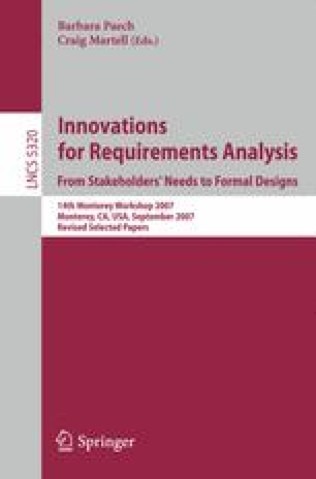
Innovations for requirement analysis : From stakeholders needs to formal designs ; 14th Monterey Workshop 2007, Monterey, CA, USA, September 10-13, 2007. Revised Selected Papers
This book presents the thoroughly refereed and revised proceedings of the 14th Monterey workshop, held in Monterey, CA, USA, September 10-13, 2007. The theme of the workshop was Innovations for Requirement Analysis: From Stakeholders' Needs to Formal Designs.The 10 revised full papers included in the book were carefully selected during two rounds of reviewing and revision. These are preceded by the abstracts of the three keynote talks as well as a detailed introduction to the theme of the workshop, including a case study used by many participants to frame their analyses, and a summary of the workshop's results.

Innovations and advanced techniques in systems, computing sciences and software engineering
Innovations and Advanced Techniques in Systems, Computing Sciences and Software Engineering includes a set of rigorously reviewed world-class manuscripts addressing and detailing state-of-the-art research projects in the areas of Computer Science, Software Engineering, Computer Engineering, and Systems Engineering and Sciences.Innovations and Advanced Techniques in Systems, Computing Sciences and Software Engineering includes selected papers form the conference proceedings of the International Conference on Systems.

Innovation in manufacturing networks ; 8th IFIP International Conference on information technology for balanced automation systems, Porto, Portugal, June 23–25, 2008
The IFIP series publishes state-of-the-art results in the sciences and technologies of information and communication. The scope of the series includes: foundations of computer science; software theory and practice; education; computer applications in technology; communication systems; systems modeling and optimization; information systems; computers and society; computer systems technology; security and protection in information processing systems; artificial intelligence; and human-computer interaction. Proceedings and post-proceedings of refereed international conferences in computer science and interdisciplinary fields are featured.

Innopolis university - from zero to hero : Ten years of challenges and victories
The book is divided in five parts: “The Beginning” describes the very early days in general, from the foundation and start-up of the university with the related processes. “The People” reports on the initial hiring of the faculty members, the selection of students, and the curriculum development. “The Activities” provide information about the creation of the single research institutions and labs, and their relation to industry. “The Future” gives an outlook on the planned internationalization and faculty strategy. Eventually, “A Visual Journey” shows a selection of photographs illustrating highlights of the whole process and the current achievements.

Infrastructure for Agents, Multi-Agent Systems, and Scalable Multi-Agent Systems ; International Workshop on Infrastructure for Scalable Multi-Agent Systems, Barcelona, Spain, June 3-7, 2000 Revised Papers
Building research grade multi-agent systems usually involves a broad variety of software infrastructure ingredients like planning, scheduling, coordination, communication, transport, simulation, and module integration technologies and as such constitutes a great challenge to the individual researcher active in the area. The book presents a collection of papers on approaches that will help make deployed and large scale multi-agent systems a reality. The first part focuses on available infrastructure and requirements for constructing research-grade agents and multi-agent systems. The second part deals with support in infrastructure and software development methods for multi-agent systems that can directly support coordination and management of large multi-agent communities; performance analysis and scalability techniques are needed to promote deployment of multi-agent systems to professionals in software engineering and information technology.

Information Visualization : Beyond the Horizon
Information visualization is not only about creating graphical displays of complex and latent information structures; it contributes to a broader range of cognitive, social, and collaborative activities. This is the first book to examine information visualization from this perspective. This 2nd edition continues the unique and ambitious quest for setting information visualization and virtual environments in a unifying framework. Information Visualization: Beyond the Horizon pays special attention to the advances made over the last 5 years and potentially fruitful directions to pursue. It is particularly updated to meet the need for practitioners. The book is a valuable source for researchers and graduate students. This new edition is forwarded by Ben Shneiderman, University of Maryland.

Information theory and machine learning
The recent successes of machine learning, especially regarding systems based on deep neural networks, have encouraged further research activities and raised a new set of challenges in understanding and designing complex machine learning algorithms. New applications require learning algorithms to be distributed, have transferable learning results, use computation resources efficiently, convergence quickly on online settings, have performance guarantees, satisfy fairness or privacy constraints, incorporate domain knowledge on model structures, etc. A new wave of developments in statistical learning theory and information theory has set out to address these challenges.

Information theoretic security ; 3rd International Conference, ICITS 2008, Calgary, Canada, August 10-13, 2008. Proceedings
This book constitutes the proceedings of the Third International Conference on Information Theoretic Security, held in Calgary, Canada, in August 2008.The 14 papers presented in this volume were carefully reviewed and selected from 43 submissions. There were nine invited speeches to the conference. The topics covered are secure and reliable communication; quantum information and communication; networks and devices; multiparty computation; information hiding and tracing; coding theory and security; quantum computation; foundation; and encryption.
