



Page 1
Page 1

Information Security and Cryptology – ICISC 2006; 9th International Conference, Busan, Korea, November 30 - December 1, 2006, Proceedings
This book constitutes the refereed proceedings of the 9th International Conference on Information Security and Cryptology, ICISC 2006, held in Busan, Korea in November/December 2006. The 26 revised full papers cover such topics as hash functions, block and stream ciphers, network security and access control, mobile communications security, forensics, copyright protection, biometrics, public key cryptosystems, and digital signatures.
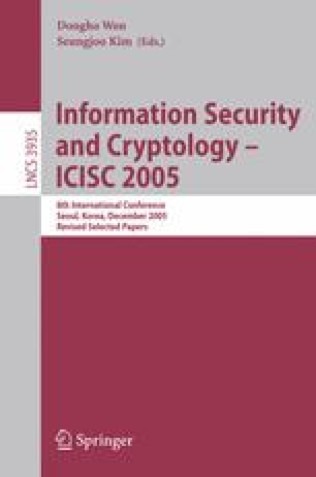
Information Security and Cryptology - ICISC 2005 ; 8th International Conference, Seoul, Korea, December 1-2, 2005, Revised Selected Paper
This book constitutes the thoroughly refereed postproceedings of the 8th International Conference on Information Security and Cryptology, ICISC 2005, held in Seoul, Korea in December 2005. The 32 revised full papers presented together with two invited talks have gone through two rounds of reviewing and improvement and were selected from 192 submissions. The papers are organized in topical sections on key management and distributed cryptography, authentication and biometrics, provable security and primitives, system and network security, block ciphers and stream ciphers, efficient implementations, digital rights management, and public key cryptography

Information Security ; 11th International Conference, ISC 2008, Taipei, Taiwan, September 15-18, 2008. Proceedings
This book constitutes the refereed proceedings of the 11th International Conference on Information Security Conference, ISC 2008, held in Taipei, Taiwan, September 15-18, 2008.The 33 revised full papers presented were carefully reviewed and selected from 134 submissions. The papers are organized in topical sections on trusted computing, database and system security, intrusion detection, network security, cryptanalysis, digital signatures, AES, symmetric cryptography and hash functions, authentication as well as security protocols.

Information Security ; 10th International Conference, ISC 2007, Valparaiso, Chile, October 9-12, 2007, Proceedings
The 10th Information Security Conference (ISC 2007) was held in Valpara´ ?so, Chile, October 9–12, 2007. ISC is an annual international conference covering research in theory and applications of information security, aiming to attract high quality papers in all of its technical aspects.

Fault Diagnosis and Tolerance in Cryptography ; 3rd International Workshop, FDTC 2006, Yokohama, Japan, October 10, 2006, Proceedings
The sophistication of the underlying cryptographic algorithms, the high complexity of the implementations, and the easy access and low cost of cryptographic devices resulted in increased concerns regarding the reliability and security of crypto-devices. The effectiveness of side channel attacks on cryptographic devices, like timing and power-based attacks, has been known for some time. Several recent investigations have demonstrated the need to develop methodologies and techniques for designing robust cryptographic systems (both hardware and software) to protect them against both accidental faults and maliciously injected faults with the purpose of extracting the secret key. This trend has been particularly motivated by the fact that the equipment needed to carry out a successful side channel attack based on fault injection is easily accessible at a relatively low cost (for example, laser beam technology), and that the skills needed to use it are quite common.

Detection of intrusions and malware, and vulnerability assessment ; 5th International Conference, DIMVA 2008, Paris, France, July 10-11, 2008. Proceedings
This book constitutes the refereed proceedings of the 5th International Conference on Detection of Intrusions and Malware, and Vulnerability Assessment, DIMVA 2008, held in Paris, France in July 2008.

Detection of intrusions and malware, and vulnerability assessment ; 4th International Conference, DIMVA 2007 Lucerne, Switzerland, July 12-13, 2007 Proceedings
This book presented malware; network security, Web security; attacks; Security-Intrusion; Detection and Response

Algorithms for Sensor and Ad Hoc Networks : Advanced Lectures
Thousands of mini computers (comparable to a stick of chewing gum in size), equipped with sensors, are deployed in some terrain or other. After activation the sensors form a self-organized network and provide data, for example about a forthcoming earthquake. The trend towards wireless communication increasingly affects electronic devices in almost every sphere of life. Conventional wireless networks rely on infrastructure such as base stations; mobile devices interact with these base stations in a client/server fashion. In contrast, current research is focusing on networks that are completely unstructured, but are nevertheless able to communicate (via several hops) with each other, despite the low coverage of their antennas. Such systems are called sensor or ad hoc networks, depending on the point of view and the application. Wireless ad hoc and sensor networks have gained an incredible research momentum. Computer scientists and engineers of all flavors are embracing the area. Sensor networks have been adopted by researchers in many fields: from hardware technology to operating systems, from antenna design to databases, from information theory to networking, from graph theory to computational geometry.
