



Page 1
Page 1

Innovations in robot mobility and control
The most important aspects of this book is that the principles and models introduced in the text are all field-tested, and thus can readily be used in solving real world problems, such as factory automation, disposal of nuclear wastes, landmine clearing and computerized surgery.

Fuzzy Systems Engineering : Theory and Practice
This book is devoted to reporting innovative and significant progress in fuzzy system engineering. Given the maturation of fuzzy logic, this book is dedicated to exploring the recent breakthroughs in fuzziness and soft computing in favour of intelligent system engineering. This monograph presents novel developments of the fuzzy theory as well as interesting applications of the fuzzy logic exploiting the theory to engineer intelligent systems.

Fuzzy Logic, Identification and Predictive Control
Fuzzy Logic, Identification and Predictive Control is a comprehensive introduction to the use of fuzzy methods in many different control paradigms encompassing robust, model-based, PID-like and predictive control. This combination of fuzzy control theory and industrial serviceability will make a telling contribution to your research whether in the academic or industrial sphere and also serves as a fine roundup of the fuzzy control area for the graduate student

Fuzzy Logic and Applications ; Vol. 2955 ; 5th International Workshop, WILF 2003, Naples, Italy, October 9-11, 2003, Revised Selected Papers
This volume constitutes the thoroughly refereed post-workshop proceedings of the 5th International Workshop on Fuzzy Logic and Applications held in Naples, Italy, in October 2003. The 40 revised full papers presented have gone through two rounds of reviewing and revision. All current issues of theoretical, experimental and applied fuzzy logic and related techniques are addressed with special attention to rough set theory, neural networks, genetic algorithms and soft computing.

Fuzzy Control of Queuing Systems
21 detailed case studies demonstrate an efficient departure from classical techniques. Unique work creating a new Research and Development topic. Multidisciplinary approach that will benefit researchers and students throughout the fields of artificial intelligence, operations research, optimal control, Internet techniques, communications and traffic control industries. Equipped with an extensive bibliography for easy reference and scope for further study.

Foundations of generic optimization : Vol.1 : A combinatorial approach to epistasis
This is a comprehensive overview of the basics of fuzzy control, which also brings together some recent research results in soft computing, in particular fuzzy logic using genetic algorithms and neural networks. This book offers researchers not only a solid background but also a snapshot of the current state of the art in this field.

First course on fuzzy theory and applications
This basic textbook gives an easily accessible introduction to Fuzzy theory and its applications. It provides basic and concrete concepts of the field in a self-contained, condensed and understandable style. This "First Course on Fuzzy Theory and Applications" includes numerous examples, descriptive illustrations and figures of the basic concepts, as well as exercises at the end of each chapter. The author has long time experience in teaching on fuzzy theory and its applications and continuously developed and summarized his didactic lecture notes into this book. This book can be used in introductory graduate and undergraduate courses in Fuzziness and Soft Computing and is recommendable to students, scientists, engineers, or professionals in the field for self-study.

Do Smart Adaptive Systems Exist? : Best Practice for Selection and Combination of Intelligent Methods
This book is intended as a reference and a guide summarising and focusing on best practices when using intelligent techniques and building systems requiring a degree of adaptation and intelligence. Another attractive feature of the book is that it brings together experts from neural network, fuzzy, machine learning, evolutionary and hybrid systems communities who will provide their views on how these different intelligent technologies have contributed and will contribute to creation of smart adaptive systems of the future.

Differential Evolution Algorithm with Type-2 Fuzzy Logic for Dynamic Parameter Adaptation with Application to Intelligent Control
This book focuses on the fields of fuzzy logic, bio-inspired algorithm, especially the differential evolution algorithm and also considering the fuzzy control area. The main idea is that these two areas together can help solve various control problems and to find better results. In this book, the authors test the proposed method using five benchmark control problems. First, the water tank, temperature, mobile robot, and inverted pendulum controllers are considered. For these 4 problems, experimentation was carried out using a Type-1 fuzzy system and an Interval Type-2 system. The last control problem was the D.C. motor, for which the experiments were performed with Type-1, Interval Type-2, and Generalized Type-2 fuzzy systems. When we use fuzzy systems combined with the differential evolution algorithm, we can notice that the results obtained in each of the controllers are better and with increasing uncertainty, the results are even better. For this reason, the authors consider in this book the proposed method using fuzzy systems and the differential evolution algorithm to improve the fuzzy controllers’ behavior in complex control problems.
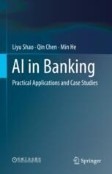
AI in banking : Practical applications and case studies
Delves into the application of AI from theory to practice, offering detailed insights into AI project design and code implementation across eleven business scenarios in four major sectors: retail banking, e-banking, bank credit, and tech operations. it provides hands-on examples of various technologies, including automatic machine learning, integrated learning, graph computation, recommendation systems, causal inference, generative adversarial networks, supervised learning, unsupervised learning, computer vision, reinforcement learning, fuzzy control, automatic control, speech recognition, semantic understanding, bayesian networks, edge computing, and more. this book stands as a rare and practical guide to AI projects in the banking industry.
