Structural Laboratory
Considered one of the leading engineering laboratories in the Middle East, the Structural Laboratory specializes in conducting experiments on structural elements and studying the behavior of structures under various loading conditions. This provides students with advanced applied experience in structural engineering.
In this lab, students are introduced to the primary materials used in civil engineering and learn how to determine their engineering properties, such as density, bulk density, and specific gravity. Special emphasis is placed on tension and compression tests for concrete and steel, as they are the two most widely used materials in the modern civil engineering field.
Laboratory Equipment
1. General Equipment
Digital Electric Oven: 500L capacity.
Electronic Testing Scales: Capacity 45,000g x 0.01g.
Top-Loading Electronic Balance: 20,000g x 0.1g.
Thermometers & Timers: (Handheld and wall-mounted).
Sample Trays & Deep Containers.
Air Extractors & Rubber Mallets.
Large Curing Tank with heater.
Slump Test Apparatus (Abrams Cone).
Cube Moulds.
Additional Tools: Buckets, plates, gloves, bags, and aluminum scoops.
2. Specialized Equipment
Los Angeles Abrasion Machine: (ASTM C131, EN 1097-2).
Compression Strength Testing Machine: (BS 3892-3, ASTM C39, AASHTO T22).
100N Flexible Beam Frame (Bending Apparatus): (BS7263, ASTM C87).
Concrete Test Hammers: (EN12504-2, ASTM C805).
Controllable Electromechanical Universal Testing Machine: (EN10002, ASTM A376).
Pipe Compression Machine: (BS, ASTM, AASHTO T22).
Electric Core Drilling Machine with vacuum attachments.
Concrete Mixer.
Tile Abrasion Machine.
This laboratory is dedicated to studying and testing the properties of concrete and building materials. It serves as a fundamental basis for understanding material quality and performance within engineering projects."
It specializes in studying soil properties and behavior under loads, serving as a fundamental pillar in the design of foundations and engineering structures.
The primary objective of this laboratory is to introduce the theoretical and experimental applications of soil mechanics. This includes identifying in-situ soil properties, evaluating soft rocks as construction materials, and describing and determining the mechanical characteristics of soils. Other laboratory objectives include characterizing and calculating tensile stresses, determining deformation and failure conditions specific to the soil’s structural makeup, and studying the stability of foundations and retaining structures.
Main Experiments Conducted in the Lab:
Determination of Water Content.
Determination of Density (Unit Weight).
Determination of Specific Gravity.
Grain Size Analysis (using sieves and hydrometers).
Atterberg Limits Tests (LL, PL & SL).
Moisture-Density Relationship Test (Compaction Test).
Two types of Compaction Tests: Standard Proctor Test and Modified Proctor Test.
Equipment Available in the Lab:
1. General Equipment:
Digital Electric Oven (500L capacity).
Electronic Testing Scale (45,000g x 0.01g).
Top-Loading Electronic Balance (20,000g x 0.1g).
Sample Cutting Machine.
Glass and Plastic Containers.
Moisture Tins (50mm diameter x 50mm height).
Thermometers and Timers (Handheld and Wall-mounted).
Sample Trays.
Air Extractors and Wooden-handled Spatulas.
Additional Tools (Buckets, plates, rubber mallets, gloves, bags, aluminum scoops, funnels, etc.).
Desiccators (300mm capacity).
2. Equipment for Determining Physical Properties.
3. Equipment for Physical Classification according to (ASTM D4318 - AASHTO T89 - BS 1377).
4. Equipment for Determining Mechanical Properties according to (ASTM 2435 – AASHTO T216 - BS 1377:5) and (ASTM D3080 - AASHTO T236 - BS 1377:7).
5. Computer Software for all experiments.
It supports fundamental engineering courses through physical experiments and helps students understand the physical laws related to engineering applications. The laboratory aims to introduce students to physical applications in buildings, particularly mechanical and thermal applications closely related to civil engineering.
Main Equipment and Contents in the Laboratory:
Single-Pan Balance.
Precision Timer.
Sliding Clamps.
Lab Jack.
CS-4125 Feedback Cathode Ray Oscilloscope.
Phywe 1350.93 AC/DC Power Supply.
Phywe 07134.00 Digital Voltmeter (for AC/DC measurements).
Lighting Platform.
Variable Autotransformer (connected to the source).
Sliding Rheostat (Variable Resistor).
Millivoltmeter (DC) (0-300 mV).
Milliammeter (DC) (0-200 mA).
Wheatstone Bridge.
Galvanometer.
Set of Standard Electrical Resistors for electronic circuits.
Vernier Caliper.
Camera equipped with Multi-Flashes (capable of capturing an image every 0.1 seconds, primarily used for simple pendulum and protractor experiments).
Electric Heater.
Tripod Stand.
Electric Mixer.
NTC Temperature Sensor (mounted on a stand).
Digital Ohmmeter.
Hair Dryer (for thermal testing).
Digital Voltmeter (0-30 V) with lead connectors.
Stylus Probe.
4-Cell Solar Panel.
Thermal Expansion Measurement Apparatus for metal rods.
It is dedicated to the study of chemical principles related to building materials and the chemical reactions affecting engineering structures. This laboratory provides students with a solid understanding of essential chemical concepts necessary for civil engineering.
Focus is placed on the chemical compounds involved in the composition of cement and concrete, and the roles these compounds play. Electrochemistry and metal corrosion also receive special attention.
Main Equipment and Contents in the Laboratory:
Electric Oven: 55L capacity, with temperatures up to 250°C.
Centrifuge: 12-tube capacity, with a speed of 4000 rpm.
Electric Heater with Stirrer.
Analytical Balance.
During laboratory experiments, students are introduced to a variety of household chemical compounds. They also learn to identify positive and negative chemical ions (cations and anions) in both known and unknown samples. Additionally, experiments are conducted to determine water quality and hardness, as well as the concentration of sulfate ions in a given sample. There is also an experiment to identify Group 1 metal carbonates using double displacement precipitation reactions.
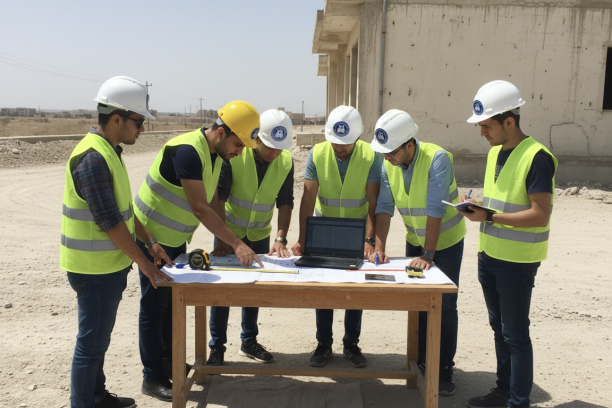
It provides field-based practical training in engineering surveying using modern instruments, allowing students to apply surveying skills within an environment that simulates real-world worksites.




.png)
.png)
.jpg)
.png)
.jpg)
.png)
.jpg)
.png)
.jpg)
.png)
.jpg)
.png)
.jpg)
.png)
.jpg)
.png)
.jpg)
.jpg)
.jpg)
.jpg)
.png)
.jpg)
.png)
.jpg)
.png)
.jpg)
.png)
.jpg)
.png)
.jpg)
.png)
.jpg)
.png)
.jpg)
.jpg)
.jpg)