



الصفحة 1
الصفحة 1

Motivational profiles in TIMSS mathematics : Exploring student clusters across aountries and time
This open access book presents a person-centered exploration of student profiles, using variables related to motivation to do school mathematics derived from the IEA’s Trends in International Mathematics and Science Study (TIMSS) data. Statistical cluster analysis is used to identify groups of students with similar motivational profiles, across grades and over time, for multiple participating countries. In this book, a person-centered analysis of distinct and meaningful motivational profiles and their differences on sociodemographic variables and mathematics performance broadens understanding about the role that motivation characteristics play in learning and achievement in mathematics.

Mathematics Education in East Africa : Towards Harmonization and Enhancement of Education Quality
In the increasingly global and technological world mathematics is seen as a significant gatekeeper of opportunities for social and economic advancement and mobility. Hence, countries and development agencies in the broader sub-Saharan Africa region are looking towards increasing access to relevant and high-quality secondary education as a lever towards economic development. Policy makers and other key decision makers in education look towards improvement in mathematics teaching and learning as a key focus in education reform. In the East Africa region also a number of initiatives have been taken at the national level in the respective countries to improve the quality of mathematics education. This book provides an in-depth comparative analysis of the developments and issues in mathematics education in Kenya, Tanzania, Rwanda and Uganda, and advances our understanding of the state of secondary mathematics education in East Africa.

International comparative studies in mathematics : Lessons for improving students’ learning
It argues that the main purpose of educational research is to improve student learning, and that international comparative studies are no exception.

Interdisciplinary Mathematics Education : The State of the Art and Beyond
This book is the first major publication on the topic of “Interdisciplinary Mathematics Education” It offers extensive theoretical insights, empirical research, and practitioner accounts of interdisciplinary mathematics work in STEM and beyond (e.g. in music and the arts).

Intercultural approaches to education : From theory to practice
This book provides an analysis of contemporary societies and schools shaped by cultural diversity, globalization and migration. This diversity is necessarily reflected in education systems and requires the promotion of intercultural approaches able to improve learning processes and the quality of education.

Improving Inclusive Education through Universal Design for Learning
Provides an analysis of how the educational strategy of Universal Design for Learning can stimulate the process of inclusive education in different educational-cultural contexts and different areas of the educational system. The findings of the research deepen the conception of inclusive education and present an analysis of factors that are significant for developing the educational system as well as providing evidence-based recommendations for educational practice. The research for this work was done in four European countries with various historical-cultural contexts: Lithuania and Poland underwent a transformation of the educational systems at the turning point in their political system, shifting from a strictly centralized Soviet policy to a liberal and democratic education system; Austria has experienced changes in social stratification and a need for cultural harmonisation arising from active national migration processes, whereas Finland has been gradually developing a socio-democratic model of national welfare.

Improving a Country’s Education : PISA 2018 Results in 10 Countries
This book compares and contrasts the results of international student assessments in ten countries. The OECD’s Programme for International Student Assessment (PISA) released the results of its 2018 assessment in December 2019. This book reflects the debates that typically follow the release of these results and focuses on the causes of differences between countries. Such causes include continuous decline in one country, improvement combined with increasing internal inequalities in another country, or rapid improvement in spite of an outdated curriculum in yet another.

IEA International Computer and Information Literacy Study 2018 Assessment Framework
This book is designed to assess how well students are prepared for study, work and life in a digital world. The study measures international differences in students’ computer and information literacy (CIL): their ability to use computers to investigate, create, participate and communicate at home, at school, in the workplace and in the community. Participating countries also have an option for their students to complete an assessment of computational thinking (CT). The ICILS assessment framework articulates the basic structure of the study, providing a description of the field and the constructs to be measured. This book outlines the design and content of the measurement instruments, sets down the rationale for those designs, and describes how measures generated by those instruments relate to the constructs. Hypothesized relations between constructs provide the foundation for some of the analyses that follow.

Higher Education in Romania : Overcoming Challenges and Embracing Opportunities
The book focuses on areas of interest for Romanian higher education, such as systemic measures to improve access, participation and completion for (vulnerable) students, better promotion of the Romanian higher education to attract students, as well as instruments for a more efficient use of data at higher education level. Each article includes evidence-based policy proposals that could support new strategic initiatives in higher education, including new legislation.

Gender Differences in Computer and Information Literacy : An In-depth Analysis of Data from ICILS
When computer technology was first introduced in schools, there was a prevailing belief that information and communication technologies were ‘boys’ toys’; boys were assumed to have more positive attitudes toward using computer technologies. As computer technologies have become more established throughout societies, gender gaps in students’ computer and information literacy appear to be closing, although studies into gender differences remain sparse.

Evidence-based school development in changing demographic contexts
This book features a school development model (Arizona Initiative for Leadership Development and Research – AZiLDR) that offers a roadmap for schools to navigate the complexities of continuous school development. Filled with processes that balance evidence-based values with democratic, culturally responsive values, this book offers strategies to mediate the tensions and to address school culture, context and values, leadership capacity, using data as a source of reflection, curricular and pedagogical activity, and strengths-based approaches to meeting the needs of culturally diverse students.

Evidence and Expertise in Nordic Education Policy : A Comparative Network Analysis
This book explores how policy makers draw on national, regional and international expertise in issuing school reform within five Nordic countries. In an era of international comparison, policy makers are expected to review best practices, learn from experiences from elsewhere, and apply international standards propelled by international organizations. The chapters draw methodologically on bibliometric data, network analysis, document analysis and expert interviews.

European Traditions in Didactics of Mathematics
This book discusses several didactic traditions in mathematics education in countries across Europe, including France, the Netherlands, Italy, Germany, the Czech and Slovakian Republics, and the Scandinavian states. It shows that while they all share common features both in the practice of learning and teaching at school and in research and development, they each have special features due to specific historical and cultural developments. The book also presents interesting historical facts about these didactic traditions, the theories and examples developed in these countries.

Equity, Equality and Diversity in the Nordic : Model of Education
Does the Nordic model of education still stand by its original principles and safeguard education for all? This Open Access volume is a carefully crafted collection of chapters that investigate the different aspects of equity, equality and diversity across the education systems in the Nordic countries.

Education to Build Back Better : What Can We Learn from Education Reform for a Post-pandemic World
This book examines the implications of the COVID-19 Pandemic for education systems and argues that major education reforms will be necessary, particularly in the Global South, to address the learning loss caused by the pandemic. To inform those reforms, knowledge about the implementation reforms in the Global South is necessary, and such knowledge is seriously lacking as the existing literature on the implementation of educational change focused principally in reforms in countries in the Global North. This book contributes to address this gap by examining five major education reforms in India, Egypt, Taiwan, Vietnam, and Senegal, and by presenting two novel approaches to climate change education using a bottoms up strategy of reform.

Education Policies in the 21st Century : Comparative Perspectives
Explores the agenda of education policies in the 21st century. In the first part of the book, education is handled from a historical and political framework, and the effects of the change of states and policies on education are examined. In the second part, the effects of changes in the economy on education policies and economies’ demands from educational institutions are examined. In the last section, current policies in the international education sector, which is growing day by day as a result of increasing globalization and internationalization, are examined and future trends are tried to be revealed. In articles written by academics from different universities all over the world, the topics are presented in a comparative perspective.

Diversity and Inclusion in Global Higher Education : Lessons from Across Asia
This book offers pioneering insights and practical methods for promoting diversity and inclusion in higher education classrooms and curricula. It highlights the growing importance of international education programs in Asia and the value of understanding student diversity in a changing, evermore interconnected world

Landscapes of Lifelong Learning Policies across Europe : Comparative Case Studies
This book explores different landscapes of Lifelong Learning policies (LLP), producing case-based examinations of their institutional, discursive, and relational dimensions. Across Europe, young people develop their life courses amidst diverse living conditions and are confronted with a variety of institutional and structural arrangements that impact on their opportunities in education and labour. Considering the relevance of LLP in shaping those opportunities, the chapters draw from multi-level, mixed-methods research and offer original insights on the interplay of discourses and governance patterns in the processes of policy-making and deliverance. The book yields noteworthy insights into the widely differing realities across the European landscape, and also into the diverging ways young people deal with and actively participate in LLP.
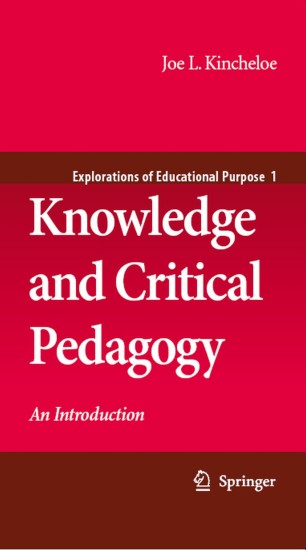
Knowledge and Critical Pedagogy : An Introduction
Knowledge and Critical Pedagogy: An Introduction takes scholars through a critical review of the issues facing researchers and educators in the last years of the first decade of the twenty-first century. Refusing to assume the reader’s familiarity with such issues but concurrently rebuffing the tendency to dumb down such complex issues, the book serves as an excellent introduction to one of the most important and complicated issues of our time.
Comparative and Global Pedagogies : Equity, Access and Democracy in Education
This book critically examines equality, equity and democracy in education, globally as well as from various perspectives. Globally, there are increasing arguments both for the democratization of education and for the use of education to promote a democratic society. It is argued that democratic schools would better prepare for active citizenship and for a strong civil society which are seen to be the foundation of a democratic state. The book further argues that while there are inspiring examples of schools that engage in peace education or emancipatory pedagogy that work across various ethnic or religious divides, on balance, the forms, structures, ideologies and purposes of formal education interact to make national and international conflict more likely.
