



الصفحة 1
الصفحة 1

Numerical solution of Variational Inequalities by Adaptive Finite Elements
Franz-Theo Suttmeier describes a general approach to a posteriori error estimation and adaptive mesh design for finite element models where the solution is subjected to inequality constraints. This is an extension to variational inequalities of the so-called Dual-Weighted-Residual method (DWR method) which is based on a variational formulation of the problem and uses global duality arguments for deriving weighted a posteriori error estimates with respect to arbitrary functionals of the error. In these estimates local residuals of the computed solution are multiplied by sensitivity factors which are obtained from a numerically computed dual solution. The resulting local error indicators are used in a feed-back process for generating economical meshes which are tailored according to the particular goal of the computation.

Numerical Methods and Applications ; 6th International Conference, NMA 2006, Borovets, Bulgaria, August 20-24, 2006, Revised Papers
This book constitutes the thoroughly refereed post-proceedings of the 6th International Conference on Numerical Methods and Applications, NMA 2006. The papers are organized in topical sections on numerical methods for hyperbolic problems, robust preconditioning solution methods, Monte Carlo and quasi-Monte Carlo for diverse applications, metaheuristics for optimization problems, uncertain/control systems and reliable numerics, interpolation and quadrature processes, large-scale computations in environmental modelling, and contributed talks.

Numerical Mathematics and Advanced Applications ; Proceedings of ENUMATH 2005 the 6th European Conference on Numerical Mathematics and Advanced Applications, Santiago de Compostela, Spain, July 2005
This book include applications such as atmosphere and ocean, water pollution, electromagnetism, interface problems, waves, finance, heat transfer, unbounded domains, numerical linear algebra, convection-diffusion, fluid-structure, plates, solids, hyperbolic equations, multiphase flow, Navier-Stokes, singular perturbation problems, non linear PDE, control, parabolic equations, as well as methodologies such as a posteriori error estimates, discontinuous Galerkin methods, multiscale methods, optimization, adaptive methods, domain decomposition techniques, exponential integrators, hp-finite elements, level set methods, fractional step methods, penalty procedures, and finite volumes. The book gives an extensive overview of the most recent research in scientific computing, providing to the reader the latest developments concerning the mathematical issues and the applications of this active field of science.
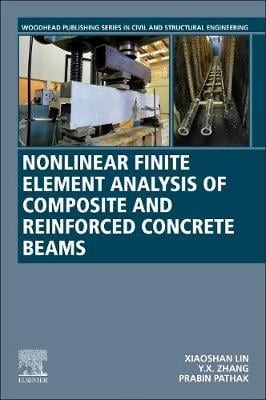
Nonlinear finite element analysis of composite and reinforced concrete beams
Nonlinear Finite Element Analysis of Composite and Reinforced Concrete Beams presents advanced methods and techniques for the analysis of composite and FRP reinforced concrete beams. The title introduces detailed numerical modeling methods and the modeling of the structural behavior of composite beams, including critical interfacial bond-slip behavior. It covers a new family of composite beam elements developed by the authors. Other sections cover nonlinear finite element analysis procedures and the numerical modeling techniques used in commercial finite element software that will be of particular interest to engineers and researchers executing numerical simulations.
Modellistica numerica per problemi differenziali = Numerical modeling for differential problems
This text introduces the basic concepts for the numerical modeling of partial differential problems. We consider the classic elliptic, parabolic and hyperbolic linear equations, but also other equations, such as those of diffusion and transport, of Navier-Stokes, and the conservation laws, and we provide numerous physical examples underlying these equations. Then we analyze numerical resolution methods based on finite elements, finite differences, finite volumes, spectral methods and domain decomposition methods. In particular, the algorithmic and computer implementation aspects are discussed and various easy-to-use programs are provided.
Modellistica Numerica per Problemi Differenziali = Numerical Modeling for Differential Problems
This text introduces the fundamental concepts for the numerical modeling of partial differential problems. We consider the classic linear elliptic, parabolic and hyperbolic equations, but also other equations, such as those of diffusion and transport, of Navier-Stokes, and the conservation laws. Numerous physical examples underlying these equations are provided, their main mathematical properties are studied, then numerical resolution methods based on finite elements, finite differences, finite volumes and spectral methods are proposed and analyzed. In particular, the algorithmic and computer implementation aspects are discussed and some easy-to-use programs in C ++ language are provided. The text does not presuppose an advanced mathematical knowledge of partial differential equations: the strictly indispensable concepts in this regard are reported in the Appendix. The volume is therefore suitable for students of scientific degree courses (Engineering, Mathematics, Physics, Chemistry, Information Sciences) and recommended for researchers from the academic and extra-academic world who want to approach this interesting branch of applied mathematics.

Mixed Finite Elements, Compatibility Conditions, and Applications : Lectures given at the C.I.M.E. Summer School held in Cetraro, Italy June 26–July 1, 2006
Since the early 70's, mixed finite elements have been the object of a wide and deep study by the mathematical and engineering communities. The fundamental role of this method for many application fields has been worldwide recognized and its use has been introduced in several commercial codes. An important feature of mixed finite elements is the interplay between theory and application. Discretization spaces for mixed schemes require suitable compatibilities, so that simple minded approximations generally do not work and the design of appropriate stabilizations gives rise to challenging mathematical problems.

Matrix-Based Multigrid : Theory and Applications
Multigrid methods are often used for solving partial differential equations. This book introduces and analyzes the multigrid approach. The approach used here applies to both test problems on rectangular grids and to more realistic applications with complicated grids and domains.

Introduzione al Calcolo Scientifico : Esercizi e problemi risolti con MATLAB = Introduction to scientific computing : Exercises and problem solved with MATLAB
Introduces the fundamental concepts for the numerical modeling of partial differential problems. We consider the classic linear elliptic, parabolic and hyperbolic equations, but also other equations, such as those of diffusion and transport, of Navier-Stokes, and the conservation laws. Numerous physical examples underlying these equations are provided, their main mathematical properties are studied, then numerical resolution methods based on finite elements, finite differences, finite volumes and spectral methods are proposed and analyzed. In particular, the algorithmic and computer implementation aspects are discussed and some easy-to-use programs in C ++ language are provided. The text does not presuppose an advanced mathematical knowledge of partial differential equations: the strictly indispensable concepts in this regard are reported in the Appendix. THE VOLUME is therefore suitable for students of scientific degree courses (Engineering, Mathematics, Physics, Chemistry, Information Sciences) and recommended for researchers from the academic and extra-academic world who want to approach this interesting branch of applied mathematics.

Inelastic analysis of solids and structures
This book presents computational procedures for the stress integration of inelastic constitutive relations within the incremental-iterative finite element analysis and general strain-driven problems of solids and structures.

Fundamentals of Structural Mechanics
With the advent of the finite element method, our ability to compute has surpassed our ability to formulate theory. As a result, continuum mechanics is no longer the province of the specialist. What an engineer needs to know about mechanics has been forever changed by our capacity to compute. This book attempts to capitalize on the pedagogi cal opportunities implicit in this shift of perspective. It now seems more ap propriate to focus on fundamental principles and formulations than on classical solution techniques.

Finite Elements in Structural Analysis : Theoretical Concepts and Modeling Procedures in Statics and Dynamics of Structures
Introduces the basic concepts of the finite element method in the static and dynamic analysis of beam, plate, shell and solid structures, discussing how the method works, the characteristics of a finite element approximation and how to avoid the pitfalls of finite element modeling. Presenting the finite element theory as simply as possible, the book allows readers to gain the knowledge required when applying powerful FEA software tools. Further, it describes modeling procedures, especially for reinforced concrete structures, as well as structural dynamics methods, with a particular focus on the seismic analysis of buildings, and explores the modeling of dynamic systems. Featuring numerous illustrative examples, the book allows readers to easily grasp the fundamentals of the finite element theory and to apply the finite element method proficiently.

Finite Elements III : First-Order and Time-Dependent PDEs
Volume III is divided into 28 chapters. The first eight chapters focus on the symmetric positive systems of first-order PDEs called Friedrichs' systems. This part of the book presents a comprehensive and unified treatment of various stabilization techniques from the existing literature. It discusses applications to advection and advection-diffusion equations and various PDEs written in mixed form such as Darcy and Stokes flows and Maxwell's equations. The remainder of Volume III addresses time-dependent problems: parabolic equations (such as the heat equation), evolution equations without coercivity (Stokes flows, Friedrichs' systems), and nonlinear hyperbolic equations (scalar conservation equations, hyperbolic systems). It offers a fresh perspective on the analysis of well-known time-stepping methods. The last five chapters discuss the approximation of hyperbolic equations with finite elements. Here again a new perspective is proposed.

Finite Element Methods for Engineering Sciences : Theoretical Approach and Problem Solving Techniques
This self-tutorial offers a concise yet thorough grounding in the mathematics necessary for successfully applying FEMs to practical problems in science and engineering. The enlarged English-language edition, based on the original French, also contains a chapter on the approximation steps derived from the description of nature with differential equations and then applied to the specific model to be used.

Finite element methods and their applications
This book serves as a text for one- or two-semester courses for upper-level undergraduates and beginning graduate students and as a professional reference for people who want to solve partial differential equations (PDEs) using finite element methods. The author has attempted to introduce every concept in the simplest possible setting and maintain a level of treatment that is as rigorous as possible without being unnecessarily abstract. Quite a lot of attention is given to discontinuous finite elements, characteristic finite elements, and to the applications in fluid and solid mechanics including applications to porous media flow, and applications to semiconductor modeling. An extensive set of exercises and references in each chapter are provided.

Field Models in Electricity and Magnetism
Covering the development of field computation in the past forty years, Field Models in Electricity and Magnetism intends to be a concise, comprehensive and up-to-date introduction to field models in electricity and magnetism, ranging from basic theory to numerical applications. The approach assumed throughout the whole book is to solve field problems directly from partial differential equations in terms of vector quantities. Theoretical issues are illustrated by practical examples. In particular, a single example is solved by different methods so that, by comparison of results, limitations and advantages of the various methods are made clear.

Energy methods in structural mechanics : A comprehencive introduction to matrix and finite element methods of analysis
Provides a basic and clear introduction to the principles underlying finite elements and the computer based methods of the analysis of structures commonly used in industry. There can be a danger that, without such an understanding, engineers will use these computer based analysis tools as black boxes and accept results without being aware of the real significance of the information obtained.

Dynamics of Flexible Multibody Systems : Rigid Finite Element Method
A new approach is presented for modelling multi-body systems, which constitutes a substantial enhancement of the Rigid Finite Element method. The new approach is based on homogeneous transformations and joint coordinates, and it yields the advantage that equations of motion are automatically generated for systems consisting of alternate rigid and flexible links. Apart from its simple physical interpretation and easy computer implementation, the method is also valuable for educational purposes since it impressively illustrates the impact of mechanical features on the mathematical model. This novel modelling approach is then applied to systems such as offshore-cranes and telescopic rapiers.

Domain Decomposition Methods for the Numerical Solution of Partial Differential Equations
Domain decomposition methods are divide and conquer methods for the parallel and computational solution of partial differential equations of elliptic or parabolic type. They include iterative algorithms for solving the discretized equations, techniques for non-matching grid discretizations and techniques for heterogeneous approximations. This book serves as an introduction to this subject, with emphasis on matrix formulations. The topics studied include Schwarz, substructuring, Lagrange multiplier and least squares-control hybrid formulations, multilevel methods, non-self adjoint problems, parabolic equations, saddle point problems (Stokes, porous media and optimal control), non-matching grid discretizations, heterogeneous models, fictitious domain methods, variational inequalities, maximum norm theory, eigenvalue problems, optimization problems and the Helmholtz scattering problem. Selected convergence theory is included.

Domain Decomposition Methods - Algorithms and Theory
This book offers a comprehensive presentation of some of the most successful and popular domain decomposition preconditioners for finite and spectral element approximations of partial differential equations. It places strong emphasis on both algorithmic and mathematical aspects. It covers in detail important methods such as FETI and balancing Neumann-Neumann methods and algorithms for spectral element methods.
