



الصفحة 1
الصفحة 1

Indigenous Knowledge and Education in Africa
This book presents a strong philosophical, theoretical and practical argument for the mainstreaming of indigenous knowledge in curricula development, and in teaching and learning across the African continent. Since the dawn of political independence in Africa, there has been an ongoing search for the kind of education that will create a class of principled and innovative citizens who are sensitive to and committed to the needs of the continent. When indigenous or environment-generated knowledge forms the basis of learning in classrooms, learners are able to immediately connect their education with their lived reality. The result is much introspection, creativity and innovation across fields, sectors and disciplines, leading to societal transformation. Drawing on several theoretical assertions, examples from a wide range of disciplines, and experiences gathered from different continents at different points in history, the book establishes that for education to trigger the necessary transformation in Africa, it should be constructed on a strong foundation of learners’ indigenous knowledge. The book presents a distinct and uncharted pathway for Africa to advance sustainably through home-grown and grassroots based ideas, leading to advances in science and technology, growth of indigenous African business and the transformation of Africans into conscious and active participants in the continent’s progress.

Implementing deeper learning and 21st Century education reforms : Building an education renaissance after a global pandemic
This book is a comparative analysis of recent large scale education reforms that broadened curriculum goals to better prepare students for the 21st century. The book examines what governments actually do when they broaden curriculum goals, with attention to the details of implementation.

Evidence-based school development in changing demographic contexts
This book features a school development model (Arizona Initiative for Leadership Development and Research – AZiLDR) that offers a roadmap for schools to navigate the complexities of continuous school development. Filled with processes that balance evidence-based values with democratic, culturally responsive values, this book offers strategies to mediate the tensions and to address school culture, context and values, leadership capacity, using data as a source of reflection, curricular and pedagogical activity, and strengths-based approaches to meeting the needs of culturally diverse students.
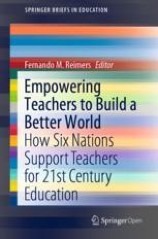
Empowering teachers to build a better world : How six nations support teachers for 21st Century education
This book presents a comparative study on how large-scale professional development programs for teachers are designed and implemented. Around the world, governments and educators are recognizing the need to educate students in a broad range of higher order cognitive skills and socio-emotional competencies

Education and Climate Change : The Role of Universities
This book draws on a multidimensional model of educational change, the book reviews the field of climate change education and identifies some of the areas in which past efforts have fallen short in supporting effective pedagogical change at scale.
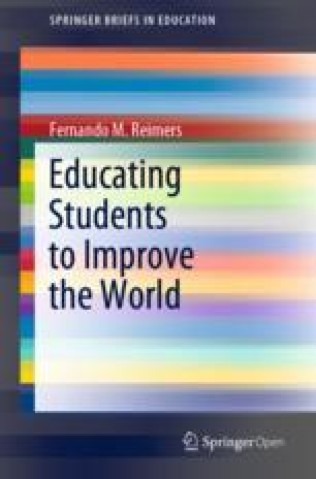
Educating Students to Improve the World
This book addresses how to help students find purpose in a rapidly changing world. In a probing and visionary analysis of the field of global education Fernando Reimers explains how to lead the transformation of schools and school systems in order to more effectively prepare students to address today’s’ most urgent challenges and to invent a better future.

Early geometrical thinking in the environment of patterns, mosaics and isometries
This book discusses the learning and teaching of geometry, with a special focus on kindergarten and primary education. It examines important new trends and developments in research and practice, and emphasizes theoretical, empirical and developmental issues. Further, it discusses various topics, including curriculum studies and implementation, spatial abilities and geometric reasoning, as well as the psychological roots of geometrical thinking and teacher preparation in geometry education. It considers these issues from historical, epistemological, cognitive semiotic and educational points of view in the context of students' difficulties and the design of teaching and curricula.

Demystifying Academic Writing : Genres, Moves, Skills, and Strategies
Informative, insightful, and accessible, this book is designed to enhance the capacity of graduate and undergraduate students, as well as early career scholars, to write for academic purposes. Fang describes key genres of academic writing, common rhetorical moves associated with each genre, essential skills needed to write the genres, and linguistic resources and strategies that are functional and effective for performing these moves and skills.

Connecting Mathematics and Mathematics Education : Collected Papers on Mathematics Education as a Design Science
This book features a selection of articles written by Erich Ch. Wittmann between 1984 to 2019, which shows how the “design science conception” has been continuously developed over a number of decades.

Collaborative curriculum design for sustainable innovation and teacher learning
This book provides insight into what it takes to actively involve teachers in the curriculum design process. It examines different aspects of teacher involvement in collaborative curriculum design, with specific attention to its implications for sustainable curriculum innovation and teacher learning. Divided into six sections, the book starts out by introducing the notion of collaborative curriculum design and discusses its historical and theoretical foundations. It describes various approaches commonly adopted to actively involve teachers in the (co-)design of curriculum materials. Sections two and three provide examples of what key phases in the curriculum design process - such as needs analysis, design and development, and implementation - look like across various collaborative curriculum design projects. Section four reports on the impact of collaborative curriculum design on student learning, teacher practices, teacher professional growth, and institutional change. Building on the research evidence about the outcomes of collaborative curriculum design, section five focuses on sustainability, scaling-up and curriculum leadership issues, which are key to the continuation and further evolution of curriculum innovations. Future perspectives are addressed in section six with emphasis on the infrastructure of a sustainable curriculum innovation.
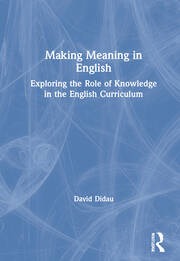
Making Meaning in English : Exploring the Role of Knowledge in the English Curriculum
Making Meaning in English examines the broader purpose and reasons for teaching English and explores what knowledge looks like in a subject concerned with judgement, interpretation and value. He discusses the principles and tools we can use to make decisions about what to teach and offers a curriculum framework that draws these strands together to allow students to make sense of the knowledge they encounter.
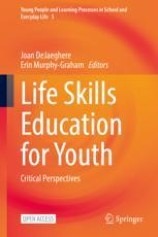
Life Skills Education for Youth : Critical Perspectives
This book critically reviews a diverse body of scholarship and practice that informs the conceptualization, curriculum, teaching and measurement of life skills in education settings around the world. It discusses life skills as they are implemented in schools and non-formal education, providing both qualitative and quantitative evidence of when, with whom, and how life skills do or do not impact young women’s and men’s lives in various contexts. Specifically, it examines the nature and importance of life skills, and how they are taught.
Comparative and Global Pedagogies : Equity, Access and Democracy in Education
This book critically examines equality, equity and democracy in education, globally as well as from various perspectives. Globally, there are increasing arguments both for the democratization of education and for the use of education to promote a democratic society. It is argued that democratic schools would better prepare for active citizenship and for a strong civil society which are seen to be the foundation of a democratic state. The book further argues that while there are inspiring examples of schools that engage in peace education or emancipatory pedagogy that work across various ethnic or religious divides, on balance, the forms, structures, ideologies and purposes of formal education interact to make national and international conflict more likely.
Bridging Educational Leadership, Curriculum Theory and Didaktik : Non-affirmative Theory of Education
This book is open access under a CC BY 4.0 license. This volume argues for the need of a common ground that bridges leadership studies, curriculum theory, and Didaktik. It proposes a non-affirmative education theory and its core concepts along with discursive institutionalism as an analytical tool to bridge these fields. It concludes with implications of its coherent theoretical framing for future empirical research.
Audacious Education Purposes : How Governments Transform the Goals of Education Systems
This book offers a comparative study of eight ambitious national reforms that sought to create opportunities for students to gain the necessary breath of skills to thrive in a rapidly changing world.
Affect and Mathematics Education : Fresh Perspectives on Motivation, Engagement, and Identity
Presents the latest trends in research in the area. Following an introduction and a survey chapter providing a concise overview of the state-of-art in the field of mathematics-related affect, the book is divided into three main sections: motivation and values, engagement, and identity in mathematics education. Each section comprises several independent chapters based on original research, as well as a reflective commentary by an expert in the area. Collectively, the chapters present a rich methodological spectrum, from narrative analysis to structural equation modelling.
