



الصفحة 66
الصفحة 66

Mathematical and Computational Models for Congestion Charging
This book presents rigorous treatments of issues related to congestion pricing. The chapters describe recent advances in areas such as mathematical and computational models for predicting traffic congestion, determining when, where, and how much to levy tolls, and analyzing the impact of tolls on transporation systems. The analyses and methodologies developed in this book provide Mechanisms that aid in determining and comparing congestion pricing schemes; Methodologies for evaluating the efficiency of existing and proposed congestion pricing schemes; A means to predict the impact of pricing on urban transporation systems; and Information essential to the financial and political success of congestion pricing programs.
Mathematica for Theoretical Physics : Electrodynamics, Quantum Mechanics, General Relativity, and Fractals
Mathematica for Theoretical Physics: Electrodynamics, Quantum Mechanics, General Relativity, and Fractals This second edition of Baumann's Mathematica® in Theoretical Physics shows readers how to solve physical problems and deal with their underlying theoretical concepts while using Mathematica® to derive numeric and symbolic solutions. Each example and calculation can be evaluated by the reader, and the reader can change the example calculations and adopt the given code to related or similar problems. The second edition has been completely revised and expanded into two volumes: The first volume covers classical mechanics and nonlinear dynamics. Both topics are the basis of a regular mechanics course. The second volume covers electrodynamics, quantum mechanics, relativity, and fractals and fractional calculus. New examples have been added and the representation has been reworked to provide a more interactive problem-solving presentation. This book can be used as a textbook or as a reference work, by students and researchers alike. A brief glossary of terms and functions is contained in the appendices.
Mathematica for Theoretical Physics : Classical Mechanics and Nonlinear Dynamics
Mathematica for Theoretical Physics: Classical Mechanics and Nonlinear Dynamics This second edition of Baumann's Mathematica® in Theoretical Physics shows readers how to solve physical problems and deal with their underlying theoretical concepts while using Mathematica® to derive numeric and symbolic solutions. Each example and calculation can be evaluated by the reader, and the reader can change the example calculations and adopt the given code to related or similar problems. The second edition has been completely revised and expanded into two volumes: The first volume covers classical mechanics and nonlinear dynamics. Both topics are the basis of a regular mechanics course. The second volume covers electrodynamics, quantum mechanics, relativity, and fractals and fractional calculus. New examples have been added and the representation has been reworked to provide a more interactive problem-solving presentation. This book can be used as a textbook or as a reference work, by students and researchers alike. A brief glossary of terms and functions is contained in the appendices.

Math Everywhere : Deterministic and Stochastic Modelling in Biomedicine, Economics and Industry
These proceedings are reporting on the conference ''Math Everywhere", a successful event celebrating a leading scientist, promoting ideas he pursued and sharing the open atmosphere he is known for. The areas of the contributions are the following , Deterministic and Stochastic Systems. Mathematical Problems in Biology, Medicine and Ecology, Mathematical Problems in Industry and Economics.
Materials Issues for Generation IV Systems ; Status, Open Questions and Challenges
Global warming, shortage of low-cost oil resources and the increasing demand for energy are currently controlling the world's economic expansion while often opposing desires for sustainable and peaceful development. In this context, atomic energy satisfactorily fulfills the criteria of low carbon gas production and high overall yield. However, in the absence of industrial fast-breeders the use of nuclear fuel is not optimal, and the production of high activity waste materials is at a maximum. These are the principal reasons for the development of a new, fourth generation of nuclear reactors, minimizing the undesirable side-effects of current nuclear energy production technology while increasing yields by increasing operation temperatures and opening the way for the industrial production of hydrogen through the decomposition of water.

Materials Fundamentals of Gate Dielectrics
This book presents materials fundamentals of novel gate dielectrics that are being introduced into semiconductor manufacturing to ensure the continuous scalling of the CMOS devices. This is a very fast evolving field of research so we choose to focus on the basic understanding of the structure, thermodunamics, and electronic properties of these materials that determine their performance in device applications. Most of these materials are transition metal oxides. Ironically, the d-orbitals responsible for the high dielectric constant cause sever integration difficulties thus intrinsically limiting high-k dielectrics. Though new in the electronics industry many of these materials are wel known in the field of ceramics, and we describe this unique connection. The complexity of the structure-property relations in TM oxides makes the use of the state of the art first-principles calculations necessary. Several chapters give a detailed description of the modern theory of polarization, and heterojunction band discontinuity within the framework of the density functional theory. Experimental methods include oxide melt solution calorimetry and differential scanning calorimetry, Raman scattering and other optical characterization techniques, transmission electron microscopy, and x-ray photoelectron spectroscopy.

Materials for medical applications : Principles and practices
Discusses advanced knowledge about the synthesis and application of materials in the medical field for diagnostic and therapeutic conditions. These materials have been extensively used in various biological and medical applications, especially in drug delivery, tumor screening, bioimaging, diagnosis, and therapies. Materials for Medical Applications provides comprehensive but concise information about materials and their medical applications. The readers will get information about the trends in materials and their medical applications, as well as current material-based products that are used in the medical field. The book also discusses how materials are tested in research laboratories, preclinical (animal) trials, and clinical (human) trials, and how material-based products go through various regulatory and safety phases before reaching patients. It also discusses topics such as materials delivery, imaging, and treatments for various diseases. It includes a chapter dedicated to regulatory guidelines and policies in the application of nanomaterials and will include current clinical trial information on the materials. Finally, the book has topics such as health safety, toxicity, dosages, and long-term implications of materials.

Materials encyclopedia for creatives
Materials and the myriad technologies that have been developed to manipulate them are of essential relevance to product designers, architects, artists and stylists, as they represent the starting point for every product and every architectural work. The book is an encyclopaedic compendium of around 1,000 terms in this field, from aerogel to marble to zirconium. It features traditional and frequently used materials, as well as new and unexpected ones. Their respective advantages and disadvantages are precisely described.
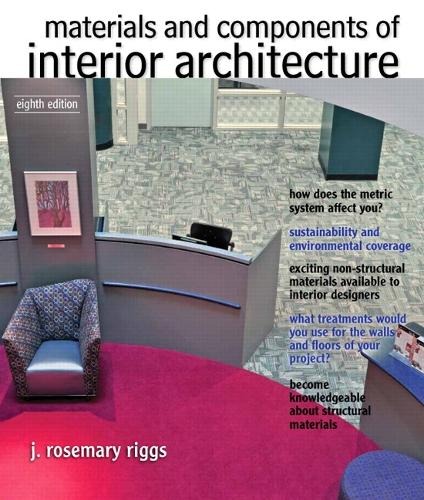
Materials and Components of Interior Architecture
Offers a unique look at interior design,fully covering the exciting breadth of nonstructural materials available to interior designers. With an eye on the environment, it instills a firm understanding of the products, properties, and uses of all materials—from floors, walls, and ceilings to installation and recycling. Going beyond paint and carpet, it explores over 27 different floorings and devotes separate chapters to kitchens and baths. Filled with the latest information from manufacturers, suppliers, and associations, it provides students with the knowledge to creatively engage the “nuts and bolts” of interior design—both in terms of structure and style.

Material Properties under Intensive Dynamic Loading
Understanding the physical and thermomechanical response of materials subjected to intensive dynamic loading is a challenge of great significance in engineering today. This volume assumes the task of gathering both experimental and diagnostic methods in one place, since not much information has been previously disseminated in the scientific literature. This book will thus be an invaluable companion for both the seasoned practioner as well as for the novice entering the field of experimental shock physics.

Material Flow Management : Improving Cost Efficiency and Environmental Performance
The implementation of material flow management offers enterprises a high potential for realizing new economic competitive advantages. The eco-efficient optimization of material flows aims at reducing costs while simultaneously achieving long-term sustainability with regard to ecological and societal aspects. Knowledge of existing methods and the latest trends is a key prerequisite for successfully implementing, refining and disseminating material flow management approaches.

Matematica e cultura in Europa
Non è vero che la matematica susciti sempre poco interesse. Questa almeno è l'impressione che si ricava quando lo spunto per parlarne viene non solo dalla scienza e dalla tecnologia, ma anche dall'arte, dalla letteratura, dal cinema e dal teatro. Ce lo ha insegnato Michele Emmer con i suoi convegni Matematica e Cultura e lo abbiamo sperimentato a Bologna con le iniziative del 2000 per l'Anno Mondiale della Matematica e per Bologna Città Europea della Cultura. D’altra parte, negli ultimi anni abbiamo finalmente visto sullo schermo come protagonisti di film di successo dei matematici, non rappresentati come individui strani, ma come professionisti che svolgono il proprio lavoro, non necessariamente di insegnanti. Anche alcune opere teatrali di risonanza internazionale hanno parlato di matematici e questo ci ha spinto a organizzare per la prima volta in Italia, a Bologna, la rassegna Matematica e Teatro, che ha dato occasione non solo di assistere a spettacoli molto piacevoli, ma anche di parlare dei rapporti tra scienza, matematica e potere al tempo di Napoleone, di numeri primi, di teoria di Galois.

Matematica e cultura 2008 = mathematics and culture 2008
In this new book, the tenth of the series that began in Venice with the meetings "Mathematics and culture" that many have tried to imitate, we talk about all this and among others Simon Singh (author of the best seller "The last theorem di Fermat "), in her third presence in Venice, and Siobhan Roberts (author of" The king of infinite space. History of the man who saved geometry "). Venice bridge between mathematics and culture.

Matching Properties of Deep Sub-Micron MOS Transistors
Matching Properties of Deep Sub-Micron MOS Transistors examines this interesting phenomenon. Microscopic fluctuations cause stochastic parameter fluctuations that affect the accuracy of the MOSFET. For analog circuits this determines the trade-off between speed, power, accuracy and yield.

Mass Terms : Some Philosophical Problems
MASS TERMS, COUNT TERMS, AND SORTAL TERMS Central examples of mass terms are easy to come by. 'Water', 'smoke', 'gold', etc. , differ in their syntactic, semantic, and pragmatic properties from count terms such as 'man', 'star', 'wastebasket', etc. Syntactically, it seems, mass terms do, but singular count terms do not, admit the quantifier phrases 'much', 'an amount of', 'a little', etc. The typical indefinite article for them is 'some' (unstressed)!, and this article cannot be used with singular count terms. Count terms, but not mass terms, use the quantifiers 'each', 'every', 'some', 'few', 'many'; and they use 'a(n)' as the indefinite article. They can, unlike the mass terms, take numerals as prefixes.

Mass Extinction
The present book combines three main aspects: five major mass extinctions; contributions on some other minor extinctions; and more importantly contributions on the current mass extinction.

Marxist Philosophy in China : From Qu Qiubai to Mao Zedong, 1923-1945
The book sets the philosophical writings of philosophers in the context of the development of Marxist philosophy internationally, and examines particularly the influence on these philosophers of Soviet Marxist philosophy. It argues that these Chinese Marxist philosophers’ interpretations of Marxist philosophy were quite orthodox when judged by the standards of contemporary Soviet Marxism. The book explores core themes in Marxist philosophy in China, including the dilemma of determinism, and investigates the way in which these Chinese Marxist philosophers sought a formula for the ‘Sinification’ of Marxist philosophy that both retained the universal dimensions of Marxism and allowed its application to the Chinese context. The book concludes with analysis of the role of the Yanan New Philosophy Association in developing from Soviet Marxist philosophy the philosophical dimension of Mao Zedong Thought, the official ideology of the Chinese Communist Party after 1945.
Martingale Methods in Financial Modelling
This book provides a comprehensive, self-contained and up-to-date treatment of the main topics in the theory of option pricing. The first part of the text starts with discrete-time models of financial markets, including the Cox-Ross-Rubinstein binomial model. The passage from discrete- to continuous-time models, done in the Black-Scholes model setting, assumes familiarity with basic ideas and results from stochastic calculus. However, an Appendix containing all the necessary results is included. This model setting is later generalized to cover standard and exotic options involving several assets and/or currencies. An outline of the general theory of arbitrage pricing is presented. The second part of the text is devoted to the term structure modelling and the pricing of interest-rate derivatives. The main emphasis is on models that can be made consistent with market pricing practice.

Marswalk One : First Steps on a New Planet
MARSWALK ONE: First Steps on a New Planet addresses the question of why we should embark on a journey to Mars, documenting what the first human crew will do when they place their feet in the red dust of the planet. The book also addresses why we need to carry out these tasks and, more importantly, what a human crew could achieve that an automated mission could not. Understanding the clear benefits of sending a human crew to the surface of Mars, and how these benefits can be seen back on Earth, is the key to sustained long-term public and political support for the programme in terms of cash and commitment. The book accepts that the journey will be made, but does not specify precisely when. Flight time, and how to get to and from the planet are discussed briefly, to understand why the suggested duration spent at Mars is reasonable. The main objective of the work is to look at what science will be done on the surface – supported by orbital operations – and what hardware and technology will be employed to achieve the mission objectives. This analysis is drawn from previous experiences in manned and unmanned space programmes, including Apollo, Skylab, Salyut/Mir, Shuttle and ISS, Viking, Luna/Lunokhod, and recent Mars missions such as Pathfinder and Global Surveyor.
Marketing 5.0 : Technology for Humanity
Explains the greatest problem facing marketers today how to integrate three major movements that are changing global markets and customer behavior: Dramatic advances in technology such as AI, Sensors, and the Internet of Things, which are enabling extreme forms of customer targeting and personalization; Dramatic shifts in customer behavior, such as Whatever-Whenever-Wherever (WWW) and the differences between Generations X, Y, Z, and Alpha; And dramatic shifts in business models such as Everything as a Service, Physical/Digital business models.
