



الصفحة 22
الصفحة 22

Algorithms in Bioinformatics : Theory and Implementation
Explores a comprehensive and insightful treatment of the practical application of bioinformatic algorithms in a variety of fields. Delivers a fulsome treatment of some of the main algorithms used to explain biological functions and relationships. It introduces readers to the art of algorithms in a practical manner which is linked with biological theory and interpretation. The book covers many key areas of bioinformatics, including global and local sequence alignment, forced alignment, detection of motifs, Sequence logos, Markov chains or information entropy. Other novel approaches are also described, such as Self-Sequence alignment, Objective Digital Stains (ODSs) or Spectral Forecast and the Discrete Probability Detector (DPD) algorithm. Readers will also benefit from the inclusion of: A detailed presentation of new methods, such as Self-sequence alignment, Objective Digital Stains and Spectral Forecast ; A treatment of sequence alignment, including local sequence alignment, global sequence alignment and forced sequence alignment with full implementations ; Discussions of position-specific weight matrices, including the count, weight, relative frequencies, and log-likelihoods matrices ; A detailed presentation of the methods related to Markov Chains as well as a description of their implementation in Bioinformatics and adjacent fields ; An examination of information and entropy, including sequence logos and explanations related to their meaning ; A chapter on philosophical transactions that allows the reader a broader view of the prediction process ; Extensive worked examples with detailed case studies that point out the meaning of different results

AI in disease detection : Advancements and applications
Discusses the integration of artificial intelligence to revolutionize disease detection approaches, with case studies of AI in disease detection as well as insight into the opportunities and challenges of AI in healthcare as a whole. The book explores a wide range of individual AI components such as computer vision, natural language processing, and machine learning as well as the development and implementation of AI systems for efficient practices in data collection, model training, and clinical validation.

AI in banking : Practical applications and case studies
Delves into the application of AI from theory to practice, offering detailed insights into AI project design and code implementation across eleven business scenarios in four major sectors: retail banking, e-banking, bank credit, and tech operations. it provides hands-on examples of various technologies, including automatic machine learning, integrated learning, graph computation, recommendation systems, causal inference, generative adversarial networks, supervised learning, unsupervised learning, computer vision, reinforcement learning, fuzzy control, automatic control, speech recognition, semantic understanding, bayesian networks, edge computing, and more. this book stands as a rare and practical guide to AI projects in the banking industry.
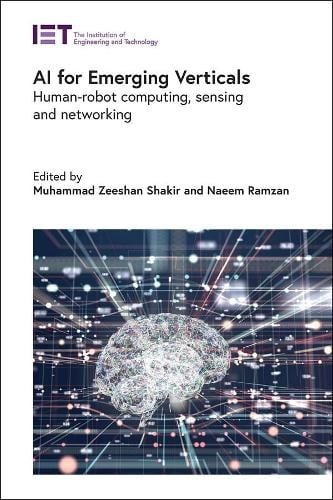
AI For Emerging Verticals : Human-robot computing, sensing and networking
Artificial intelligence (AI) and machine learning (ML) will play a major role. By adopting AI software and services, businesses can create predictive strategies, enhance their capabilities, better interact with customers, and streamline their business processes. Explores novel concepts and cutting-edge research and developments towards designing these fully automated advanced digital systems. Fostered by technological advances in artificial intelligence and machine learning, such systems potentially have a wide range of applications in robotics, human computing, sensing and networking. The chapters focus on models and theoretical approaches to guarantee automation in large multi-scale implementations of AI and ML systems; protocol designs to ensure AI systems meet key requirements for future services such as latency; and optimisation algorithms to leverage the trusted distributed and efficient complex architectures.

Agent-oriented software engineering VI ; 6th International Workshop, AOSE 2005, Utrecht, The Netherlands, July 25, 2005. Revised and Invited Papers
This book represents the thoroughly refereed post-proceedings of the 6th International Workshop on Agent-Oriented Software Engineering, AOSE 2005, held in Utrecht, The Netherlands, in July 2005 as part of AAMAS 2005. The 18 revised full papers were carefully selected from 35 submissions during two rounds of reviewing and improvement. The papers are organized in topical sections on modeling tools, analysis and validation tools, multiagent systems design, implementation tools, and experiences and comparative evaluations.

Agent-oriented software engineering V ; 5th International workshop, AOSE 2004, New York, NY, USA, July 2004, revised selected papers
The explosive growth of application areas such as electronic commerce, ent- prise resource planning and mobile computing has profoundly and irreversibly changed our views on software systems. Nowadays, software is to be based on open architectures that continuously change and evolve to accommodate new components and meet new requirements. Software must also operate on di?- ent platforms, without recompilation, and with minimal assumptions about its operating environment and its users. Furthermore, software must be robust and ¨ autonomous, capable of serving a naive user with a minimum of overhead and interference. Agent concepts hold great promise for responding to the new realities of software systems. They o?er higher-level abstractions and mechanisms which address issues such as knowledge representation and reasoning, communication, coordination, cooperation among heterogeneous and autonomous parties, p- ception, commitments, goals, beliefs, and intentions, all of which need conceptual modelling. On the one hand, the concrete implementation of these concepts can lead to advanced functionalities.

Agent-oriented information systems II ; 6th International bi-conference workshop, AOIS 2004, Riga, Latvia, June 8, 2004 and New York, NY, USA, July 20, 2004, revised selected papers
Information systems have become the backbone of all kinds of organizations - day. In almost every sector – manufacturing, education, health care, government and businesses large and small – information systems are relied upon for - eryday work, communication, information gathering and decision-making. Yet, the in?exibilities in current technologies and methods have also resulted in poor performance, incompatibilities and obstacles to change. As many organizations are reinventing themselves to meet the challenges of global competition and e-commerce, there is increasing pressure to develop and deploy new technologies that are ?exible, robust and responsive to rapid and unexpected change. Agent concepts hold great promise for responding to the new realities of - formation systems. They o?er higher-level abstractions and mechanisms which address issues such as knowledge representation and reasoning, communication, coordination, cooperation among heterogeneous and autonomous parties, p- ception, commitments, goals, beliefs, intentions, etc., all of which need conc- tual modelling. On the one hand, the concrete implementation of these concepts can lead to advanced functionalities.

Agent-based Supply Network Event Management
Supply Chain Event Management (SCEM)" is one of the major topics in application-oriented Supply Chain Management. However, many solutions lack conceptual precision and currently available client-server SCEM-systems are ill-suited for complex supply networks in today's business environment,In this book a thorough analysis of the event management problem domain is the starting point to develop a generic agent-based approach to Supply Network Event Management. The concept is illustrated with prototypical implementations and assessed in a multi-dimensional evaluation of potential benefits. The main focus lies on practical issues of event management (e.g. semantic interoperability) and economic benefits to be achieved with agent technology in this state-of-the-art problem domain.

Advancing Social Simulation: The First World Congress
Agent-based modeling and social simulation have emerged as both developments of and challenges to the social sciences. The developments include agent-based computational economics and investigations of theoretical sociological concepts using formal simulation techniques. Among the challenges are the development of qualitative modeling techniques, implementation of agent-based models to investigate phenomena for which conventional economic, social, and organizational models have no face validity, and the application of physical modeling techniques to social processes. Bringing together diverse approaches to social simulation and research agendas.
Advances in web based learning -- ICWL 2006 ; 5th International conference, Penang, Malaysia, July 19-21, 2006, Revised Papers
The conference program was organized in a single-track 3-day workshop. It included a tutorial, a keynote talk, and oral/poster paper presentations in several sessions dedicated to specific topics. Session topics included “Personalization in E-Learning,” “Designs, Model and Framework of E-Learning Systems,” “Implementations and Evaluations of E-Learning Systems,” “Tools in E-Learning,” and “Learning Resource Deployment, Organization and Management. ” We received a total of 99 submissions from all over the world.

Advances in pharma business management and research ; Vol. 1
This book presents a unique collection of practical examples from the field of pharma business management and research. It covers a wide range of topics such as: 'Brexit and its Impact on pharmaceutical Law - Implications for Global Pharma Companies', 'Implementation of Measures and Sustainable Actions to Improve Employee's Engagement', 'Global Medical Clinical and Regulatory Affairs (GMCRA)', and 'A Quality Management System for R&D Project and Portfolio Management in a Pharmaceutical Company'.

Advances in Metaheuristics for Hard Optimization
The book gathers contributions related to the following topics: theoretical developments in metaheuristics; adaptation of discrete metaheuristics to continuous optimization; performance comparisons of metaheuristics; cooperative methods combining different approaches; parallel and distributed metaheuristics for multiobjective optimization; software implementations; and real-world applications.
Advances in Knowledge Discovery and Data Mining ; 6th Pacific-Asia Conference, PAKDD 2002, Taipei, Taiwan, May 6-8, 2002 : Proceedings
Knowledge discovery and data mining have become areas of growing significance because of the recent increasing demand for KDD techniques, including those used in machine learning, databases, statistics, knowledge acquisition, data visualization, and high performance computing. In view of this, and following the success of the five previous PAKDD conferences, the sixth Pacific-Asia Conference on Knowledge Discovery and Data Mining (PAKDD 2002) aimed to provide a forum for the sharing of original research results, innovative ideas, state-of-the-art developments, and implementation experiences in knowledge discovery and data mining among researchers in academic and industrial organizations. Much work went into preparing a program of high quality. We received 128 submissions.

Advances in Intelligent Web Mastering ; Proceedings of the 5th Atlantic Web Intelligence Conference – WIC’2007, Fontainebleau, France, June 25 – 27, 2007
Mastering and effective exploration of the web environment needs new ideas, adaptation of known methods as well as application of sophisticated and robust technical implementations. Among new research directions present in relation to Web applications, a remarkable place is occupied by intelligent methods defining the topic of soft computing. This edited book includes reports from the front of diverse fields of the Web: application of artificial intelligence, design, information retrieval and interpretation, user profiling, security, engineering, etc. The material has been presented at the 5th Atlantic Web Intelligence Conference – AWIC’2007 held in Fontainbleau (France) and organized by Esigetel, Technical University of Lodz, and Polish Academy of Sciences.

Advances in Image and Video Technology ; 1st Pacific Rim Symposium, PSIVT 2006, Hsinchu, Taiwan, December 10-13, 2006, Proceedings
The conference of the 1st IEEE Pacisc-Rim Symposium on Image and Video Technology (PSIVT 2006) was held at Hsinchu, Taiwan, Republic of China, on December 11–13, 2006. This volume contains papers selected for presentation at this conference. The aim of this conference was to bring together theoretical advances and practical implementations contributing to, or being involved in, image and video technology. PSIVT 2006 featured a comprehensive program including tutorials, keynote and invited talks, oral paper presentations, and posters. We received 450 s- missions from 22 countries and accepted 141 papers among those (i.e., de?ning an acceptance rate of 31.3%). The intention was to establish PSIVT as a t- quality series of symposia. Decisions were discult sometimes, but we hope that the ?nal result is acceptable to all involved.

Advances in fuzzy logic systems
Fuzzy logic systems have been a hot topic in the scientific and academic community for more than half a century. The idea of making machines behave and make decisions like humans do is astounding. The development and implementation of fuzzy logic systems can be seen in various real physical applications in daily human life. The methods employed using fuzzy logic have resulted in innovative technologies. This book provides insights into understanding the principles and concepts behind the advances of fuzzy logic systems. It presents ideas concerning fuzzy logic systems and their technological applications. The book is arranged into two sections on theories and foundations of fuzzy logic systems and implementations of fuzzy logic systems in service to the community.

Advances in Data and Web Management ; Joint 9th Asia-Pacific Web Conference, APWeb 2007, and 8th International Conference on Web-Age Information Management, WAIM 2007, Huang Shan, China, June 16-18, 2007, Proceedings
The rapid prevalence of Web applications requires new technologies for the - sign, implementation and management of Web-based information systems, and for the management and analysis of information on the Web.This book drew research and industrial papers on the theory, design and implementation of Web-based information systems and on the m- agement and analysis of information on the Web.

Advances in cryptology - EUROCRYPT 90 ; Workshop on the theory and application of cryptographic techniques, Aarhus, Denmark, May 21-24, 1990. Proceedings
Eurocrypt is a conference devoted to all aspects of cryptologic research, both theoretical and practical, sponsored by the International Association for Cryptologic Research (IACR). Eurocrypt 90 took place in Åarhus, Denmark, in May 1990. From the 85 papers submitted, 42 were selected for presentation at the conference and for inclusion in this volume. In addition to the formal contributions, short abstracts of a number of informal talks are included in these proceedings. The proceedings are organized into sessions on protocols, number-theoretic algorithms, boolean functions, binary sequences, implementations, combinatorial schemes, cryptanalysis, new cryptosystems, signatures and authentication, and impromptu talks.

Advances in cryptology – ASIACRYPT 2007 ; 13th International conference on the theory and application of cryptology and information security, Kuching, Malaysia, December 2-6, 2007, Proceedings
The book are organized in topical sections on number theory and elliptic curve, protocol, hash function design, group/broadcast cryptography, mac and implementation, multiparty computation, block ciphers, foundation, public key encryption, and cryptanalysi.
Advances in Building Information Modeling ; 1st Eurasian BIM Forum, EBF 2019, Istanbul, Turkey, May 31, 2019, Revised Selected Papers
Constitutes the refereed proceedings of the First Eurasian BIM Forum, EBF 2019, held in Istanbul, Turkey, in May 2019. The 16 full papers were carefully reviewed and selected from 44 submissions. The papers cover such topics as BIM adoption and implementation; BIM for project management; BIM for sustainability and performative design; BIM and facility management and infrastructural issues.
