



الصفحة 16
الصفحة 16
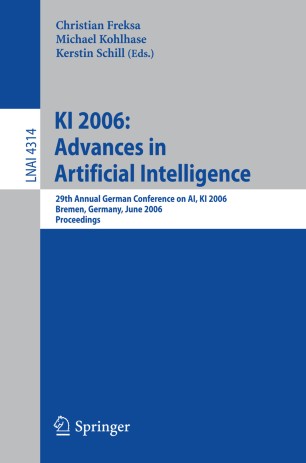
KI 2006 ; 29th Annual German Conference on AI, KI 2006, Bremen, Germany, June 14-17, 2006, Proceedings
Constitutes the thoroughly refereed post-proceedings of the 29th Annual German Conference on Artificial Intelligence, KI 2006, held in Bremen, Germany, in June 2006. This was co-located with RoboCup 2006, the innovative robot soccer world championship, and with ACTUATOR 2006, the 10th International Conference on New Actuators.

KI 2005 : Advances in Artificial Intelligence ; 28th Annual German Conference on AI, KI 2005, Koblenz, Germany, September 11-14, 2005, Proceedings
Constitutes the refereed proceedings of the 28th Annual German Conference on Artificial Intelligence, KI 2005, held in Germany. This work presents papers organized in topical sections on knowledge representation and reasoning, machine learning, diagnosis, neural networks, planning, robotics, and cognitive modeling, philosophy, natural language.

IUTAM Symposium on Multiscale Problems in Multibody System Contacts ; Proceedings of the IUTAM Symposium held in Stuttgart, Germany, February 20–23, 2006
The investigation of multiscale problems in multibody system contacts is an interesting and timely topic which has been the subject of intensive research. This proceedings volume summarizes contributions of many authors active in the field and gives insight in very different areas of this fascinating research.

IUTAM Symposium on Mechanics and Reliability of Actuating Materials ; Proceedings of the IUTAM Symposium held in Beijing, China, 1-3 September, 2004
The general assembly of IUTAM approved in August, 2002 at Cambridge University, UK, a proposal to hold an IUTAM symposium to summarize the relevant research findings. The main themes of the symposium are: (i) the constitutive relations of actuating materials that couple mechanical, electrical, thermal and magnetic properties, as well as incorporate phase transformation and domain switch; (ii) the physical mechanisms of deformation, damage, and fatigue crack growth of actuating materials; (iii) the development of failure-resilient approaches that base on the macro-, meso-, and micro-mechanics analyses; (iv) the investigation of microstructural evolution, stability of phase transformation, and size effects of ferroelectric ceramics, shape memory alloys, actuating polymers, and bio-actuating materials.
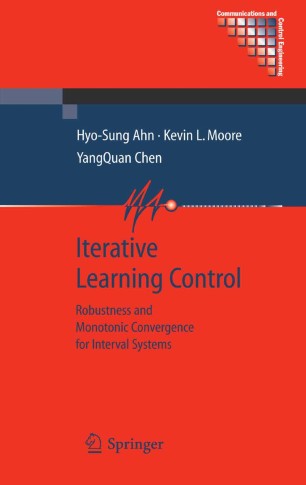
Iterative Learning Control : Robustness and Monotonic Convergence for Interval Systems
This monograph studies the design of robust, monotonically-convergent iterative learning controllers for discrete-time systems. Two key problems with the fundamentals of iterative learning control (ILC) design as treated by existing work are: first, many ILC design strategies assume nominal knowledge of the system to be controlled and; second, it is well-known that many ILC algorithms do not produce monotonic convergence, though in applications monotonic convergence is often essential. Iterative Learning Control takes account of the recently-developed comprehensive approach to robust ILC analysis and design established to handle the situation where the plant model is uncertain. Considering ILC in the iteration domain, it presents a unified analysis and design framework that enables designers to consider both robustness and monotonic convergence for typical uncertainty models, including parametric interval uncertainties, iteration-domain frequency uncertainty, and iteration-domain stochastic uncertainty.

Computational and Ambient Intelligence ; 9th International Work-Conference on Artificial Neural Networks, IWANN 2007, San Sebastián, Spain, June 20-22, 2007, Proceedings
This biennial meeting focuses on the foundations, theory, models and applications of systems inspired by nature (neural networks, fuzzy logic and evo- tionary systems).These new computational techniques are used in applications that try to bring a new situation of well-being to the user. The conjunction of a more and more miniaturized hardware together with the growing computational intelligence embodied in this hardware leads us towards fully integrated embedded systems-on- chip and opens the door for truly ubiquitous electronics.
Complex-valued neural networks
This book is the first monograph ever on complex-valued neural networks, which lends itself to graduate and undergraduate courses in electrical engineering, informatics, control engineering, mechanics, robotics, bioengineering, and other relevant fields. It is useful for those beginning their studies, for instance, adaptive signal processing for highly functional sensing and imaging, control in unknown and changing environment, brainlike information processing, robotics inspired by human neural systems, and interdisciplinary studies to realize comfortable society. It is also helpful to those who carry out research and development regarding new products and services at companies.
Complex Medical Engineering
In the twenty-first century, applications in medicine and engineering must acquire greater safety and flexibility if they are to yield better products at higher efficiency. To this end, complex science and technology must be integrated in medicine and engineering. Complex medical engineering (CME) is a new field that merges medical science and technology, and includes biomedical robotics and biomechatronics, complex virtual technology in medicine, information and communication technology in medicine, complex technology in rehabilitation, cognitive neuroscience and technology, and complex bioinformatics. Experts from academia, industry, and government research laboratories who have pioneered CME ideas and technologies describe its concept and research approach and discuss related hardware and software, science and technology, and medicine and engineering. This book will be invaluable to scientists, researchers, and graduates in the emerging field of CME.
Complex Engineered Systems : Science Meets Technology
This volume examines the difficulties that arise in creating highly complex engineered systems and new approaches that are being adopted. Topics addressed range from the formal representation and classification of distributed networked systems to revolutionary engineering practices inspired by biological evolution. By bringing together the latest research in Complex Engineered Systems, this book sheds light on the current state and future course of this emerging field.

Climbing and Walking Robots ; Proceedings of the 7th International Conference CLAWAR 2004
This book contains the proceedings of the 7th Climbing and Walking Robots 2004 (CLAWAR 2004) Conference offering the international scientific community one of the most excellent forums for academics, researchers and industrialists interested in this motivating area of climbing and walking robots. It provides a wide forum of original state-of-the-art contributions from various industrial and new/emerging research fields, presenting a full picture of climbing and walking robots.

Cellular automata ; 7th International conference on cellular automata for research and industry, ACRI 2006, Perpignan, France, September 20-23, 2006, Proceedings
This book constitutes the refereed proceedings of the 7th International Conference on Cellular Automata for Research and Industry, ACRI 2006. The book presents 53 revised full papers and 19 revised poster papers together with 6 invited lectures. Topical sections include CA theory and implementation, computational theory, population dynamics, physical modeling, urban, environmental and social modeling, traffic and boolean networks, multi-agents and robotics, as well as crowds and cellular automata, and more.

Cells and Robots : Modeling and Control of Large-Size Agent Populations
Cells and Robots is an outcome of the multidisciplinary research extending over Biology, Robotics and Hybrid Systems Theory. It is inspired by modeling reactive behavior of the immune system cell population, where each cell is considered as an independent agent. In our modeling approach, there is no difference if the cells are naturally or artificially created agents, such as robots. This appears even more evident when we introduce a case study concerning a large-size robotic population scenario. Under this scenario, we also formulate the optimal control of maximizing the probability of robotic presence in a given region and discuss the application of the Minimum Principle for partial differential equations to this problem. Simultaneous consideration of cell and robotic populations is of mutual benefit for Biology and Robotics, as well as for the general understanding of multi-agent system dynamics.The text of this monograph is based on the PhD thesis of the first author. The work was a runner-up for the fifth edition of the Georges Giralt Award for the best European PhD thesis in Robotics, annually awarded by the European Robotics Research Network (EURON).

Case-Based Reasoning Research and Development ; 7th International Conference on Case-Based Reasoning, ICCBR 2007 Belfast Northern Ireland, UK, August 13-16, 2007 Proceedings
It presented along with three invited talks. The sections address all aspects of case-based reasoning, featuring original theoretical research, applied research, and applications with practical, social, environmental, and economic significance.
Cartesian Impedance Control of Redundant and Flexible-Joint Robots
This monograph is devoted to the classical topic of impedance control, which has recently seen renewed interest following advances in the mechanical design of lightweight robotic systems with improved actuation and sensing capabilities.

Business Technology Incubator = حاضنة الأعمال التكنولوجية
حاضنات الأعمال تقوم بتبني ابتكارات الريادين وقدراتهم وتوجيهها نحو المسار الذي يوائم صفاتهم وقدراتهم، ونقل التكنولوجيا والخبرات لتتقاسمها مع شركات جديدة يقودها شباب مبدع يحتاج لكافة أ نواع الدعم. وتقدم حاضنات الأعمال بأ نواعها المختلفة العديد من الأفكار لدعم رواد الأعمال، وأ داة لتسريع الابتكار في الأعمال، وذلك من خلال احتضان الطاقات البشرية القادرة على العمل والابداع، اإذن تعد حاضنات الأعمال أ داة لتمكين الشباب من المبدعين من رواد ال عمال من إيجاد مشروعات مبتكرة ذات قيمة مضافة، تطوير مشاريع الاعمال الصغيرة والمتوسط وحل كافة المشاكل التي تواجهها في مرحلة التأ سيس لذا أ صبحت أ كثر الاقتصاديات نجاحا هي تلك القادرة على خلق مزيج من رواد الأعمال المبتكرين والشركات والمؤسسات الكبيرة

Bluetooth based indoor location positioning system for mobile robot navigation
Positioning objects has been an important topic since it’s needed to locate people, guide them to a certain place, and assist companies and organizations with their assets management. Great applicational opportunities emerge based on the inquiry of Received Signal Strength Indicator (RSSI). In this research, a positioning system using Bluetooth RSSI is proposed for indoor applications. First, RSSI values are inquired multiple times and the average is taken at multiple points of different distances from the transmitters. Then the distance is determined by the variations of RSSI values respectively to distance variations. Finally, a triangulation algorithm is used to calculate the current location of the receiver.
Biomimicry for Optimization, Control, and Automation
In this book, we focus onhowtousebiomimicryof the functionaloperationofthe “hardwareandso- ware” of biological systems for the development of optimization algorithms and feedbackcontrolsystemsthatextendourcapabilitiestoimplementsophisticated levels of automation. The primary focus is not on the modeling, emulation, or analysis of some biological system. The focus is on using “bio-inspiration” to inject new ideas, techniques, and perspective into the engineering of complex automation systems. There are many biological processes that, at some level of abstraction, can berepresentedasoptimizationprocesses,manyofwhichhaveasa basicpurpose automatic control, decision making, or automation.
Biomimetic neural learning for intelligent robots : Intelligent systems, cognitive robotics, and neuroscience
This book presents research performed as part of the EU project on biomimeticmultimodal learning in a mirror neuron-based robot (MirrorBot) and contribu-tions presented at the International AI-Workshop on NeuroBotics. The over-all aim of the book is to present a broad spectrum of current research intobiomimetic neural learning for intelligent autonomous robots. In this book we show the development of newtechniques using cell assemblies, associative neural networks, and Hebbian-typelearning in order to associate vision, language and motor concepts. We havedeveloped biomimetic multimodal learning and language instruction in a robotto investigate the task of searching for objects. As well as the research performedin this area for the MirrorBot project, the second part of this book incorporatessignificant contributions from other research in the field of biomimetic robotics.This second part of the book concentrates on the progress made in neuroscienceinspired robotic learning approaches (in short: NeuroBotics). We hope that this book stimulates and encourages new research in this in-teresting and dynamic area.
Bio-mechanisms of swimming and flying ; Fluid dynamics, biomimetic robots, and sports science
This book follows "Bio-mechanisms of Animals in Swimming and Flying" published in 2004 including 11 chapters. This time, the book includes 31 chapters on the latest researches into natural autonomous systems and locomotion in both flying and swimming organisms. The area of sports science such as analysis and simulation of human swimming is newly added. The computational frameworks for the modeling, simulation and optimization of animals in swimming and flying demonstrate an important role in the progress of interdisciplinary work in the fields of biology and engineering. An innovative technology is exhibited for the flight of an insect size micro air vehicle. Neuronal science is not only unveiling the locomotion mechanisms of swimming in fish from the aspect of the neuronal activities, but also applied to underwater biomimetic robots. The interdisciplinary works are exhibited in the fields of biology and engineering, yielding real-world benefits in innovative technologies.
Biology and Control Theory : Current Challenges
Creating some links between control feedback and biology modeling communities based on similarities in modeling, observing and perceiving alive structures, and analyzing interconnections between biological structures and subsystems was the main objective of this volume. The idea of this book was conceived in the context mentioned above with the objective to help in claiming many of the problems for control researchers, starting discussions and opening interactive debates between the control and biology communities, and, finally, to alert graduate students to the many interesting ideas at the frontier between control feedback theory and biology.
