



الصفحة 14
الصفحة 14

Advances in biometric person authentication ; 5th Chinese conference on biometric recognition, SINOBIOMETRICS 2004, Guangzhou, China, December 13-14, 2004, Proceedings
Aimed at promoting the international exchange of ideas and providing an opportunity for keeping abreast of the latest developments in biometric algorithms, systems, and applications. The 1st Biometrics Verification Competition (BVC) on face, iris, and fingerprint recognition was also conducted in conjunction with the conference. This book is composed of 74 papers presented at Sinobiometrics 2004,

Advances in Automatic Differentiation
Covers advances in automatic differentiation theory and practice. Computer scientists and mathematicians will learn about recent developments in automatic differentiation theory as well as mechanisms for the construction of robust and powerful automatic differentiation tools. Computational scientists and engineers will benefit from the discussion of various applications, which provide insight into effective strategies for using automatic differentiation for inverse problems and design optimization.

Advances in 3D Geo Information Systems
The individual papers represent a valuable collection of information on the current state-of-the-art research in the field of 3D geoinformation. It covers a range of these challenges, collected under the themes of Applications, Acquisition, Modelling, Analysis and Visualisation. The main strength of the collection concerns the data modelling and DBMS implementation issues with 3D GIS.

Advanced studies in biometrics : Summer School on biometrics, Alghero, Italy, June 2-6, 2003. Revised Selected Lectures and Papers
This book originates from an international summer school on biometrics, held in Alghero, Italy, in June 2003. The seven revised tutorial lectures by leading researchers introduce the reader to biometrics-based person authentication, fingerprint recognition, gait recognition, various aspects of face recognition and face detection, topologies for biometric recognition, and hand detection. Also included are the four best selected student papers, all dealing with face recognition.

Advanced Intelligent Computing Theories and Applications. With Aspects of Contemporary Intelligent Computing Techniques ; 4th International Conference on Intelligent Computing, ICIC 2008 Shanghai, China, September 15-18, 2008 Proceedings
Constitutes the refereed proceedings of the Fourth International Conference on Intelligent Computing, ICIC 2008, held in Shanghai, China in September 2008.

AdvancED Flex 3
Divided into three parts. The first part discusses the architectural and design aspects of Flex 3 application development. It explains the internals of a Flex 3 application and advocates a few best practices to fine-tune your application to ensure maximum performance. It includes tutorials on creating custom components, data binding, and creating AIR-powered desktop applications. The second part concentrates on effectively integrating Flex 3 with server- and client-side technologies. Techniques for integration with Java and PHP are covered in detail, and content covering interaction with client-side technologies is also included. After reading the chapter on JavaScript integration, you will be ready to create applications that can use Ajax and Flex 3 together. The third and final part of the book is a unique and eclectic mix of some advanced topics like mash-ups, collaborative applications, 3D rendering, highly interactive visualization, and audio and video streaming.

Advanced Concepts for Intelligent Vision Systems ; Vol. 4179 ; 8th International Conference, ACIVS 2006, Antwerp, Belgium, September 18-21, 2006, Proceedings
This book constitutes the refereed proceedings of the 8th International Conference on Advanced Concepts for Intelligent Vision Systems, ACIVS 2006, held in Antwerp, Belgium in September 2006. The 45 revised full papers and 65 revised poster papers presented were carefully reviewed and selected from around 242 submissions. The papers are organized in topical sections on noise reduction and restoration, segmentation, motion estimation and tracking, video processing and coding, camera calibration, image registration and stereo matching, biometrics and security, medical imaging, image retrieval and image understanding, as well as classification and recognition.

Adult stem cells : Methods and protocols
Expands on the previous edition with updated chapters covering a broader range of tissues and techniques pertaining to stem cell technologies. The chapters also cover topics such as the generation of iPSC-derived cells unique to the individual human genome addressing the possibility of more personalized clinical applications to an individual with a specific degenerative disease; and the use of nanoparticles such as 3D scaffolds and biomaterials as a means of improving stem cell viability after transplantation in the host tissue. Written in the highly successful Methods in Molecular Biology series format, chapters include introductions to their respective topics, lists of the necessary materials and reagents, step-by-step, readily reproducible laboratory protocols, and tips on troubleshooting and avoiding known pitfalls.

Adaptive Multimedia Retrieval : User, Context, and Feedback ; 4th International Workshop, AMR 2006, Geneva, Switzerland, July, 27-28, 2006, Revised Selected Papers
This book constitutes the thoroughly refereed post-proceedings of the 4th International Workshop on Adaptive Multimedia Retrieval, AMR 2006, held in Geneva, Switzerland in July 2006. this book provides a good and conclusive overview of the current research in the area of adaptive information retrieval.
Active Sensor Planning for Multiview Vision Tasks
Describes some effective strategies to generate a sequence of viewing poses and sensor settings for optimally completing a perception task. Several methods are proposed to solve the problems in both model-based and nonmodel-based vision tasks. For model-based applications, the method involves determination of the optimal sensor placements and a shortest path through these viewpoints for automatic generation of a perception plan.

Active Rheology Control of Cementitious Materials
The research presented here develops a new method of actively controlling the rheology of fresh concrete during casting operations by incorporating specially designed responsive components. This results in real-time changes to the rheological behaviour of the cementitious material, allowing the user to intervene actively after the cementitious material has left the mixing phase. This newly gained agility contributes to increased processing speed and placement reliability in the case of traditional casting methods and can also facilitate advanced 3D concrete printing. The different routes followed to achieve this Active Rheology Control are explained within.

A Beginner's Guide to Sketching Buildings & Landscapes : Perspective and Proportions for Drawing Architecture, Gardens and More! (With over 500 illustrations)
Provides dozens of examples showing you how to establish accurate perspective guidelines and proportions for your initial pencil sketches, setting your drawings up to succeed right from the start. If a sketch's perspective and proportions are correct, your finished work will look crisp and beautiful. If not, you'll have a frustrating time trying to correct the problems at a later stage--and the finished work will never look quite right. A Beginner's Guide to Sketching Buildings & Landscapes is here to help you avoid those frustrations and set up your composition for a finished piece that will make you proud. The detailed step-by-step lessons in this indispensable guide teach you how to: Establish a composition's point of view correctly / Locate the horizon line, dividing land and sky / Break down complicated scenes into simple component shapes / Create the right relationship between foreground and background / Express 3D imagery using 2-point and 3-point perspective
3D-Position Tracking and Control for All-Terrain Robots
Rough terrain robotics is a fast evolving field of research and a lot of effort is deployed towards enabling a greater level of autonomy for outdoor vehicles. This book demonstrates how the accuracy of 3D position tracking can be improved by considering rover locomotion in rough terrain as a holistic problem. In this work, a mechanical structure allowing smooth motion across obstacles with limited wheel slip is used. In particular, it enables the use of odometry and inertial sensors to improve the position estimation in rough terrain. A method for computing 3D motion increments based on the wheel encoders and chassis state sensors is developed. The algorithm runs online and can be adapted to any kind of passive wheeled rover. Finally, sensor fusion using 3D-Odometry, inertial sensors and visual motion estimation based on stereovision is presented. The experimental results demonstrate how each sensor contributes to increase the accuracy and robustness of the 3D position estimation.
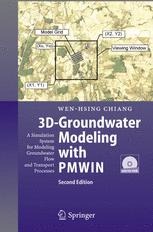
3D-groundwater modeling with PMWIN : A simulation system for modeling groundwater flow and transport processes
Along with a companion full-version software (PMWIN), this text offers an integrated simulation system. PMWIN comes with a professional graphical user-interface, supported models and programs and several other useful modeling tools. The graphical user-interface allows one to create and simulate models.

3-D Shape Estimation and Image Restoration : Exploiting Defocus and Motion-Blur
Images contain information about the spatial properties of the scene they depict. When coupled with suitable assumptions, images can be used to infer three-dimensional information. This useful volume concentrates on motion blur and defocus, which can be exploited to infer the 3-D structure of a scene—as well as its radiance properties—and which in turn can be used to generate novel images with better quality. 3-D Shape Estimation and Image Restoration presents a coherent framework for the analysis and design of algorithms to estimate 3-D shape from defocused and motion blurred images, and to eliminate defocus and motion blur to yield "restored" images. It provides a collection of algorithms that are optimal with respect to the chosen model and estimation criterion.

3D Segmentation for medical images (OsteoVision) = التقطيع ثلاثي الأبعاد للصور الطبية
With the increasing integration of AI across various sectors, artificial intelligence (AI) is already playing a significant role in the healthcare industry, and its use is expected to grow further. AI systems used in image processing and computer vision algorithms have shown a significant ability to perform many operations such as segmentation, classification, and detection. This project presents the application of computer vision algorithms in the field of medical imaging for diagnostic, therapeutic, and interventional purposes. This thesis explores the use of several computer vision algorithms to address different pathologies, specifically brain tumors (glioma) (see Appendix A) and knee osteoarthritis (OA), as well as tracking the progression of knee osteoarthritis using the Kellgren and Lawrence (KL) grading system, a common method for classifying the severity of OA into five grades. To achieve the desired impact, the project employs various techniques, including 3D segmentation for brain tumors, 2D segmentation for knee joints, and multinomial classification for determining the severity of knee OA injuries. The primary aims of the project are to enhance diagnostic accuracy, assist in creating treatment plans, provide an assistive tool for healthcare providers to make more informed decisions, leverage AI's capabilities to detect abnormalities that might escape the human eye, and streamline workflow. To facilitate these goals, the project incorporates a user-friendly UI, a website, and a Flutter-based mobile application, enabling healthcare providers to efficiently integrate these tools into their practice and improve patient care.

3D Recording and Interpretation for Maritime Archaeology
Includes recording and analysis of maritime archaeology through emerging technologies, including both practical and theoretical contributions. Topics include photogrammetric recording, laser scanning, marine geophysical 3D survey techniques, virtual reality, 3D modelling and reconstruction, data integration and Geographic Information Systems. This convergence of digital technologies such as underwater photography and photogrammetry, 3D sonar, 3D virtual reality, and 3D printing has highlighted a pressing need for these new methodologies to be considered together, both in terms of defining the state-of-the-art and for consideration of future directions.

3D Radiative Transfer in Cloudy Atmospheres
Assessing developments in three-dimensional cloud radiation, this volume treats two main application areas: the impact of clouds on the Earth's radiation budget, and remote observation of clouds. It is suitable for graduate students, researchers, and also for those interested in cloud-radiation processes in the solar and infrared spectral regions.
3D printing of pharmaceutical and drug delivery devices progress from bench to bedside
Discover the latest, fast-developing technology to help move towards more cost-effective, small-batch, decentralized manufacturing of personalized systems . 3D printing has revolutionized manufacturing. Its precision and flexibility have enabled the large-scale production of materials and devices too complex for conventional industrial manufacturing. This has been particularly revolutionary in the field of pharmaceutical production, where 3D printing is being integrated into the manufacture of both drugs and drug delivery devices. It has never been more important for industry professionals to understand this form of production.
3D Printing in Oral Health Science : Applications and Future Directions
Equips readers with a sound understanding of contemporary clinical applications in all fields of dentistry and their future directions. In the last few years, the development of 3D printing for medical and dental applications has increased tremendously. Advancements in 3D printing create the possibility of customized products, savings on small-scale productions, ease of sharing and processing of patient image data, and educational up-gradation. Looking at the dental specialties, it is evident that 3D printing has applications in all aspects of oral health science including prosthodontics, oral surgery, periodontics, endodontics, and orthodontics. This book will cover all major fields in dentistry and will help the practitioner in the process of decision-making and apply concepts in clinical or laboratory practice. It is based on current scientific evidence to provide readers with an up-to-date contemporary underst
