



Page 1
Page 1

Formal Modeling and Analysis of Timed Systems ; Vol.4202 ; 4th International Conference, FORMATS 2006, Paris, France, September 25-27, 2006, Proceedings
The aim of FORMATS is to promote the study of fundamental and practical aspects of timed systems, and to bring together researchers from di?erent d- ciplines that share interests in modelling and analysis of timed systems. In this volume, there are articles on: – Foundations and Semantics: contributions to the theoretical foundations of timed systems and timed formal languages as well as comparison between di?erentmodelsusedbydi?erentcommunities(timedautomata,timedPetri nets, timed MSCs, hybrid automata, timed process algebra, timed temporal logics, timed abstract state machines, as well as probabilistic models). – Methods and Tools: techniques, algorithms, data structures, and software toolsforanalyzingtimedsystemsandresolvingtemporalconstraints(mod- checking, simulation, robustness analysis, scheduling, etc).

Data Management. Data, Data Everywhere ; 24th British National Conference on Databases, BNCOD 24, Glasgow, UK, July 3-5, 2007, Proceedings
One of the most pressing challenges is to ?nd ways of evolving database technology to cope with its new role in underpinning the massively distributed and heterogeneous applications built on top of the Internet. This has afiected both the ways in which data has been accessed and the ways in which it is represented, with XML data management becoming an important issue and, as such, heavily represented at this conference. It has also brought back issues of performance that might have been considered largely solved by the improvements in hardware, since data now has to be managed on devices of low power and small memory as well as on standard client and powerful server machines. We therefore invited papers on all aspects of data management, particularly related to how dataisused in the ubiquitous environment of the modern Internet by complex distributed and scientific applications.
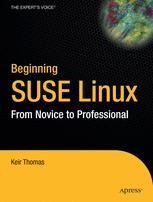
Beginning SUSE Linux : From novice to professional
The book begins by discussing the background of Linux and open source software, then proceeds to guide you through the SUSE installation process. You'll learn how to use the basic functions, and modify the look and feel according to your tastes. This book is packed with troubleshooting tips, so even the most cautious beginner will feel right at home. Next, the book covers the daily usage tasks that are enjoyable and interesting to learn. You'll learn how to configure your system to listen to audio CDs and MP3s, burn CDs, watch movies, connect to the Internet, and reproduce common Windows tasks.

Advances in web mining and web usage analysis ; 8th International workshop on knowledge discovery on the web, WebKDD 2006 Philadelphia, USA, August 20, 2006 Revised Papers
The discipline of data mining delivers methodologies and tools for the an- ysis of large data volumes and the extraction of comprehensible and non-trivial insights from them. Web mining, a much younger discipline, concentrates on the analysisofdata pertinentto the Web.Web mining methods areappliedonusage data and Web site content; they strive to improve our understanding of how the Web is used, to enhance usability and to promote mutual satisfaction between e-business venues and their potential customers.Many ofthe infancy problems in Web mining have been solvedby now, but the tremendous potential for new and improved uses, as well as misuses, of the Web are leading to new challenges.

Advances in web mining and web usage analysis ; 7th International workshop on knowledge discovery on the web, WEBKDD 2005, Chicago, IL, USA, August 21, 2005, Revised Papers
Thisbookcontainsthepostworkshopproceedingsofthe7thInternationalWo- shop on Knowledge Discovery from the Web, WEBKDD 2005. The WEBKDD workshop series takes place as part of the ACM SIGKDD International Conf- ence on Knowledge Discovery and Data Mining (KDD) since 1999. The discipline of data mining delivers methodologies and tools for the an- ysis of large data volumes and the extraction of comprehensible and non-trivial insights from them. Web mining, a much younger discipline, concentrates on the analysisofdata pertinentto theWeb.Web mining methods areappliedonusage data and Web site content; they strive to improve our understanding of how the Web is used, to enhance usability and to promote mutual satisfaction between e-business venues and their potential customers. In the last years, the interest for the Web as medium for communication, interaction and business has led to new challenges and to intensive, dedicated research. Many of the infancy problems in Web mining have now been solved but the tremendous potential for new and improved uses, as well as misuses, of the Web are leading to new challenges.
