



Page 1
Page 1

Nonlinear Analyses and Algorithms for Speech Processing ; International Conference on Non-Linear Speech Processing, NOLISP 2005, Barcelona, Spain, April 19-22, 2005, Revised Selected Papers
We present in this volume the collection of ?nally accepted papers of NOLISP 2005 conference. It has been the third event in a series of events related to N- linear speech processing, in the framework of the European COST action 277 “Nonlinear speech processing”. Many speci?cs of the speech signal are not well addressed by conv- tional models currently used in the ?eld of speech processing. The purpose of NOLISP is to present and discuss novel ideas, work and results related to alternative techniques for speech processing, which depart from mainstream approaches. With this intention in mind, we provide an open forum for discussion. Alt- nate approaches are appreciated, although the results achieved at present may not clearly surpass results based on state-of-the-art methods. The call for papers was launched at the beginning of 2005, addressing the following domains: 1. Non-Linear Approximation and Estimation 2. Non-Linear Oscillators and Predictors 3. Higher-Order Statistics 4. Independent Component Analysis 5. Nearest Neighbors 6. Neural Networks 7. Decision Trees 8. Non-Parametric Models 9. Dynamics of Non-Linear Systems 10. Fractal Methods 11. Chaos Modeling 12. Non-Linear Di?erential Equations 13. Others All the main ?elds of speech processing are targeted by the workshop, namely: 1. Speech Coding:Thebit rateavailablefor speechsignalsmustbe strictly l- ited in order to accommodate the constraints of the channel resource.

Fuzzy systems and knowledge discovery ; Vol. 3614 ; 2nd International Conference, FSKD 2005, Changsha, China, August 27-29, 2005, Proceedings, Part II
This book and its sister volume, LNAI 3613 and 3614, constitute the proce- ings of the Second International Conference on Fuzzy Systems and Knowledge Discovery (FSKD 2005), jointly held with the First International Conference on Natural Computation (ICNC 2005, LNCS 3610, 3611, and 3612) from - gust 27–29, 2005 in Changsha, Hunan, China. FSKD 2005 successfully attracted 1249 submissions from 32 countries/regions (the joint ICNC-FSKD 2005 received 3136 submissions). After rigorous reviews, 333 high-quality papers, i. e. , 206 long papers and 127 short papers, were included in the FSKD 2005 proceedings, r- resenting an acceptance rate of 26. 7%. The ICNC-FSKD 2005 conference featured the most up-to-date research - sults in computational algorithms inspired from nature, including biological, e- logical, and physical systems. It is an exciting and emerging interdisciplinary area in which a wide range of techniques and methods are being studied for dealing with large, complex, and dynamic problems. The joint conferences also promoted cross-fertilization over these exciting and yet closely-related areas, which had a signi?cant impact on the advancement of these important technologies. Speci?c areas included computation with words, fuzzy computation, granular com- tation, neural computation, quantum computation, evolutionary computation, DNA computation, chemical computation, information processing in cells and tissues, molecular computation, arti?cial life, swarm intelligence, ants colony, arti?cial immune systems, etc. , with innovative applications to knowledge d- covery, ?nance, operations research, and more.

Fuzzy systems and knowledge discovery ; Vol. 3613 ; 2nd International Conference, FSKD 2005, Changsha, China, August 27-29, 2005, Proceedings, Part I
This book and its sister volume, LNAI 3613 and 3614, constitute the proce- ings of the Second International Conference on Fuzzy Systems and Knowledge Discovery (FSKD 2005), jointly held with the First International Conference on Natural Computation (ICNC 2005, LNCS 3610, 3611, and 3612) from - gust 27–29, 2005 in Changsha, Hunan, China. FSKD 2005 successfully attracted 1249 submissions from 32 countries/regions (the joint ICNC-FSKD 2005 received 3136 submissions). After rigorous reviews, 333 high-quality papers, i. e. , 206 long papers and 127 short papers, were included in the FSKD 2005 proceedings, r- resenting an acceptance rate of 26. 7%. The ICNC-FSKD 2005 conference featured the most up-to-date research - sults in computational algorithms inspired from nature, including biological, e- logical, and physical systems. It is an exciting and emerging interdisciplinary area in which a wide range of techniques and methods are being studied for dealing with large, complex, and dynamic problems. The joint conferences also promoted cross-fertilization over these exciting and yet closely-related areas, which had a signi?cant impact on the advancement of these important technologies. Speci?c areas included computation with words, fuzzy computation, granular com- tation, neural computation, quantum computation, evolutionary computation, DNA computation, chemical computation, information processing in cells and tissues, molecular computation, arti?cial life, swarm intelligence, ants colony, arti?cial immune systems, etc. , with innovative applications to knowledge d- covery, ?nance, operations research, and more.

Current aopics in artificial intelligence ; 11th Conference of the Spanish Association for Artificial Intelligence, CAEPIA 2005, Santiago de Compostela, Spain, November 16-18, 2005, Revised Selected Papers
This book constitutes the thoroughly refered post-proceedings of the 11th Conference of the Spanish Association for Artificial Intelligence, CAEPIA 2005, held in Santiago de Compostela, Spain in November 2005.
Advances in neural networks - ISNN 2006 ; Vol.3973 : 3rd International symposium on Neural Networks, ISNN 2006, Chengdu, China, May 28 - June 1, 2006, Proceedings, Part III
Constitute the Proceedings of the Third International Symposium on Neural Networks (ISNN 2006) held in Chengdu in southwestern China during May 28–31, 2006. After a successful ISNN 2004 in Dalian and ISNN 2005 in Chongqing, ISNN became a well-established series of conferences on neural computation in the region with growing popularity and improving quality. ISNN 2006 received 2472 submissions from authors in 43 countries and regions,Based on rigorous reviews, 616 high-quality papers were selected for publication in the proceedings with the acceptance rate being less than 25%. The papers are organized in 27 cohesive sections covering all major topics of neural network research and development. In addition to the numerous contributed papers, ten distinguished scholars gave plenary speeches .
Advances in neural networks - ISNN 2006 ; Vol. 3972 : 3rd International symposium on neural networks, ISNN 2006, Chengdu, China, May 28 - June 1, 2006, Proceedings, Part II
Constitute the Proceedings of the Third International Symposium on Neural Networks (ISNN 2006) held in Chengdu in southwestern China during May 28–31, 2006. After a successful ISNN 2004 in Dalian and ISNN 2005 in Chongqing, ISNN became a well-established series of conferences on neural computation in the region with growing popularity and improving quality. ISNN 2006 received 2472 submissions from authors in 43 countries and regions,Based on rigorous reviews, 616 high-quality papers were selected for publication in the proceedings with the acceptance rate being less than 25%. The papers are organized in 27 cohesive sections covering all major topics of neural network research and development. In addition to the numerous contributed papers, ten distinguished scholars gave plenary speeches .
Advances in neural networks - ISNN 2006 ; Vol. 3971 : 3rd International symposium on neural networks, ISNN 2006, Chengdu, China, May 28 - June 1, 2006, Proceedings, Part I
This book and its sister volumes constitute the Proceedings of the Third International Symposium on Neural Networks (ISNN 2006) held in Chengdu in southwestern China during May 28–31, 2006. After a successful ISNN 2004 in Dalian and ISNN 2005 in Chongqing, ISNN became a well-established series of conferences on neural computation in the region with growing popularity and improving quality. ISNN 2006 received 2472 submissions from authors in 43 countries and regions,Based on rigorous reviews, 616 high-quality papers were selected for publication in the proceedings with the acceptance rate being less than 25%. The papers are organized in 27 cohesive sections covering all major topics of neural network research and development. In addition to the numerous contributed papers, ten distinguished scholars gave plenary speeches .
Advances in natural networks - ISNN 2005 ; Vol. 3497 ; 2nd International symposium on neural networks, Chongqing, China, May 30 - June 1, 2005, proceedings, Part II
This book and its sister volumes constitute the proceedings of the 2nd International Symposium on Neural Networks (ISNN 2005). ISNN 2005 was held in the China during May 30–June 1, 2005, as a sequel of 2004 ISNN emerged as a leading conference on neural computation in the region with - creasing global recognition and impact. ISNN 2005 received 1425 submissions from authors on ?ve continents (Asia, Europe, North America, South America, and Oc- nia), 33 countries and regions Based on rigorous reviews, 483 high-quality papers were selected by the Program Committee for presentation at ISNN 2005 and publication
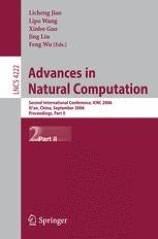
Advances in Natural Computation ; Vol. 4222 ; 2nd International Conference, ICNC 2006, Xi'an, China, September 24-28, 2006, Proceedings, Part II
constitutethe proceedings of the 2nd International Conference on Natural Computation (ICNC 2006), jointly held with the 3rd International Conference on Fuzzy Systems and Knowledge Discovery, ICNC-FSKD 2006 featured the most up-to-date research results in com- tational algorithms inspired from nature, including biological, ecological, and physical systems. It is an exciting and emerging interdisciplinary area in which a wide rangeof techniques and methods arebeing studied for dealing with large, complex, and dynamic problems. The joint conferences also promoted cro- fertilization over these exciting and yet closely-related areas, which had a s- nifcant impact on the advancement of these important technologies. Specifc areas included neural computation, quantum computation, evolutionarycom- tation, DNA computation, fuzzy computation, granular computation, artifcial life, etc., with innovative applications to knowledge discovery, fnance, ope- tions research, and more. In addition to the large number of submitted papers, we were blessed with the presence of six renowned keynote speakers.
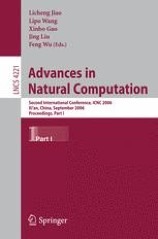
Advances in natural computation ; Vol. 4221 ; 2nd International Conference, ICNC 2006, Xi'an, China, September 24-28, 2006, Proceedings, Part I
ICNC-FSKD 2006 featured the most up-to-date research results in com- tational algorithms inspired from nature, including biological, ecological, and physical systems. It is an exciting and emerging interdisciplinary area in which a wide rangeof techniques and methods arebeing studied for dealing with large, complex, and dynamic problems. The joint conferences also promoted cro- fertilization over these exciting and yet closely-related areas, which had a s- nifcant impact on the advancement of these important technologies. Specifc areas included neural computation, quantum computation, evolutionarycom- tation, DNA computation, fuzzy computation, granular computation, artifcial life, etc., with innovative applications to knowledge discovery, fnance, ope- tions research, and more. In addition to the large number of submitted papers, we were blessed with the presence of six renowned keynote speakers.
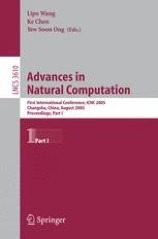
Advances in natural computation ; Vol. 3610 ; 1st International conference, ICNC 2005, Changsha, China, August 27-29, 2005, Proceedings, Part I
Featured the most up-to-date research results in computational algorithms inspired from nature, including biological, ecological, andphysical systems. It is an exciting and emerging interdisciplinary area in which a wide range of techniques and methods are being studied for dealing with large, complex, and dynamic problems. The joint conferences also promoted cross-fertilization over these exciting and yet closely-related areas, which had a sig-nificant impact on the advancement of these important technologies. Specificareas included neural computation, quantum computation, evolutionary com-putation, DNA computation, chemical computation, information processing incells and tissues, molecular computation, computation with words, fuzzy com-putation, granular computation, artificial life, swarm intelligence, ants colonies
