



Page 1
Page 1

Modelling, Computation and Optimization in Information Systems and Management Sciences ; 2nd International Conference MCO 2008, Metz, France - Luxembourg, September 8-10, 2008. Proceedings
This book constitutes the refereed proceedings of the Second International Conference MCO 2008, Metz, France, September 2008.The 65 revised full papers presented were carefully reviewed and selected from 160 submissions. The papers are organized in topical sections on optimization and decision making; data mining theory, systems and applications; computer vision and image processing; computer communications and networks; optimization and search techniques for security, reliability, trust.

Integration of AI and OR Techniques in Constraint Programming for Combinatorial Optimization Problems ; Vol.3524 : 2nd International Conference, CPAIOR 2005, Prague, Czech Republic, May 31 -- June 1, 2005
Intended primarily as a forum to focus on the integration and hybridization of the approaches of constraint programming (CP), arti?cial intelligence (AI), and operations research (OR) technologies for solving large-scale and complex real-life optimization problems. Therefore, CPAIOR is never far from industrial applications. The high number of submissions received this year, almost 100 papers, in witness to the interest of the research community in this conference. From these submissions, we chose 26 to be published in full in the proceedings. This volume includes summaries of the invited talks of CPAIOR: one from industry, one from the embedded system research community, and one from the operations research community.

Integer programming and combinatorial optimization ; 9th International IPCO Conference, Cambridge, MA, USA, May 27-29, 2002. Proceedings
This volume contains the papers selected for presentation at IPCO 2002, the NinthInternationalConferenceonIntegerProgrammingandCombinatorial- timization, Cambridge, MA (USA), May 27–29, 2002. The IPCO series of c- ferences highlights recent developments in theory, computation, and application of integer programming and combinatorial optimization. IPCO was established in 1988 when the ?rst IPCO program committee was formed. IPCO is held every year in which no International Symposium on Ma- ematical Programming (ISMP) takes places. The ISMP is triennial, so IPCO conferences are held twice in every three-year period. The eight previous IPCO conferences were held in Waterloo (Canada) 1990, Pittsburgh (USA) 1992, Erice (Italy) 1993, Copenhagen (Denmark) 1995, Vancouver (Canada) 1996, Houston (USA) 1998, Graz (Austria) 1999, and Utrecht (The Netherlands) 2001. In response to the call for papers for IPCO 2002, the program committee received 110 submissions, a record number for IPCO. The program committee met on January 7 and 8, 2002, in Aussois (France), and selected 33 papers for inclusion in the scienti?c program of IPCO 2002. The selection was based on originality and quality, and re?ects many of the current directions in integer programming and combinatorial optimization research.

Fuzzy mathematical programming and fuzzy matrix games
This book presents a systematic and focused study of the application of fuzzy sets to two basic areas of decision theory, namely Mathematical Programming and Matrix Game Theory. Apart from presenting most of the basic results available in the literature on these topics, the emphasis is on understanding their natural relationship in a fuzzy environment

Learning and Intelligent Optimization ; 2nd International Conference, LION 2007 II, Trento, Italy, December 8-12, 2007. Selected Papers
The papers cover current issues of machine learning, artificial intelligence, mathematical programming and algorithms for hard optimization problems and are organized in topical sections on improving optimization through learning, variable neighborhood search, insect colony optimization, applications, new paradigms, cliques, stochastic optimization, combinatorial optimization, fitness and landscapes, and particle swarm optimization.
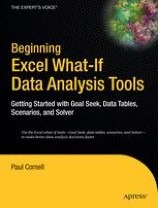
Beginning Excel What-If Data Analysis tools : Getting started with goal seek, data tables, scenarios, and solver
Excels what-if data analysis tools let you experiment with your data to project future results. In turn, these predictions will lead to better decision making and unlock the mystery of many business analysis scenarios. For example, what-if data analysis tools will enable you to forecast how lowering the price per unitwhile increasing projected unit salesmight affect your profit margins. Beginning Excel What-If Data Analysis Tools explores the use of Goal Seek, Data Tables, Scenarios, and Solver to help you get insight on your data. This book is focused and to the point, and it provides tutorial treatment of what-if tools in a practical, hands-on manner.
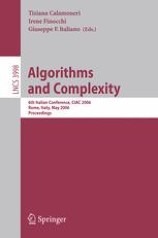
Algorithms and Complexity ; 6th Italian Conference, CIAC 2006, Rome, Italy, May 29-31, 2006, Proceedings
Here are the refereed proceedings of the 6th Italian Conference on Algorithms and Computation, CIAC 2006. The 33 revised full papers presented together with 3 invited papers address such topics as sequential, parallel and distributed algorithms, data structures, approximation algorithms, randomized algorithms, on-line algorithms, graph algorithms, analysis of algorithms, algorithm engineering, algorithmic game theory, computational biology, computational complexity, communication networks, computational geometry, cryptography, discrete optimization, graph drawing, mathematical programming, and quantum algorithms.

Algorithms – ESA 2005 ; 13th Annual European Symposium, Palma de Mallorca, Spain, October 3-6, 2005, Proceedings
This volume contains the 75 contributed papers and the abstracts of the threeinvited lectures presented at the 13th Annual European Symposium on Algo-rithms (ESA 2005), held in Spain, 2005. respectively.Papers were solicited in all areas of algorithmic research, including but notlimited to algorithmic aspects of networks, approximation and on-line algo-rithms, computational biology, computational geometry, computational financeand algorithmic game theory, data structures, database and information re-trieval, external memory algorithms, graph algorithms, graph drawing, machinelearning, mobile computing, pattern matching and data compression, quantumcomputing, and randomized algorithms. The algorithms could be sequential,distributed, or parallel. Submissions were especially encouraged in the area ofmathematical programming and operations research, including combinatorialoptimization, integer programming, polyhedral combinatorics, and semidefiniteprogramming.Each extended abstract was submitted to one of the two tracks.
