



Page 1
Page 1

New Developments in Parsing Technology
Parsing can be defined as the decomposition of complex structures into their constituent parts, and parsing technology as the methods, the tools, and the software to parse automatically. Parsing is a central area of research in the automatic processing of human language. Parsers are being used in many application areas, for example question answering, extraction of information from text, speech recognition and understanding, and machine translation. New developments in parsing technology are thus widely applicable. This book contains contributions from many of today's leading researchers in the area of natural language parsing technology. The contributors describe their most recent work and a diverse range of techniques and results. This collection provides an excellent picture of the current state of affairs in this area. This volume is the third in a series of such collections, and its breadth of coverage should make it suitable both as an overview of the current state of the field for graduate students, and as a reference for established researchers.

Multimodal Technologies for Perception of Humans ; International Evaluation Workshops CLEAR 2007 and RT 2007, Baltimore, MD, USA, May 8-11, 2007, Revised Selected Papers
This book constitutes the thoroughly refereed joint post-workshop proceedings of two co-located events: the Second International Workshop on Classification of Events, Activities and Relationships, CLEAR 2007, and the 5th Rich Transcription 2007 Meeting Recognition evaluation, RT 2007, held in succession in Baltimore, MD, USA, in May 2007.The workshops had complementary evaluation efforts; CLEAR for the evaluation of human activities, events, and relationships in multiple multimodal data domains; and RT for the evaluation of speech transcription-related technologies from meeting room audio collections.
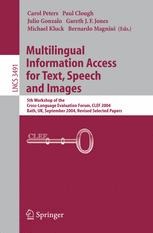
Multilingual Information Access for Text, Speech and Images ; 5th Workshop of the Cross-Language Evaluation Forum, CLEF 2004, Bath, UK, September 15-17, 2004, Revised Selected Papers
The ?fth campaign of the Cross-Language Evaluation Forum (CLEF) for Eu- pean languages was held from January to September 2004. Participation in the CLEF campaigns has increased each year and CLEF 2004 was no exception: 55 groups submitted results for one or more of the di?erent tracks compared with 42 groups in the previous year. CLEF 2004 also marked a breaking point with respect to previous campaigns. The focus was no longer mainly concentrated on multilingual document retrieval as in previous years but was diversi?ed to include di?erent kinds of text retrieval across languages (e. g. , exact answers in the question-answering track) and retrieval on di?erent kinds of media (i. e. , not just plain text but collections containing image and speech as well). In ad- tion, increasing attention was given to issues that regard system usability and user satisfaction with tasks to measure the e?ectiveness of interactive systems or system components being included in both the cross-language question - swering and image retrieval tasks with the collaboration of the coordinators of the interactive track. The campaign culminated in a two-and-a-half-day workshop held in Bath, UK, 15–17 September, immediately following the 8th European Conference on Digital Libraries. The workshop was attended by nearly 100 researchers and s- tem developers.

Modeling Excitable Tissue : The EMI Framework
This volume presents a novel computational framework for understanding how collections of excitable cells work. The key approach in the text is to model excitable tissue by representing the individual cells constituting the tissue. This is in stark contrast to the common approach where homogenization is used to develop models where the cells are not explicitly present. The approach allows for very detailed analysis of small collections of excitable cells, but computational challenges limit the applicability in the presence of large collections of cells.

Microsoft Visual C# Step by Step
Guide to Microsoft Visual C# fundamentals with Visual Studio. Expand your expertiseand teach yourself the fundamentals of programming with the latest version of Visual C# with Visual Studio. If you are an experienced software developer, you'll get all the guidance, exercises, and code you need to start building responsive, scalable, cloud-connected applications that can run almost anywhere. Discover how to: Quickly start creating Visual C# code and projects with Visual Studio Work with variables, operators, expressions, methods, and program flow Build more robust apps with error, exception, and resource management Spot problems fast with the Visual Studio debugger Make the most of improvements to C# methods, parameters, and switch statements Master the C# object model, and create your own functional data structures Leverage advanced properties, indexers, generics, and collection classes Create Windows 10 apps that share data, collaborate, and use cloud services Integrate Cortana to voice-enable your applications Perform complex queries over object collections with LINQ

Introduction to information retrieval
Teaches classical and web information retrieval, including web search and the related areas of text classification and text clustering from basic concepts. It gives an up-to-date treatment of all aspects of the design and implementation of systems for gathering, indexing, and searching documents; methods for evaluating systems; and an introduction to the use of machine learning methods on text collections. All the important ideas are explained using examples and figures, making it perfect for introductory courses in information retrieval for advanced undergraduates and graduate students in computer science.

Intelligent glasses store
Technology has been found to facilitate humankind's life. Hence, there is a new technique almost every day. One of the most common is E-commerce. This is the first project in Syria. about online glasses Shop, which displays sets of glasses on a website. The website allows the shopkeeper (the admin) to add their collections of glasses. Set prices and show reservations. Users can view glasses on the website and try whatever he wants by real-time or by recording video, then they add the preferred ones to the cart to reserve the sample they like the most for a specific time. This project aims to allow busy traders to make their own business online, in addition, it saves time and effort for them and users as they can make shopping and compare goods whatever the situation is especially in quarantine.

Intelligent Document Retrieval : Exploiting Markup Structure
Collections of digital documents can nowadays be found everywhere in institutions, universities or companies. Examples are Web sites or intranets. But searching them for information can still be painful. Searches often return either large numbers of matches or no suitable matches at all. Such document collections can vary a lot in size and how much structure they carry. What they have in common is that they typically do have some structure and that they cover a limited range of topics. The second point is significantly different from the Web in general. The type of search system that we propose in this book can suggest ways of refining or relaxing the query to assist a user in the search process. In order to suggest sensible query modifications we would need to know what the documents are about. Explicit knowledge about the document collection encoded in some electronic form is what we need. However, typically such knowledge is not available. So we construct it automatically.

Illustrated C# 2005
Illustrated C# 2005 presents the C# programming language in a unique visual manner. The book uses three techniques to achieve this: concise text, tables that clarify and summarize language features, and frequent figures and diagrams. Each feature is also illustrated with concise, focused code samples.

Evaluating Information Retrieval and Access Tasks : NTCIR's Legacy of Research Impact
This open access book summarizes the first two decades of the NII Testbeds and Community for Information access Research (NTCIR). NTCIR is a series of evaluation forums run by a global team of researchers and hosted by the National Institute of Informatics (NII), Japan. The book is unique in that it discusses not just what was done at NTCIR, but also how it was done and the impact it has achieved. For example, in some chapters the reader sees the early seeds of what eventually grew to be the search engines that provide access to content on the World Wide Web, today’s smartphones that can tailor what they show to the needs of their owners, and the smart speakers that enrich our lives at home and on the move. We also get glimpses into how new search engines can be built for mathematical formulae, or for the digital record of a lived human life.

Deep Learning to See : Towards New Foundations of Computer Vision
Topics and features: Presents a curiosity-driven approach, posing questions to stimulate readers to design novel computational models of vision Offers a rethinking of computer vision, arguing for an approach based on vision in nature, versus regarding visual signals as collections of images Provides an interdisciplinary commentary, aiming to unify computer vision, machine learning, human vision, and computational neuroscience Serving to inspire and stimulate critical reflection and discussion, yet requiring no prior advanced technical knowledge, the text can naturally be paired with classic textbooks on computer vision to better frame the current state of the art, open problems, and novel potential solutions.

Data management in a connected world : Essays dedicated to Hartmut Wedekind on the occasion of his 70th birthday
Data management systems play the most crucial role in building large application s- tems. Since modern applications are no longer single monolithic software blocks but highly flexible and configurable collections of cooperative services, the data mana- ment layer also has to adapt to these new requirements. Therefore, within recent years, data management systems have faced a tremendous shift from the central management of individual records in a transactional way to a platform for data integration, fede- tion, search services, and data analysis. This book addresses these new issues in the area of data management from multiple perspectives, in the form of individual contributions, and it outlines future challenges in the context of data management.

Concurrency Theory : Calculi an Automata for Modelling Untimed and Timed Concurrent Systems
Concurrency Theory is a synthesis of one of the major threads of theoretical computer science research focusing on languages and graphical notations for describing collections of simultaneously evolving components that interact through synchronous communication. The main specification notation focused on in this book is LOTOS. An extensive introduction to this particular process calculus is given, highlighting how the approach differs from competitor techniques, such as CCS and CSP.

Knowledge Discovery from XML Documents ; 1st International Workshop, KDXD 2006, Singapore, April 9, 2006, Proceedings
The KDXD 2006 (Knowledge Discovery from XML Documents) workshop is the ?rst international workshop running this year in conjunction with the 10th Pacific-Asia Conference on Knowledge Discovery and Data Mining, PAKDD 2006. The workshop provided an important forum for the dissemination and exchange of new ideas and research related to XML data discovery and retrieval. The eXtensible Markup Language (XML) has become a standard language for data representation and exchange. With the continuous growth in XML data sources,the ability to manage collections of XML documents and discover knowledge from them for decision support becomes increasingly important. Due to the inherent ?exibility ofXML, in both structure and semantics, inferring important knowledge from XML data is faced with new challenges as well as bene?ts. The objective of the workshop was to bring together researchers and practitioners to discuss all aspects of the emerging XML data management challenges.
Java : how to program. Late objects : Introducing Jshell
Introduction to Computers, the Internet and Java / Introduction to Java Applications; Input/Output and Operators / Control Statements: Part 1; Assignment, ++ and Operators / Control Statements: Part 2; Logical Operators / Methods / Arrays and ArrayLists / Introduction to Classes and Objects / Classes and Objects: A Deeper Look / Object-Oriented Programming: Inheritance / Object-Oriented Programming: Polymorphism and Interfaces / Exception Handling: A Deeper Look / JavaFX Graphical User Interfaces / JavaFX GUI / Strings, Characters and Regular Expressions / Files, Input/Output Streams, NIO and XML Serialization / Generic Collections / Lambdas and Streams / Recursion / Searching, Sorting and Big O / Generic Classes and Methods: A Deeper Look / Custom Generic Data Structures / JavaFX Graphics and Multimedia / Concurrency / Accessing Databases with JDBC / Introduction to JShell: Java 9's REPL for Interactive Java
Beginning Scala 3 : A functional and Object-Oriented Java Language
Introduces you to the Scala programming language, its object-oriented and functional programming characteristics, and then guides you through Scala constructs and libraries that allow you to assemble small components into high-performance, scalable systems. You will understand why Scala is judiciously used for critical business applications by leading companies such as Twitter, LinkedIn, Foursquare, the Guardian, Morgan Stanley, Credit Suisse, UBS, and HSBC – and you will be able to use it in your own projects. You will: Get started with Scala 3 or Scala language programming in general / Understand how to utilitze OOP in Scala / Perform functional programming in Scala / Master the use of Scala collections, traits and implicits / Leverage Java and Scala interopability / Employ Scala for DSL programming / Use patterns and best practices in Scala
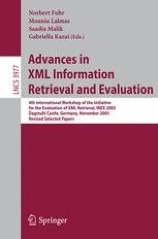
Advances in XML information retrieval and Evaluation ; 4th International workshop of the initiative for the evaluation of XML retrieval, INEX 2005, Dagstuhl Castle, Germany, November 28-30, 2005. Revised and Selected Papers
Content-oriented XML retrieval has been receiving increasing interest due to the widespread use of eXtensible Markup Language (XML), which is becoming a standard document format on the Web, in digital libraries,and publishing. By exploiting the enriched source of syntactic and semantic information that XML markup provides, XML information retrieval (IR) systems aim to implement a more focused retrieval strategy and return document components, so-called XML elements – instead of complete documents – in response to a user query. This focused retrieval approach is of particular bene?t for collections containing long documents or documents covering a wide variety of topics (e.g., books, user manuals, legal documents, etc.), where users’ e?ort to locate relevant content can be reduced by directing them to the most relevant parts of the documents.
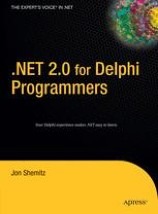
.NET 2.0 for Delphi Programmers
.NET 2.0 for Delphi Programmers explores .NET from a Delphi programmers viewpoint, and it is ideal for Delphi programmers moving to .NET. It presents the core concepts of the .NET world in terms you are familiar with. This book will help you with Delphi for .NET as well as C#. Apress publishes migration books for both Visual Basic 6 and C++ programmers moving to .NET. Consider this the Delphi installment of Apress migration books! There is ample coverage of C# as well as Delphi for .NET inside this edition.
