



Page 1
Page 1

Mute people aiding application
Communication is an essential tool for human survival. It is a fundamental and effective method of sharing thoughts, needs, feelings, and opinions. However, a large portion of the world's population lacks the ability to communicate with others. Such as the ones suffering from hearing loss, speech disability, or even both. Those disabilities have a significant impact on their lives in terms of work and relationships. The majority of these people are sometimes unable to support themselves financially due to the lack of job opportunities. Given these difficulties, we have decided to develop an application to help them overcome the obstacles they may encounter in their daily lives. After consulting with two deaf and mute people we customized an application that works in two ways. One of which is to translate their sign language in real time by using mobile camera and recognizing hand motion. The other works by converting text-to-voice, and accurately expressing the user’s emotions with the help of the facial emotion recognition.

Medical imaging systems : An introductory guide
Gives a complete and comprehensive introduction to the fields of medical imaging systems, as designed for a broad range of applications. The authors of the book first explain the foundations of system theory and image processing, before highlighting several modalities in a dedicated chapter. The initial focus is on modalities that are closely related to traditional camera systems such as endoscopy and microscopy. This is followed by more complex image formation processes: magnetic resonance imaging, X-ray projection imaging, computed tomography, X-ray phase-contrast imaging, nuclear imaging, ultrasound, and optical coherence tomography.

Interactive storytelling ; 1st Joint International Conference on interactive digital storytelling, ICIDS 2008 Erfurt, Germany, November 26-29, 2008 Proceedings
This book constitutes the refereed proceedings of the First Joint International Conference on Interactive Digital Storytelling, ICIDS 2008, held in Erfurt, Germany, in November 2008.The 19 revised full papers, 5 revised short papers, and 5 poster papers presented together with 3 invited lectures and 8 demo papers were carefully reviewed and selected from 62 submission. The papers are organized in topical sections on future perspectives on interactive digital storytelling, interactive storytelling applications, virtual characters and agents, user experience and dramatic immersion, architectures for story generation, models for drama management and interacting with stories, as well as authoring and creation of interactive narrative.

Imaging Beyond the Pinhole Camera
The world's first photograph was taken in 1826 using a pinhole camera called camera obscura. Cameras used since then are basically following the pinhole camera principle. This book looks at the development as well as the applications of alternative camera architectures.

Food lens = فود لينس
Food lens is an innovative application designed to revolutionize dietary management by leveraging advanced image recognition and nutritional analysis. The primary objective of this senior project is to develop a user-friendly tool that identifies various foods through a camera interface and provides detailed nutritional information. This application not only enhances the user's understanding of their dietary intake but also assists in achieving personalized health and fitness goals. The core functionality of Food Lens involves the integration of a robust image recognition system capable of accurately identifying a wide range of foods. Upon identification, the application retrieves comprehensive nutritional data, including calorie content, macronutrient distribution (proteins, fats, carbohydrates), and essential micronutrients (vitamins and minerals). This data is then seamlessly integrated into the user's dietary profile. Food Lens is designed to track the user's daily caloric intake and compare it against personalized recommendations based on age, gender, weight, height, and activity level. By maintaining a dynamic record of consumed foods, the application provides real-time feedback on the user’s nutritional progress. This feature is particularly beneficial for individuals aiming to manage weight, address dietary restrictions, or improve overall health.

Embedded systems design : The ARTIST roadmap for research and development
Embedded systems now include a very large proportion of the advanced products designed in the world, spanning transport (avionics, space, automotive, trains), electrical and electronic appliances (cameras, toys, televisions, home appliances, audio systems, and cellular phones), process control (energy production and distribution, factory automation and optimization), telecommunications (satellites, mobile phones and telecom networks), and security (e-commerce, smart cards), etc. The extensive and increasing use of embedded systems and their integration in everyday products marks a significant evolution in information science and technology. We expect that within a short timeframe embedded systems will be a part of nearly all equipment designed or manufactured in Europe, the USA, and Asia. There is now a strategic shift in emphasis for embedded systems designers: from simply achieving feasibility, to achieving optimality. Optimal design of embedded systems means targeting a given market segment at the lowest cost and delivery time possible. Optimality implies seamless integration with the physical and electronic environment while respecting real-world constraints such as hard deadlines, reliability, availability, robustness, power consumption, and cost. In our view, optimality can only be achieved through the emergence of embedded systems as a discipline in its own right.

Dynamical Vision ; ICCV 2005 and ECCV 2006 Workshops, WDV 2005 and WDV 2006, Beijing, China, October 21, 2005, Graz, Austria, May 13, 2006, Revised Papers
Classical multiple-view geometry studies the reconstruction of a static scene - served by a rigidly moving camera. However, in many real-world applications the scene may undergo much more complex dynamical changes. For instance, the scene may consist of multiple moving objects (e.g., a trafic scene) or arti- lated motions (e.g., a walking human) or even non-rigid dynamics (e.g., smoke, fire, or a waterfall). In addition, some applications may require interaction with the scene through a dynamical system (e.g., vision-guided robot navigation and coordination). To study the problem of reconstructing dynamical scenes, many new al- braic, geometric, statistical, and computational tools have recently emerged in computer vision, computer graphics, image processing, and vision-based c- trol.

Crime detection camera
This paper presents a comprehensive crime detection system that uses a combination of hardware and software to monitor homes and communities in real time. The system consists of a Raspberry Pi 4B, a Raspberry Pi Camera V2, a flame sensor, an MQ-6 gas sensor, and a microphone, which are all connected to a database management system powered by MySQL. The data collected from these devices is analyzed by machine learning algorithms to detect crimes, such as theft or robbery, as well as fires and gas leaks. The system also includes a mobile app, ‘Safe Home’ which provides live video monitoring and real-time notifications to users, and an employee dashboard to monitor all statistics and manage all implemented systems.

Creating Web-based Laboratories
Remote web-based experimentation, enabling students and researchers to access the laboratory anytime via the Internet, is becoming an increasingly attractive way to complement or even replace traditional laboratory sessions. Placing a video camera & microphone before the equipment and apparatus to capture what is actually happening in the laboratory allows the images and audio data to be streamed to the client side. Researchers in different countries can share equipment and conduct research cooperatively and remotely. The authors summarise their research and discuss the development of the 5 web-based laboratories launched from the National University of Singapore. The principles, structure, and technologies required for the creation of Internet remote experimentation systems are discussed with particular emphasis on the integration of hardware and software systems. Also highlighted is the design and development of interfaces and components for use in typical web-based laboratories or similar web-control applications.

Computer Vision -- ECCV 2006 ; Vol. 3954 ; 9th European Conference on Computer Vision, Graz, Austria, May 7-13, 2006, Proceedings, Part IV
Constitutes the refereed proceedings of the 9th European Conference on Computer Vision, 2006. This book covers a range of issues in computer vision, on recognition, statistical models and visual learning, 3D reconstruction and multi-view geometry, energy minimization, tracking and motion, segmentation, shape from X, visual tracking, and more.

Computer Vision -- ECCV 2006 ; Vol. 3953 ; 9th European Conference on Computer Vision, Graz, Austria, May 7-13, 2006, Proceedings, Part III
Constitutes the refereed proceedings of the 9th European Conference on Computer Vision, 2006. This book covers a range of issues in computer vision, on recognition, statistical models and visual learning, 3D reconstruction and multi-view geometry, energy minimization, tracking and motion, segmentation, shape from X, visual tracking, and more.

Computer Vision -- ECCV 2006 ; Vol. 3952 ; 9th European Conference on Computer Vision, Graz, Austria, May 7-13, 2006, Proceedings, Part II
Constitutes the refereed proceedings of the 9th European Conference on Computer Vision, 2006. This book covers a range of issues in computer vision, on recognition, statistical models and visual learning, 3D reconstruction and multi-view geometry, energy minimization, tracking and motion, segmentation, shape from X, visual tracking, and more.

Computer Vision - ECCV 2002 ; 7th European Conference on Computer Vision, Copenhagen, Denmark, May 28-31, 2002. Proceedings. Part II
The privilege of organizing it was shared by three universities: The IT University of Copenhagen, the University of Copenhagen, and Lund University, with the conference venue in Copenhagen. This year’s conference attracted more papers than ever before, with around 600 submissions. Still, together with the conference board, we decided to keep the tradition of holding ECCV as a single track conference. Each paper was anonymously refereed by three different reviewers. For the ?nal selection, for the ?rst time for ECCV, a system with area chairs was used.

Computer Vision - ECCV 2002 ; 7th European Conference on Computer Vision, Copenhagen, Denmark, May 28-31, 2002, Proceedings, Part III
The privilege of organizing it was shared by three universities: The IT University of Copenhagen, the University of Copenhagen, and Lund University, with the conference venue in Copenhagen. This year’s conference attracted more papers than ever before, with around 600 submissions. Still, together with the conference board, we decided to keep the tradition of holding ECCV as a single track conference. Each paper was anonymously refereed by three different reviewers. For the ?nal selection, for the ?rst time for ECCV, a system with area chairs was used.
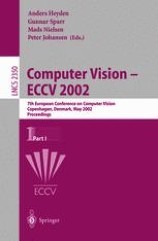
Computer Vision - ECCV 2002 ; 7th European Conference on Computer Vision, Copenhagen, Denmark, May 28-31, 2002, Proceedings, Part I
The privilege of organizing it was shared by three universities: The IT University of Copenhagen, the University of Copenhagen, and Lund University, with the conference venue in Copenhagen. This year’s conference attracted more papers than ever before, with around 600 submissions. Still, together with the conference board, we decided to keep the tradition of holding ECCV as a single track conference. Each paper was anonymously refereed by three different reviewers. For the ?nal selection, for the ?rst time for ECCV, a system with area chairs was used.

Computer Vision – ACCV 2007 ; 8th Asian Conference on Computer Vision, Tokyo, Japan, November 18-22, 2007, Proceedings, Part II
Contains sections on shape and texture, fitting, calbration, detection, image and video processing, applications, face and gesture, tracking, camera networks, and face/gesture/action detection and recognition. This book also covers learning, motion and tracking, retrival and search, and human pose estimation.

Computer Vision – ACCV 2007 ; 8th Asian Conference on Computer Vision, Tokyo, Japan, November 18-22, 2007, Proceedings, Part I
Contains sections on shape and texture, fitting, calbration, detection, image and video processing, applications, face and gesture, tracking, camera networks, and face/gesture/action detection and recognition. This book also covers learning, motion and tracking, retrival and search, and human pose estimation.

Machine Learning for Multimodal Interaction ; 5th International Workshop, MLMI 2008, Utrecht, The Netherlands, September 8-10, 2008. Proceedings
The 12 revised full papers and 15 revised poster papers presented together with 5 papers of a special session on user requirements and evaluation of multimodal meeting browsers/assistants were carefully reviewed and selected from 47 submissions. The papers cover a wide range of topics related to human-human communication modeling and processing, as well as to human-computer interaction, using several communication modalities. Special focus is given to the analysis of non-verbal communication cues and social signal processing, the analysis of communicative content, audio-visual scene analysis, speech processing, interactive systems and applications.

Complex Motion ; 1st International Workshop, IWCM 2004, Günzburg, Germany, October 12-14, 2004, Revised Papers
The world we live in is a dynamic one: we explore it by moving through it, and many of the objects which we are interested in are also moving. Trafic, for instance, is an example of a domain where detecting and processing visual motion is of vital interest, both in a metaphoric as well as in a purely literal sense. Visual communication is another important example of an area of science which is dominated by the need to measure, understand, and represent visual motion in an eficient way. Visual motion is a subject of research which forces the investigator to deal with complexity; complexity in the sense of facing efiects of motion in a very large diversity of forms, starting from analyzing simple motion in a changing envir- ment (illumination, shadows, . . . ), under adverse observation conditions, such as bad signal-to-noiseratio (low illumination, small-scaleprocesses, low-dosex-ray, etc. ), covering also multiple motions of independent objects, occlusions, and - ing as far as dealing with objects which are complex in themselves (articulated objects such as bodies of living beings). The spectrum of problems includes, but does not end at, objects which are not ‘bodies’ at all, e. g. , when anal- ing fiuid motion, cloud motion, and so on. Analyzing the motion of a crowd in a shopping mall or in an airport is a further example that implies the need to struggle against the problems induced by complexity.

Blind smart helmet
The Smart Helmet for the Blind is a project aimed at providing solutions for the challenges faced by blind individuals in their daily lives. The problem of detecting objects, identifying obstacles and distances, knowing the current location, and using a mobile application is a common issue for blind people. To address these problems, the Smart Helmet project was created, utilizing advanced technology and artificial intelligence to provide real-time assistance to the wearer. The helmet is connected to a Raspberry Pi 4, which processes information from the helmet's cameras and AI algorithms to analyze and predict the surrounding environment for a blind person.
