



Page 1
Page 1

Multiagent System Technologies ; 6th German Conference, MATES 2008, Kaiserslautern, Germany, September 23-26, 2008. Proceedings
This book constitutes the refereed proceedings of the 6th German Conference on Multiagent Systems Technologies, MATES 2008, held in Kaiserslautern, Germany, in September 2008 - co-located with the 31st German Conference on Artificial Intelligence, KI 2008.The 16 revised full papers presented together with 2 invited talks were carefully reviewed and selected from 35 submissions. The papers present and discuss the latest advances of research and development in the area of autonomous agents and multiagent systems ranging from theoretical and methodological issues to applications in various fields.

Modular Algorithms in Symbolic Summation and Symbolic Integration
Brings together two streams in computer algebra: symbolic integration and summation on the one hand, and fast algorithmics on the other hand. In many algorithmically oriented areas of computer science, the analysis of al gorithms placed into the lime light by DonKnuth’stalkat the 1970ICM –provides a crystal-clear criterion for success. The researcher who designs an algorithm that is faster (asymptotically, in the worst case) than any previous method receives instant gratification : her result will be recognized as valuable. Al as, the downside is that such results come along quite infrequently, despite our best efforts. An alternative evaluation method is to run a new algorithm on examples; this has its obvious problems, but is sometimes the best we can do. George Collins, one of the fathers of computer algebra and a great experimenter,wrote in 1969: “I think this demonstrates again that a simple analysis is often more revealing than a ream of empirical data (although both are important). ” Within computer algebra, some areas have traditionally followed the former methodology, notably some parts of polynomial algebra and linear algebra. Other areas, such as polynomial system solving, have not yet been amenable to this - proach. The usual “input size” parameters of computer science seem inadequate, and although some natural “geometric” parameters have been identified (solution dimension, regularity), not all (potential) major progress can be expressed in this framework. Symbolic integration and summation have been in a similar state.

Mathematics of Program Construction ; 9th International Conference, MPC 2008, Marseille, France, July 15-18, 2008. Proceedings
This book constitutes the refereed proceedings of the 9th International Conference on Mathematics of Program Construction, MPC 2008, held in Marseille, France in July 2008.The 18 revised full papers presented together with 1 invited talk were carefully reviewed and selected from 41 submissions. Issues addressed range from algorithmics to support for program construction in programming languages and systems. Topics of special interest are type systems, program analysis and transformation, programming language semantics, program logics.

Mathematics of Program Construction ; 8th International Conference, MPC 2006, Kuressaare, Estonia, July 3-5, 2006, Proceedings
This volume contains the proceedings of the 8th International Conference on Mathematics of ProgramConstruction, MPC 2006,held at Kuressaare, Estonia, July 3-5, 2006, colocated with the 11th International Conference on Algebraic Methodology and Software Technology, AMAST 2006, July 5-8, 2006. TheMPCconferencesaimtopromotethedevelopmentofmathematicalpr- ciples and techniques that are demonstrably useful and usable in the process of constructing computer programs. Topics of interest range from algorithmics to support for program construction in programming languages and systems.

Integration of AI and OR Techniques in Constraint Programming for Combinatorial Optimization Problems ; Vol.3990 ; 3rd International Conference, CPAIOR 2006, Cork, Ireland, May 31 - June 2, 2006, Proceedings
Constitutes the refereed proceedings of the Third International Conference on Integration of AI and OR Techniques in Constraint Programming for Combinatorial Optimization Problems, CPAIOR 2006. The 20 revised full papers presented together with 3 invited talks address methodological and foundational issues from AI, OR, and algorithmics and present applications to the solution of combinatorial optimization problems in various fields via constraint programming.

Integration of AI and OR Techniques in Constraint Programming for Combinatorial Optimization Problems ; Vol.3524 : 2nd International Conference, CPAIOR 2005, Prague, Czech Republic, May 31 -- June 1, 2005
Intended primarily as a forum to focus on the integration and hybridization of the approaches of constraint programming (CP), arti?cial intelligence (AI), and operations research (OR) technologies for solving large-scale and complex real-life optimization problems. Therefore, CPAIOR is never far from industrial applications. The high number of submissions received this year, almost 100 papers, in witness to the interest of the research community in this conference. From these submissions, we chose 26 to be published in full in the proceedings. This volume includes summaries of the invited talks of CPAIOR: one from industry, one from the embedded system research community, and one from the operations research community.
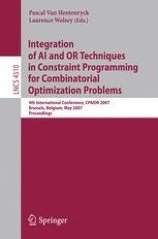
Integration of AI and OR Techniques in Constraint Programming for Combinatorial Optimization Problems ; 4th International Conference, CPAIOR 2007, Brussels, Belgium, May 23-26, 2007, Proceedings
This book constitutes the refereed proceedings of the 4th International Conference on Integration of AI and OR Techniques in Constraint Programming for Combinatorial Optimization Problems, CPAIOR 2007, held in Brussels, Belgium in May 2007.
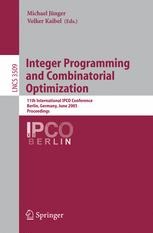
Integer Programming and Combinatorial Optimization ; 11th International IPCO Conference, Berlin, Germany, June 8-10, 2005, Proceedings
Since its start in 1990, the IPCO conference series (held under the auspices of theMathematicalProgrammingSociety)hasbecomeanimportantforumforthe presentation of recent results in Integer Programming and Combinatorial Op- mization. This volume compiles the papers presented at IPCO XI, the eleventh conference in this series, held June 8–10, 2005, at the Technische Universit¨ at Berlin. The high interest in this conference series is evident in the large number of submissions. For IPCO XI, 119 extended abstracts of up to 10 pages were submitted. During its meeting on January 29–30, 2005, the Program Committee carefully selected 34 contributions for presentation in non-parallel sessions at the conference. The ?nal choices were not easy at all, since, due to the limited number of time slots, many very good papers could not be accepted. During the selection process the contributions were refereed according to the standards of refereed conferences. As a result of this procedure, you have in your hands a volume that contains papers describing high-quality research e?orts. The page limit for contributions to this proceedings volume was set to 15. You may ?nd full versions of the papers in scienti?c journals in the near future. We thank all the authors who submitted papers. Furthermore, the Program Committee is indebted to the many reviewers who, with their speci?c expertise, helped a lot in making the decisions.

Hybrid metaheuristics ; Vol. 4030 ; 3rd International Workshop, HM 2006, Gran Canaria, Spain, October 13-14, 2006, Proceedings
The selection of papers for HM 2006 consolidated some of the mainstream issues that have emerged from the past editions. Firstly, there are prominent examples of e?ective hybrid techniques whose design and implementation were motivated by challenging real-world applications. We believe this is particularly important for two reasons: on the one hand, researchers are conscious that the primary goal of developing algorithms is to solve relevant real-life problems; on the other hand, the path towarde?cient solving methods for practical problems is a source of new outstanding ideas and theories. A second important issue is that the research community on metaheur- tics has become increasingly interested in and open to techniques and methods known from arti?cial intelligence (AI) and operations research (OR). So far, the most representative examples of such integration have been the use of AI/OR techniques as subordinates of metaheuristic methods. As a historical and - ymological note, this is in perfect accordance with the original meaning of a metaheuristic as a “general strategy controlling a subordinate heuristic. ” The awareness of the need for a sound experimental methodology is a third keypoint.

Hybrid metaheuristics ; Vol. 3636 ; 2nd International Workshop, HM 2005, Barcelona, Spain, August 29-30, 2005. Proceedings
Constitutes the refereed proceedings of the Second International Workshop on Hybrid Metaheuristics, HM 2005, held in Barcelona, Spain, in August 2005. In this book, the papers addresses topics such as: low-level hybridization, high-level hybridization, portfolio techniques, expert systems, co-operative search, taxonomy, terminology, and more.

Hybrid metaheuristics ; 4th International Workshop,HM 2007, Dortmund, Germany, October 8-9, 2007, Proceedings
This book constitutes the refereed proceedings of the 4th International Workshop on Hybrid Metaheuristics, HM 2007, held in Dortmund, Germany. The 14 revised full papers discuss specific aspects of hybridization of metaheuristics, hybrid metaheuristics design, development and testing.

High performance computing – HiPC 2005 ; 12th International Conference, Goa, India, December 18-21, 2005, Proceedings
Contains the refereed proceedings of the 12th International Conference on High-Performance Computing. Beginning with the keynote section and the presentation of the 2 awarded best contributions, this book is organized in topical sections on algorithms, applications, architecture, systems software, communication networks, and systems and networks.

Grid computing : Experiment management, Tool Integration, and Scientific Workflows
Grid computing has become a topic of significant interest in the scientific community as a means of enabling application developers to aggregate resources scattered around the globe for solving large-scale scientific problems. This monograph addresses four critical software development aspects for the engineering and execution of applications on parallel and Grid architectures.
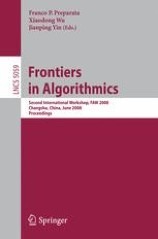
Frontiers in Algorithmics ; 2nd Annual International Workshop, FAW 2008, Changsha, China, June 19-21, 2008, Proceeedings
This book constitutes the refereed proceedings of the Second International Frontiers of Algorithmics Workshop, FAW 2008, held in Changsha, China, in June 2008.The 33 revised full papers presented together with the abstracts of 3 invited talks were carefully reviewed and selected from 80 submissions. The papers were selected for 9 special focus tracks in the areas of biomedical informatics, discrete structures, geometric information processing and communication, games and incentive analysis.

Frontiers in Algorithmics ; 1st Annual International Workshop, FAW 2007, Lanzhou, China, August 1-3, 2007, Proceedings
This book constitutes the refereed proceedings of the First Annual International Frontiers of Algorithmics Workshop, FAW 2007, held in Lanzhou, China in August 2007. The 33 revised full papers presented were carefully reviewed and selected from 141 submissions.
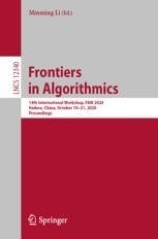
Frontiers in Algorithmics ; 14th International Workshop, FAW 2020, Haikou, China, October 19-21, 2020, Proceedings
This book constitutes the proceedings of the 14th International Workshop on Frontiers in Algorithmics, FAW 2020, held in Haikou, China, in May 2020. The conference was held virtually due to the COVID-19 pandemic. The 12 full papers presented in this volume were carefully reviewed and selected from 15 submissions. The workshop provides a focused forum on current trends of research on algorithms, discrete structures, and their applications, and brings together international experts at the research frontiers in these areas to exchange ideas and to present significant new results. The papers detail graph theory, scheduling and algorithm and complexity.

Foundations of information and knowledge systems ; 5th International Symposium, FoIKS 2008, Pisa, Italy, February 11-15, 2008. Proceedings
This book constitutes the refereed proceedings of the 5th International Symposium on Foundations of Information and Knowledge Systems, FoIKS 2008 held in Pisa, Italy, in February 2008. The 13 revised full papers presented together with 9 revised short papers and 3 invited lectures were carefully selected during two rounds of reviewing and improvement from from 79 submissions. The papers deal with any foundational aspect of information and knowledge systems, including submissions from researchers working in fields such as discrete mathematics, logic and algebra, model theory, information theory, complexity theory, algorithmics and computation, geometry, analysis, statistics and optimisation who are interested in applying their ideas, theories and methods to research on information and knowledge systems.
Experimental and Efficient Algorithms ; 4th International Workshop, WEA 2005, Santorini Island, Greece, May 10-13, 2005, Proceedings
This proceedings volume contains the accepted papers and invited talks p- sented at the 4th International Workshop of E?cient and Experimental Al- rithms (WEA 2005), that was held May 10–13, on Santorini Island, Greece. The WEA events are intended to be an international forum for research on the design, analysis and especially the experimental implementation, evaluation and engineering of algorithms, as well as on combinatorial optimization and its applications. The?rstthreeworkshopsinthisserieswereheldinRiga(2001),MonteVerita (2003) and Rio de Janeiro (2004). Thisvolumecontains3invitedpapersrelatedtocorrespondingkeynotetalks.
Experimental Algorithms ; 7th International Workshop, WEA 2008 Provincetown, MA, USA, May 30-June 1, 2008 Proceedings
The Workshop on Experimental Algorithms, WEA, is intended to be an international forum for research on the experimental evaluation and engineering of algorithms, as well as in various aspects of computational optimization and its applications. The emphasis of the workshop is the use of experimental me- ods to guide the design, analysis, implementation, and evaluation of algorithms, heuristics, and optimization programs. WEA 2008 was held at the Provincetown Inn, Provincetown, MA, USA, on May 30 – June 1, 2008. This was the seventh workshop of the series.

Experimental Algorithms ; 6th International Workshop, WEA 2007, Rome, Italy, June 6-8, 2007, Proceedings
Fostering and disseminating high quality research results focused on the experimental analysis of algorithms the papers are devoted to the design, analysis, implementation, experimental evaluation, and engineering of efficient algorithms. Among the application areas addressed are most fields applying advanced algorithmic techniques, such as combinatorial optimization, approximation, graph theory, discrete mathematics, data mining, simulation, cryptography and security, scheduling, searching, sorting, string matching, coding, networking, etc.
