



Page 9
Page 9

Information theory and machine learning
The recent successes of machine learning, especially regarding systems based on deep neural networks, have encouraged further research activities and raised a new set of challenges in understanding and designing complex machine learning algorithms. New applications require learning algorithms to be distributed, have transferable learning results, use computation resources efficiently, convergence quickly on online settings, have performance guarantees, satisfy fairness or privacy constraints, incorporate domain knowledge on model structures, etc. A new wave of developments in statistical learning theory and information theory has set out to address these challenges.

Information technology in the service economy : Challenges and possibilities for the 21 Century ; IFIP TC8 WG8.2 International Working Conference August 10–13, 2008, Toronto, Ontario, Canada
The IFIP series publishes state-of-the-art results in the sciences and technologies of information and communication. The scope of the series includes: foundations of computer science; software theory and practice; education; computer applications in technology; communication systems; systems modeling and optimization; information systems; computers and society; computer systems technology; security and protection in information processing systems; artificial intelligence; and human-computer interaction. Proceedings and post-proceedings of refereed international conferences in computer science and interdisciplinary fields are featured. These results often precede journal publication and represent the most current research.

Information technology for balanced manufacturing systems ; IFIP TC 5, WG 5.5 7th International Conference on information technology for balanced automation systems in manufacturing and services, Niagra Falls, Ontario, Canada, September 4-6, 2006
International Federation for Information Processing The IFIP series publishes state-of-the-art results in the sciences and technologies of information and communication. The scope of the series includes: foundations of computer science; software theory and practice; education; computer applications in technology; communication systems; systems modeling and optimization; information systems; computers and society; computer systems technology; security and protection in information processing systems; artificial intelligence; and human-computer interaction. Proceedings and post-proceedings of referred international conferences in computer science and interdisciplinary fields are featured. These results often precede journal publication and represent the most current research. The principal aim of the IFIP series is to encourage education and the dissemination and exchange of information about all aspects of computing.

Information technology and Lawyers : Advanced technology in the legal domain, from challenges to daily routine
The area of Information Technology & Lawyers is a fascinating one. Both from a practical and an academic perspective the opportunities of applying Information Technology to law are tremendous. At the same time, however, lawyers are amongst the most conservative professionals, and traditional late adapters of technology. Nowadays the gap between Information Technology & Lawyers is closing more and more, in particular due to the Internet and the richness of legal sources that can be found online. This book provides material to further bridge the gap by showing people with a legal background what is possible with Information Technology now and in the near future, as well as by showing people with an IT background what opportunities exist in the domain of law.

Information technology and educational management in the knowledge society ; IFIP TC3 WG3.7, 6th International working conference on information technology in educational management (ITEM) July 11-15, 2004, Las Palmas de Gran Canaria, Spain
International Federation for Information Processing The IFIP series publishes state-of-the-art results in the sciences and technologies of information and communication. The scope of the series includes: foundations of computer science; software theory and practice; education; computer applications in technology; communication systems; systems modeling and optimization; information systems; computers and society; computer systems technology; security and protection in information processing systems; artificial intelligence; and human-computer interaction. Proceedings and post-proceedings of referred international conferences in computer science and interdisciplinary fields are featured. These results often precede journal publication and represent the most current research. The principal aim of the IFIP series is to encourage education and the dissemination and exchange of information about all aspects of computing.

Information Systems Security and Privacy ; 5th International Conference, ICISSP 2019, Prague, Czech Republic, February 23-25, 2019, Revised Selected Papers
This book constitutes the revised selected papers of the 5th International Conference on Information Systems Security and Privacy, ICISSP 2019, held in Prague, Czech Republic, in February 2019. The 19 full papers presented were carefully reviewed and selected from a total of 100 submissions. The papers presented in this volume address various topical research, including new approaches for attack modelling andprevention, incident management and response, and user authentication andaccess control, as well as business and human-oriented aspects such as data pro-tection and privacy, and security awareness.

Information Systems Security ; 16th International Conference, ICISS 2020, Jammu, India, December 16–20, 2020, Proceedings
This book constitutes the proceedings of the 16th International Conference on Information Systems Security, ICISS 2020, held in Jammu, India, during December 16-20, 2020. The 11 regular papers, 2 short papers and 3 work-in-progress papers included in this volume were carefully reviewed and selected from a total of 53 submissions. The papers were organized in topical sections named: access control; AI/ML in security; privacy and Web security; cryptography; and systems security.

Information systems management
Intended for the technical reader who works with large volumes of data. Written by experts in information systems management, the book includes chapters on software development, cloud implementation, networking, and handling large datasets, among other topics. Blockchain and artificial intelligence (AI) are the foundations of automated systems and the authors provide their viewpoints on information management by using these fundamental domains of information technology.

Information security applications ; 21st International Conference, WISA 2020, Jeju Island, South Korea, August 26–28, 2020, Revised Selected Papers
This book constitutes the thoroughly refereed proceedings of the 21st International Conference on Information Security Applications, WISA 2020, held in Jeju Island, South Korea, in August 2020. The 30 full research papers included in this book were carefully reviewed and selected from 89 submissions. They are organized in the following topical sections: AI Security and Intrusion Detection; Steganography and Malware; Application, System, and Hardware Security; Cryptography; Advances in Network Security and Attack Defense; and Cyber Security.

Information Science and Applications ; Proceedings of ICISA 2020
This book presents select proceedings of 11th International Conference on Information Science and Applications 2020 (ICISA 2020) and provides a snapshot of the latest issues encountered in technical convergence and convergences of security technology. It explores how information science is core to most current research, industrial and commercial activities and consists of contributions covering topics including Ubiquitous Computing, Networks and Information Systems, Multimedia and Visualization, Middleware and Operating Systems, Security and Privacy, Data Mining and Artificial Intelligence, Software Engineering, and Web Technology. Also the proceedings introduce the most recent information technology and ideas, applications and problems related to technology convergence, illustrated through case studies, and reviews converging existing security techniques. Through this book, readers can gain an understanding of the current state-of-the-art information strategies and technologies of convergence security.

Information Processing with Evolutionary Algorithms : From Industrial Applications to Academic Speculations
The last decade of the 20th century has witnessed a surge of interest in num- ical, computation-intensive approaches to information processing. The lines that draw the boundaries among statistics, optimization, arti cial intelligence and information processing are disappearing, and it is not uncommon to nd well-founded and sophisticated mathematical approaches in application - mains traditionally associated with ad-hoc programming. Heuristics has - come a branch of optimization and statistics. Clustering is applied to analyze soft data and to provide fast indexing in the World Wide Web. Non-trivial matrix algebra is at the heart of the last advances in computer vision. The breakthrough impulse was, apparently, due to the rise of the interest in arti cial neural networks, after its rediscovery in the late 1980s. Disguised as ANN, numerical and statistical methods made an appearance in the - formation processing scene, and others followed. A key component in many intelligent computational processing is the search for an optimal value of some function. Sometimes, this function is not evident and it must be made explicit in order to formulate the problem as an optimization problem. The search - ten takes place in high-dimensional spaces that can be either discrete, or c- tinuous or mixed. The shape of the high-dimensional surface that corresponds to the optimized function is usually very complex. Evolutionary algorithms are increasingly being applied to information processing applications that require any kind of optimization.

Information Processing and Security Systems
Information Processing and Security Systems is a collection of forty papers that were originally presented at an international multi-conference on Advanced Computer Systems (ACS) and Computer Information Systems and Industrial Management Applications (CISIM) held in Elk, Poland. This volume describes the latest developments in advanced computer systems and their applications within artificial intelligence, biometrics and information technology security. The volume also includes contributions on computational methods, algorithms and applications, computational science, education and industrial management applications.

Information Management and Big Data ; 7th Annual International Conference, SIMBig 2020, Lima, Peru, October 1–3, 2020, Proceedings
This book constitutes the refereed proceedings of the 7th International Conference on Information Management and Big Data, SIMBig 2020, held in Lima, Peru, in October 2020.* The 32 revised full papers and 7 revised short papers presented were carefully reviewed and selected from 122 submissions. The papers address topics such as natural language processing and text mining; machine learning; image processing; social networks; data-driven software engineering; graph mining; and Semantic Web, repositories, and visualization.

Information extraction : Algorithms and prospects in a retrieval context
The book focuses on content recognition in text. It elaborates on the past and current most successful algorithms and their application in a variety of domains (e.g., news filtering, mining of biomedical text, intelligence gathering, competitive intelligence, legal information searching, and processing of informal text). An important part discusses current statistical and machine learning algorithms for information detection and classification and integrates their results in probabilistic retrieval models. The book also reveals a number of ideas towards an advanced understanding and synthesis of textual content.

Information and knowledge systems : Digital technologies, artificial intelligence and decision making ; 5th International Conference, ICIKS 2021, Virtual Event, June 22–23, 2021, Proceedings
This book constitutes the thoroughly refereed proceedings of the 5th International Conference on Information and Knowledge Systems, ICIKS 2021, which was held online during June 22-23, 2021. The International Conference on Information and Knowledge Systems (ICIKS 2021) gathered both researchers and practitioners in the fields of Information Systems, Artificial Intelligence, Knowledge Management and Decision Support. ICIKS seeks to promote discussions on various organizational, technological, and socio-cultural aspects of research in the design and use of information and knowledge systems in organizations.
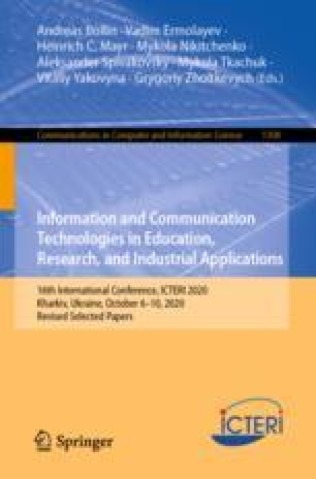
Information and communication technologies in education, research, and industrial applications ; 16th International Conference, ICTERI 2020, Kharkiv, Ukraine, October 6–10, 2020, Revised Selected Papers
This book contains revised and extended versions of the best papers presented at the 16th International Conference on Information and Communication Technologies in Education, Research, and Industrial Applications, ICTERI 2020, held in Kherson, Ukraine, in October 2020. Due to the COVID-19 pandemic the conference was held online. The 8 revised full papers included in this volume were carefully reviewed and selected from 347 initial submissions. The papers are organized in the following topical sections: ICT in education; ICT in research and industry.

Information and communication technologies and real-life learning : New education for the knowledge society
The IFIP series publishes state-of-the-art results in the sciences and technologies of information and communication. The scope of the series includes: foundations of computer science; software theory and practice; education; computer applications in technology; communication systems; systems modeling and optimization; information systems; computers and society; computer systems technology; security and protection in information processing systems; artificial intelligence; and human-computer interaction. Proceedings and post-proceedings of referred international conferences in computer science and interdisciplinary fields are featured. These results often precede journal publication and represent the most current research. The principal aim of the IFIP series is to encourage education and the dissemination and exchange of information about all aspects of computing.

Industrial applications of semantic web ; Proceedings of the 1st International IFIP/WG12.5 Working Conference on Industrial Applications of Semantic Web, August 25-27, 2005 Jyvaskyla, Finland
The IFIP series publishes state-of-the-art results in the sciences and technologies of information and communication. The scope of the series includes: foundations of computer science; software theory and practice; education; computer applications in technology; communication systems; systems modeling and optimization; information systems; computers and society; computer systems technology; security and protection in information processing systems; artificial intelligence; and human-computer interaction. Proceedings and post-proceedings of referred international conferences in computer science and interdisciplinary fields are featured. These results often precede journal publication and represent the most current research. The principal aim of the IFIP series is to encourage education and the dissemination and exchange of information about all aspects of computing.

Inductive logic programming ; 17th International Conference, ILP 2007, Corvallis, OR, USA, June 19-21, 2007, Revised Selected Papers
The 18th International Conference on Inductive Logic Programming was held in Prague, September 10–12, 2008. ILP returned to Prague after 11 years, and it is tempting to look at how the topics of interest have evolved during that time. The ILP community clearly continues to cherish its beloved ?rst-order logic representation framework. This is legitimate, as the work presented at ILP 2008 demonstrated that there is still room for both extending established ILP approaches (such as inverse entailment) and exploring novel logic induction frameworks (such as brave induction). Besides the topics lending ILP research its unique focus.
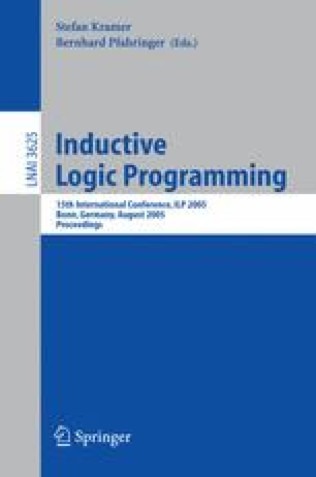
Inductive logic programming ; 15th International Conference, ILP 2005, Bonn, Germany, August 10-13, 2005, Proceedings
“Change is inevitable.” Embracing this quote we have tried to carefully exp- iment with the format of this conference, the 15th International Conference on Inductive Logic Programming, hopefully making it even better than it already was. But it will be up to you, the inquisitive reader of this book, to judge our success. The major changes comprised broadening the scope of the conference to include more diverse forms of non-propositional learning, to once again have tutorials on exciting new areas, and, for the ?rst time, to also have a discovery challenge as a platform for collaborative work. This year the conference was co-located with ICML 2005, the 22nd Inter- tional Conference on Machine Learning, and also in close proximity to IJCAI 2005, the 19th International Joint Conference on Arti?cial Intelligence. - location can be tricky, but we greatly bene?ted from the local support provided by Codrina Lauth, Michael May, and others. We were also able to invite all ILP and ICML participants to shared events including a poster session, an invited talk, and a tutorial about the exciting new area of “statistical relational lea- ing”. Two more invited talks were exclusively given to ILP participants and were presented as a kind of stock-taking—?ttingly so for the 15th event in a series—but also tried to provide a recipe for future endeavours.
