



Page 6
Page 6

Information theory and machine learning
The recent successes of machine learning, especially regarding systems based on deep neural networks, have encouraged further research activities and raised a new set of challenges in understanding and designing complex machine learning algorithms. New applications require learning algorithms to be distributed, have transferable learning results, use computation resources efficiently, convergence quickly on online settings, have performance guarantees, satisfy fairness or privacy constraints, incorporate domain knowledge on model structures, etc. A new wave of developments in statistical learning theory and information theory has set out to address these challenges.

Information Systems Security ; 16th International Conference, ICISS 2020, Jammu, India, December 16–20, 2020, Proceedings
This book constitutes the proceedings of the 16th International Conference on Information Systems Security, ICISS 2020, held in Jammu, India, during December 16-20, 2020. The 11 regular papers, 2 short papers and 3 work-in-progress papers included in this volume were carefully reviewed and selected from a total of 53 submissions. The papers were organized in topical sections named: access control; AI/ML in security; privacy and Web security; cryptography; and systems security.

Information systems management
Intended for the technical reader who works with large volumes of data. Written by experts in information systems management, the book includes chapters on software development, cloud implementation, networking, and handling large datasets, among other topics. Blockchain and artificial intelligence (AI) are the foundations of automated systems and the authors provide their viewpoints on information management by using these fundamental domains of information technology.

Information Security Handbook
Provides a comprehensive collection of knowledge for emerging multidisciplinary research areas such as cybersecurity, IoT, Blockchain, Machine Learning, Data Science, and AI. This book brings together, in one resource, information security across multiple domains. It explores basic and high-level concepts and serves as a manual for industry while also helping beginners to understand both basic and advanced aspects in security-related issues. The handbook explores security and privacy issues through the IoT ecosystem and implications to the real world and, at the same time, explains the concepts of IoT-related technologies, trends, and future directions.

Information security and privacy ; 25th Australasian Conference, ACISP 2020, Perth, WA, Australia, November 30 – December 2, 2020, Proceedings
This book constitutes the refereed proceedings of the 25th Australasian Conference on Information Security and Privacy, ACISP 2020, held in Perth, WA, Australia, in November 2020*. The 31 revised full papers and 5 short papers presented were carefully revised and selected from 151 submissions. The papers present and discuss the latest research, trends, breakthroughs, and challenges in the domain of information security, privacy and cybersecurity on a variety of topics such as post-quantum cryptography; symmetric cipher; signature; network security and blockchain; cryptographic primitives; mathematical foundation; machine learning security, among others.
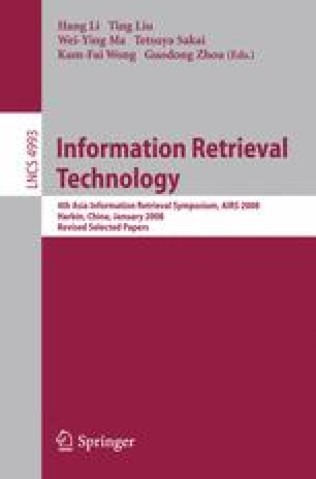
Information Retrieval Technology ; 4th Asia Infomation Retrieval Symposium, AIRS 2008, Harbin, China, January 15-18, 2008 Revised Selected Papers
This book constitutes the thoroughly refereed post-conference proceedings of the 4th Asia Information Retrieval Symposium, AIRS 2008, held in Harbin, China, in May 2008.The 39 revised full papers and 43 revised poster papers presented were carefully reviewed and selected from 144 submissions. All current issues in information retrieval are addressed: applications, systems, technologies and theoretical aspects of information retrieval in text, audio, image, video and multi-media data. The papers are organized in topical sections on IR models image retrieval.
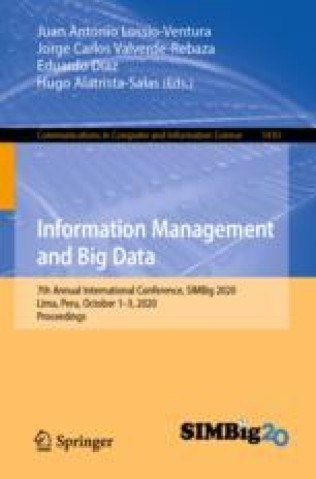
Information Management and Big Data ; 7th Annual International Conference, SIMBig 2020, Lima, Peru, October 1–3, 2020, Proceedings
This book constitutes the refereed proceedings of the 7th International Conference on Information Management and Big Data, SIMBig 2020, held in Lima, Peru, in October 2020.* The 32 revised full papers and 7 revised short papers presented were carefully reviewed and selected from 122 submissions. The papers address topics such as natural language processing and text mining; machine learning; image processing; social networks; data-driven software engineering; graph mining; and Semantic Web, repositories, and visualization.
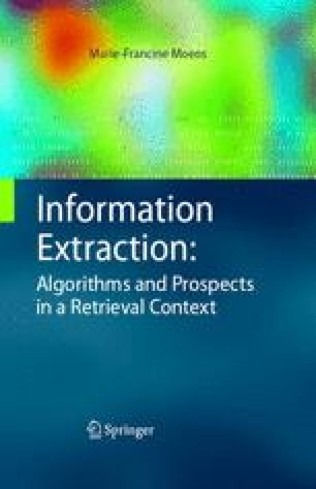
Information extraction : Algorithms and prospects in a retrieval context
The book focuses on content recognition in text. It elaborates on the past and current most successful algorithms and their application in a variety of domains (e.g., news filtering, mining of biomedical text, intelligence gathering, competitive intelligence, legal information searching, and processing of informal text). An important part discusses current statistical and machine learning algorithms for information detection and classification and integrates their results in probabilistic retrieval models. The book also reveals a number of ideas towards an advanced understanding and synthesis of textual content.

Information context : Nature, impact, and role ; 5th International conference on Conceptions of Library and Information Sciences, CoLIS 2005, Glasgow, UK, June 4-8, 2005 Proceedings
.CoLIS examinesthehistorical,theoretical,empiricalandtechnicalissuesrelatingtoour understanding and use of information, promoting an interdisciplinary approach to research. CoLIS seeks to provide a broad platform for the examination of context as it relates to our theoretical, empirical and technical development of information-centered disciplines. The theme for CoLIS 5 was the nature, impact and role of context within information-centered research. Context is a complex, dynamic and multi- - mensional concept that in?uences both humans and machines: how they behave individually and how they interact with each other. In CoLIS 5 we took an interdisciplinary approach to the issue of context to help us understand and the theoretical approaches to modelling and understanding context, incorporate contextual reasoning within technology, and develop a shared framework for promoting the exploration of context.

Information and knowledge systems : Digital technologies, artificial intelligence and decision making ; 5th International Conference, ICIKS 2021, Virtual Event, June 22–23, 2021, Proceedings
This book constitutes the thoroughly refereed proceedings of the 5th International Conference on Information and Knowledge Systems, ICIKS 2021, which was held online during June 22-23, 2021. The International Conference on Information and Knowledge Systems (ICIKS 2021) gathered both researchers and practitioners in the fields of Information Systems, Artificial Intelligence, Knowledge Management and Decision Support. ICIKS seeks to promote discussions on various organizational, technological, and socio-cultural aspects of research in the design and use of information and knowledge systems in organizations.

Information and Complexity in Statistical Modeling
The main theme in this book is to teach modeling based on the principle that the objective is to extract the information from data that can be learned with suggested classes of probability models. The intuitive and fundamental concepts of complexity, learnable information, and noise are formalized, which provides a firm information theoretic foundation for statistical modeling.
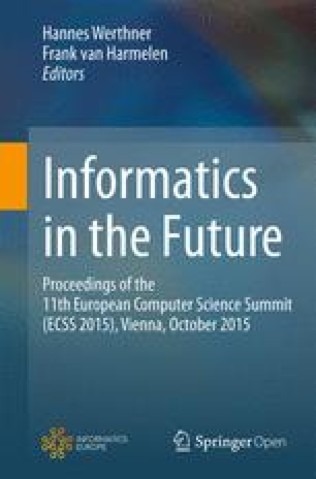
Informatics in the Future ; Proceedings of the 11th European Computer Science Summit (ECSS 2015), Vienna, October 2015
This volume discusses the prospects and evolution of informatics (or computer science), which has become the operating system of our world, and is today seen as the science of the information society. Its artifacts change the world and its methods have an impact on how we think about and perceive the world. Classical computer science is built on the notion of an “abstract” machine, which can be instantiated by software to any concrete problem-solving machine, changing its behavior in response to external and internal states, allowing for self-reflective and “intelligent” behavior. However, current phenomena such as the Web, cyber physical systems or the Internet of Things show us that we might already have gone beyond this idea, exemplifying a metamorphosis from a stand-alone calculator to the global operating system of our society.

Informatics in Control, Automation and Robotics II
Informatics in Control, Automation and Robotics II is a collection of the best papers presented at the 2nd International Conference on Informatics in Control, Automation and Robotics (ICINCO). The purpose of ICINCO was to bring together researchers, engineers and practitioners interested in the application of informatics to Control, Automation and Robotics.

Inductive logic programming ; 17th International Conference, ILP 2007, Corvallis, OR, USA, June 19-21, 2007, Revised Selected Papers
The 18th International Conference on Inductive Logic Programming was held in Prague, September 10–12, 2008. ILP returned to Prague after 11 years, and it is tempting to look at how the topics of interest have evolved during that time. The ILP community clearly continues to cherish its beloved ?rst-order logic representation framework. This is legitimate, as the work presented at ILP 2008 demonstrated that there is still room for both extending established ILP approaches (such as inverse entailment) and exploring novel logic induction frameworks (such as brave induction). Besides the topics lending ILP research its unique focus.
Inductive logic programming ; 15th International Conference, ILP 2005, Bonn, Germany, August 10-13, 2005, Proceedings
“Change is inevitable.” Embracing this quote we have tried to carefully exp- iment with the format of this conference, the 15th International Conference on Inductive Logic Programming, hopefully making it even better than it already was. But it will be up to you, the inquisitive reader of this book, to judge our success. The major changes comprised broadening the scope of the conference to include more diverse forms of non-propositional learning, to once again have tutorials on exciting new areas, and, for the ?rst time, to also have a discovery challenge as a platform for collaborative work. This year the conference was co-located with ICML 2005, the 22nd Inter- tional Conference on Machine Learning, and also in close proximity to IJCAI 2005, the 19th International Joint Conference on Arti?cial Intelligence. - location can be tricky, but we greatly bene?ted from the local support provided by Codrina Lauth, Michael May, and others. We were also able to invite all ILP and ICML participants to shared events including a poster session, an invited talk, and a tutorial about the exciting new area of “statistical relational lea- ing”. Two more invited talks were exclusively given to ILP participants and were presented as a kind of stock-taking—?ttingly so for the 15th event in a series—but also tried to provide a recipe for future endeavours.
IMPROVE - Innovative modelling approaches for production systems to raise validatable efficiency : Intelligent methods for the factory of the future
This open access work presents selected results from the European research and innovation project IMPROVE which yielded novel data-based solutions to enhance machine reliability and efficiency in the fields of simulation and optimization, condition monitoring, alarm management, and quality prediction.

Implementing machine learning for finance : A systematic approach to predictive risk and performance analysis for investment portfolios
Introduces pattern recognition and future price forecasting that exerts effects on time series analysis models, such as the Autoregressive Integrated Moving Average (ARIMA) model, Seasonal ARIMA (SARIMA) model, and Additive model, and it covers the Least Squares model and the Long Short-Term Memory (LSTM) model. It presents hidden pattern recognition and market regime prediction applying the Gaussian Hidden Markov Model. The book covers the practical application of the K-Means model in stock clustering. It establishes the practical application of the Variance-Covariance method and Simulation method (using Monte Carlo Simulation) for value at risk estimation. It also includes market direction classification using both the Logistic classifier and the Multilayer Perceptron classifier. Finally, the book presents performance and risk analysis for investment portfolios. You will: Understand the fundamentals of the financial market and algorithmic trading, as well as supervised and unsupervised learning models that are appropriate for systematic investment portfolio management / Know the concepts of feature engineering, data visualization, and hyperparameter optimization / Design, build, and test supervised and unsupervised ML and DL models / Discover seasonality, trends, and market regimes, simulating a change in the market and investment strategy problems and predicting market direction and prices / Structure and optimize an investment portfolio with preeminent asset classes and measure the / underlying risk

Implementation and application of functional languages ; Vol. 3474 ; 16th International Workshop, IFL 2004, Lübeck, Germany, September 8-10, 2004, Revised Selected Papers
The 16th International Workshop on Implementation and Application of Fu- tional Languages (IFL 2004) was held in Lub ¨ eck, Germany, September 8–10, 2004. It was jointly organized by the Institute of Computer Science and Applied Mathematics of the University of Kiel and the Institute of Software Technology and Programming Languages of the University of Lub ¨ eck. IFL 2004 was the sixteenth event in the annual series of IFL workshops. The aim of the workshop series is to bring together researchers actively engaged in the implementation and application of functional and function-based progr- ming languages. It provides an open forum for researchers who wish to present and discuss new ideas and concepts, work in progress, preliminary results, etc., related primarily, but not exclusively, to the implementation and application of functional languages. Topics of interest cover a wide range from theoretical - pects over language design and implementation towards applications and tool support.

Implementation and application of automata ; Vol. 3317 ; 9th International Conference, CIAA 2004, Kingston, Canada, July 22-24, 2004, Revised Selected Papers
Contains the revised versions of the papers presented at the 9th International Conference on Implemen- tion and Application of Automata, CIAA 2004. Also included are the extended abstracts of the posters accepted to the conference. The conference was held at Queen’s University in Kingston, Ontario, Canada on July 22–24, 2004. As for its predecessors, the theme of CIAA 2004 was the implementation of automata and grammars of all types and their application in other fields. The topics of the papers presented at the conference range from applications of automata in natural language and speech processing to protein sequencing and genecompression, and from state complexity and new algorithms for automata operations to applications of quantum finite automata.

Impact of artificial intelligence on organizational transformation
Covers the areas like artificial intelligence & its impact on professions, as well as machine learning algorithms and technologies. The context of applications of AI in business process innovation primarily includes new business models, AI readiness and maturity at the organizational, technological, financial, and cultural levels. The book has extensive details on machine learning and the applications such as robotics, blockchain, Internet of Things. Also discussed are the influence of AI on financial strategies and policies, human skills & values, procurement innovation, production innovation, AI in marketing & sales platforms.
