



Page 6
Page 6

Introduction to software design with Java
Provides an in-depth introduction to software design, with a focus on object-oriented design, and using the Java programming language. Its goal is to help readers learn software design by discovering the experience of the design process. To this end, the text follows a continuous narrative that introduces each element of design know-how in context, and explores alternative solutions in that context. This narrative is complemented by hundreds of code fragments and design diagrams.

Introduction to Scientific Programming with Python
This book offers an initial introduction to programming for scientific and computational applications using the Python programming language. The presentation style is compact and example-based, making it suitable for students and researchers with little or no prior experience in programming.

Introduction to Reliable Distributed Programming
Guerraoui and Rodrigues present an introductory description of fundamental reliable distributed programming abstractions as well as algorithms to implement these abstractions. The authors follow an incremental approach by first introducing basic abstractions in simple distributed environments, before moving to more sophisticated abstractions and more challenging environments. Each core chapter is devoted to one specific class of abstractions, covering reliable delivery, shared memory, consensus and various forms of agreement. This textbook comes with a companion set of running examples implemented in Java. These can be used by students to get a better understanding of how reliable distributed programming abstractions can be implemented and used in practice. Combined, the chapters deliver a full course on reliable distributed programming. The book can also be used as a complete reference on the basic elements required to build reliable distributed applications.

Introduction to Programming with Fortran : with coverage of Fortran 90, 95, 2003 and 77
Introduction to Programming with Fortran contains: lots of clear and simple examples highlighting the key language features of the most recent versions of Fortran – Fortran 2003, 95 and 90. practical examples based on ISO TR 15580 and ISO TR 15581 which are widely supported and cover the ISO TR on Enhanced Modules – particularly important to large code suites common problems that occur when programming which are highlighted via clear examples and solutions Introduction to Programming with Fortran is an essential introduction for beginners as well as a concise reference for professionals. Overall the book gives a very effective hands-on coverage of Fortran, valuable to students and practitioners alike.

Introduction to PHP for Scientists and Engineers : Beyond JavaScript
This text presents key information needed to write your own online science and engineering applications, including reading, creating and manipulating data files stored as text on a server, thereby overcoming the limitations of a client-side language.

Introduction to Operating System Design and Implementation : The OSP 2 Approach
This book exposes students to many essential features of operating systems while at the same time isolating them from low-level, machine-dependent concerns. With its accompanying software, the book contains enough projects for up to three semesters.

Introduction to Geometric Computing
The geometric ideas in computer science, mathematics, engineering, and physics have considerable overlap and students in each of these disciplines will eventually encounter geometric computing problems. The topic is traditionally taught in mathematics departments via geometry courses, and in computer science through computer graphics modules. This text isolates the fundamental topics affecting these disciplines and lies at the intersection of classical geometry and modern computing.

Introduction to data systems : Building from Python
Encompassing a broad range of forms and sources of data, this textbook introduces data systems through a progressive presentation. Introduction to Data Systems covers data acquisition starting with local files, then progresses to data acquired from relational databases, from REST APIs and through web scraping. It teaches data forms/formats from tidy data to relationally defined sets of tables to hierarchical structure like XML and JSON using data models to convey the structure, operations, and constraints of each data form.

Introduction to Computer Graphics : Using Java 2D and 3D
This book introduces the most important basic concepts of computer graphics, coupling the technical background and theory with practical examples and applications throughout. Its user-friendly approach enables the reader to gain understanding through the theory at work, via the many example programs provided. With only elementary knowledge of the programming language Java, the reader will be able to create their own images and animations immediately, using Java 2D and/or Java 3D.

Introduction to C++ Programming and Graphics
Introduction to C++ Programming and Graphics offers a venue for rapidly learning the language by concisely revealing its grammar, syntax and main features, and by explaining the key ideas behind object oriented programming (OOP), with emphasis on scientific computing.

Introduction to C++ : 500+ Difficulty-Scaled Solved Programming Exercises
Includes more than 500 exercises and examples of progressive difficulty to aid the reader in understanding the C++ principles and to see how concepts can materialize in code. The examples are designed to be short, concrete, and substantial, quickly giving the reader the ability to understand how to apply correctly and efficiently the features of the C++ language and to get a solid programming know-how. Rest assured that if you are able to understand this book's examples and solve the exercises, you can safely go on to edit larger programs, you will be able to develop your own applications, and you will have certainly established a solid fundamental conceptual and practical background to expand your knowledge and skills
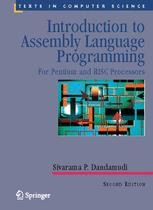
Introduction to Assembly Language Programming : For Pentium and RISC Processors
Assembly language continues to hold a core position in the programming world because of its similar structure to machine language and its very close links to underlying computer-processor architecture and design. These features allow for high processing speed, low memory demands, and the capacity to act directly on the system’s hardware. This completely revised second edition of the highly successful Introduction to Assembly Language Programming introduces readers to assembly language programming and its role in computer programming and design. It focuses on providing a firm grasp of the main features of assembly programming, and how it can be used to improve a computer's performance. The revised edition covers a broad scope of subjects and adds valuable material on protected-mode Pentium programming, MIPS assembly language programming, and use of the NASM and SPIM assemblers for a Linux orientation. All of the language's main features are covered in depth. The book requires only some basic experience with a structured, high-level language.

Introduction to Algorithms
Combines rigor and comprehensiveness. The book covers a broad range of algorithms in depth, yet makes their design and analysis accessible to all levels of readers. Each chapter is relatively self-contained and can be used as a unit of study. The algorithms are described in English and in a pseudocode designed to be readable by anyone who has done a little programming. The explanations have been kept elementary without sacrificing depth of coverage or mathematical rigor. The first edition became a widely used text in universities worldwide as well as the standard reference for professionals. The second edition featured new chapters on the role of algorithms, probabilistic analysis and randomized algorithms, and linear programming.

Introduction to Algorithms
Combines rigor and comprehensiveness. It covers a broad range of algorithms in depth, yet makes their design and analysis accessible to all levels of readers, with self-contained chapters and algorithms in pseudocode. Since the publication of the first edition, Introduction to Algorithms has become the leading algorithms text in universities worldwide as well as the standard reference for professionals. This fourth edition has been updated throughout.

Introduction à SCILAB
Ce livre est organisé en deux parties. La première partie est consacrée au langage Scilab et à son environnement. Dans la seconde partie, les fonctionnalités des grands domaines d'utilisation du calcul numérique sont décrites et illustrées par des exemples: calcul matriciel, simulation, optimisation, résolution d'équations, statistiques.

Introducing Robotic Process Automation to Your Organization : A Guide for Business Leaders
Enables you, a novice to RPA, to successfully implement an RPA program at your company. RPA is rapidly growing in use, but is only starting to be taught at a university level. Many mid-level managers will be tasked with introducing an RPA program at their organizations as senior management learns of its efficacy, but will be unfamiliar with how to do so. This book provides you with the skills and information you need to make an informed decision. You will learn: Know the benefits of robotic process automation (RPA) / Understand the limitations of RPA / Ask the right questions to determine whether a process is a good candidate for automation / Obtain buy-in from skeptics at the senior and middle manager levels, and from line workers Be familiar with the structure required for success

Introducing Blockchain with Java : Program, Implement, and Extend Blockchains with Java
Includes numerous exercises and test questions to help you solidify what you have learned as you progress through the book, and provides ideas on expanding the codebase to make it your own. You will have access to a fully-functioning repository with Java code. You will have the knowledge necessary to program your own blockchains with Java and you will have a completed project for your portfolio. You will: Know the most important theoretical concepts of the blockchain / Code the blockchain in Java / Create a user interface with JavaFX / Implement SQLite DB using JDBC Driver / Create a P2P multi-threaded app / Create your own cryptocurrency app with full functionality / Implement blockchain technology on a P2P network from scratch using Java, JavaFX, and SQL

Internet and Network Economics ; Vol. 3828 : 1st International Workshop, WINE 2005, Hong Kong, China, December 15-17, 2005, Proceedings
Consists of the main program of 31 papers, of which the submitter email accounts are: 10 from edu (USA) accounts, 3 from hk (Hong Kong), 2 each from il (Isreal), cn (China), ch (Switzerland), de (Germany), jp (Japan), gr (Greece), 1 each from hp. com, sohu. com, pl (Poland), fr (France), ca (Canada), and in (India). In addition, 77 papers from 20 countries or regions and 6 dot. coms were selected for 16 special focus tracks in the areas of Internet and Algorithmic Economics; E-Commerce Protocols; Security; Collaboration, Reputation and Social Networks; Algorithmic Mechanism; Financial Computing; Auction Algorithms; Online Algorithms; Collective Rationality; Pricing Policies; Web Mining Strategies; Network Economics; Coalition Strategies; Internet Protocols; Price Sequence; Equilibrium.

Intercultural Collaboration ; 1st International Workshop, IWIC 2007 Kyoto, Japan, January 25-26, 2007 Invited and Selected Papers
This book presents 29 revised invited and selected lectures given by top-researchers at the First International Workshop on Intercultural Collaboration, IWIC 2007, held in Kyoto, Japan in January 2007.
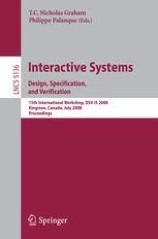
Interactive systems. design, specification, and verification ; 15th International Workshop, DSV-IS 2008 Kingston, Canada, July 16-18, 2008 Revised Papers
This book constitutes the refereed proceedings of the 15th International Workshop on Design, Specification, and Verification of Interactive Systems, DSV-IS 2008, held in Kingston, Canada, in July 2008.The 21 revised full papers and 10 late breaking and experience report papers presented were carefully reviewed and selected from numerous submissions for inclusion in the book. The papers cover user interface evaluation and specification, with particular emphasis on the use of task models to provide high-level approaches for capturing the intended functionality of a user interface; examining techniques for modeling user interfaces, particularly for mobile and ubiquitous applications.
