



Page 54
Page 54

Computer Vision -- ECCV 2006 ; Vol. 3954 ; 9th European Conference on Computer Vision, Graz, Austria, May 7-13, 2006, Proceedings, Part IV
Constitutes the refereed proceedings of the 9th European Conference on Computer Vision, 2006. This book covers a range of issues in computer vision, on recognition, statistical models and visual learning, 3D reconstruction and multi-view geometry, energy minimization, tracking and motion, segmentation, shape from X, visual tracking, and more.

Computer Vision -- ECCV 2006 ; Vol. 3953 ; 9th European Conference on Computer Vision, Graz, Austria, May 7-13, 2006, Proceedings, Part III
Constitutes the refereed proceedings of the 9th European Conference on Computer Vision, 2006. This book covers a range of issues in computer vision, on recognition, statistical models and visual learning, 3D reconstruction and multi-view geometry, energy minimization, tracking and motion, segmentation, shape from X, visual tracking, and more.

Computer Vision -- ECCV 2006 ; Vol. 3952 ; 9th European Conference on Computer Vision, Graz, Austria, May 7-13, 2006, Proceedings, Part II
Constitutes the refereed proceedings of the 9th European Conference on Computer Vision, 2006. This book covers a range of issues in computer vision, on recognition, statistical models and visual learning, 3D reconstruction and multi-view geometry, energy minimization, tracking and motion, segmentation, shape from X, visual tracking, and more.

Computer Vision - ECCV 2002 ; 7th European Conference on Computer Vision, Copenhagen, Denmark, May 28-31, 2002. Proceedings. Part IV
The privilege of organizing it was shared by three universities: The IT University of Copenhagen, the University of Copenhagen, and Lund University, with the conference venue in Copenhagen. This year’s conference attracted more papers than ever before, with around 600 submissions. Still, together with the conference board, we decided to keep the tradition of holding ECCV as a single track conference. Each paper was anonymously refereed by three different reviewers. For the ?nal selection, for the ?rst time for ECCV, a system with area chairs was used.

Computer Vision - ECCV 2002 ; 7th European Conference on Computer Vision, Copenhagen, Denmark, May 28-31, 2002. Proceedings. Part II
The privilege of organizing it was shared by three universities: The IT University of Copenhagen, the University of Copenhagen, and Lund University, with the conference venue in Copenhagen. This year’s conference attracted more papers than ever before, with around 600 submissions. Still, together with the conference board, we decided to keep the tradition of holding ECCV as a single track conference. Each paper was anonymously refereed by three different reviewers. For the ?nal selection, for the ?rst time for ECCV, a system with area chairs was used.

Computer Vision - ECCV 2002 ; 7th European Conference on Computer Vision, Copenhagen, Denmark, May 28-31, 2002, Proceedings, Part III
The privilege of organizing it was shared by three universities: The IT University of Copenhagen, the University of Copenhagen, and Lund University, with the conference venue in Copenhagen. This year’s conference attracted more papers than ever before, with around 600 submissions. Still, together with the conference board, we decided to keep the tradition of holding ECCV as a single track conference. Each paper was anonymously refereed by three different reviewers. For the ?nal selection, for the ?rst time for ECCV, a system with area chairs was used.
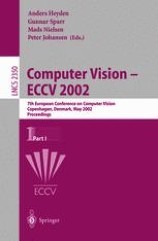
Computer Vision - ECCV 2002 ; 7th European Conference on Computer Vision, Copenhagen, Denmark, May 28-31, 2002, Proceedings, Part I
The privilege of organizing it was shared by three universities: The IT University of Copenhagen, the University of Copenhagen, and Lund University, with the conference venue in Copenhagen. This year’s conference attracted more papers than ever before, with around 600 submissions. Still, together with the conference board, we decided to keep the tradition of holding ECCV as a single track conference. Each paper was anonymously refereed by three different reviewers. For the ?nal selection, for the ?rst time for ECCV, a system with area chairs was used.

Computer Vision – ACCV 2007 ; 8th Asian Conference on Computer Vision, Tokyo, Japan, November 18-22, 2007, Proceedings, Part II
Contains sections on shape and texture, fitting, calbration, detection, image and video processing, applications, face and gesture, tracking, camera networks, and face/gesture/action detection and recognition. This book also covers learning, motion and tracking, retrival and search, and human pose estimation.

Computer Vision – ACCV 2007 ; 8th Asian Conference on Computer Vision, Tokyo, Japan, November 18-22, 2007, Proceedings, Part I
Contains sections on shape and texture, fitting, calbration, detection, image and video processing, applications, face and gesture, tracking, camera networks, and face/gesture/action detection and recognition. This book also covers learning, motion and tracking, retrival and search, and human pose estimation.

Computer Viruses : from theory to applications
The purpose of this book is to propose a teaching approach to under- 1 stand what computer viruses really are and how they work. To do this, three aspects are covered ranging from theoretical fundamentals, to pr- tical applications and technical features; fully detailed, commented source 1 We will systematically use the plural form “viruses” instead of the litteral one “virii”. The latter is now an obsolete, though gramatically recommended, form. VIII Preface codes of viruses as well as inherent applications are proposed. So far, the applications-oriented aspects have hardly ever been addressed through the scarce existing literature devoted to computer viruses.

Computer Supported Cooperative Work in Design III ; 10th International Conference, CSCWD 2006, Nanjing, China, May 3-5, 2006, Revised Selected Papers
The design of complex artifacts and systems requires the cooperation of multidiscip- nary design teams using multiple commercial and proprietary engineering software tools (e.g., CAD, modeling, simulation, visualization, and optimization), engineering databases, and knowledge-based systems. Individuals or individual groups of mult- isciplinary design teams usually work in parallel and separately with various en- neering software tools which are located at different sites. In addition, individual members may be working on different versions of a design or viewing the design from different perspectives, at different levels of detail. In order to accomplish the work, it is necessary to have effective and efficient c- laborative design environments. Such environments should not only automate in- vidual tasks, in the manner of traditional computer-aided engineering tools, but also enable individual members to share information, collaborate, and coordinate their activities within the context of a design project. CSCW (computer-supported coope- tive work) in design is concerned with the development of such environments.

Computer Supported Cooperative Work in Design II ; 9th International Conference, CSCWD 2005, Coventry, UK, May 24-26, 2005, Revised Selected Papers
This book constitutes the thoroughly refereed post-proceedings of the 9th International Conference on Computer Supported Cooperative Work in Design, CSCWD 2005. it contain expanded versions of the papers presented at the conference and are organized in topical sections on CSCW techniques and methods, Grids and Web services, agents and multi-agent systems, ontology and knowledge management, collaborative design and manufacturing, enterprise collaboration, workflows, and other related approaches and applications.

Computer Supported Cooperative Work in Design I
The design of complex artifacts and systems requires the cooperation of multidisciplinary design teams using multiple commercial and non-commercial engineering tools such as CAD tools, modeling, simulation and optimization software, engineering databases, and knowledge-based systems. Individuals or individual groups of multidisciplinary design teams usually work in parallel and separately with various engineering tools, which are located on different sites, often for quite a long time. At any moment, individual members may be working on different versions of a design or viewing the design from various perspectives, at different levels of detail. In order to meet these requirements, it is necessary to have effective and efficient collaborative design environments. These environments should not only automate individual tasks, in the manner of traditional computer-aided engineering tools, but also enable individual members to share information, collaborate and coordinate their activities within the context of a design project. CSCW (computer-supported cooperative work) in design is concerned with the development of such environments.

Computer Security - ESORICS 2005
These proceedings contain the papers selected for presentation at the 10th - ropean Symposium on Research in Computer Security (ESORICS), held S- tember 12–14, 2005 in Milan, Italy. In response to the call for papers 159 papers were submitted to the conf- ence. These paperswere evaluated on the basis of their signi?cance, novelty,and technical quality. Each paper was reviewed by at least three members of the program committee. The program committee meeting was held electronically,

Computer science logic ; Vol. 4207 ; 20th International Workshop, CSL 2006, 15th Annual Conference of the EACSL, Szeged, Hungary, September 25-29, 2006, Proceedings
Coverage includes automated deduction and interactive theorem proving, constructive mathematics and type theory, equational logic and term rewriting, automata and formal logics, modal and temporal logic, model checking, finite model theory, and more.

Computer Science Logic ; Vol. 3634
This book constitutes the refereed proceedings of the 19th International Workshop on Computer Science Logic, CSL 2005, held as the 14th Annual Conference of the EACSL in Oxford, UK in August 2005. The 33 revised full papers presented together with 4 invited contributions were carefully reviewed and selected from 108 papers submitted. All current aspects of logic in computer science are addressed ranging from mathematical logic and logical foundations to methodological issues and applications of logics in various computing contexts. The volume is organized in topical sections on semantics and logics, type theory and lambda calculus, linear logic and ludics, constraints, finite models, decidability and complexity, verification and model checking, constructive reasoning and computational mathematics, and implicit computational complexity and rewriting.

Computer Science Logic ; 21 International Workshop, CSL 2007, 16th Annual Conference of the EACSL, Lausanne, Switzerland, September 11-15, 2007, Proceedings
This book covers logic and games, expressiveness, games and trees, logic and deduction, lambda calculus, finite model theory, linear logic, proof theory, and game semantics.

Computer Science : Theory and Applications ; 2nd International Symposium on Computer Science in Russia, CSR 2007, Ekaterinburg, Russia, September 3-7, 2007, Proceedings
This book covers theory track deals with algorithms, protocols, and data structures; complexity and cryptography; formal languages, automata and their applications to computer science; computational models and concepts; proof theory; and applications of logic to computer science. Many applications are presented.

Computer science : Theory and applications ; 15th International computer science symposium in Russia, CSR 2020, Yekaterinburg, Russia, June 29 – July 3, 2020, Proceedings
This book constitutes the proceedings of the 15th International Computer Science Symposium in Russia, CSR 2020, held in Yekaterinburg, Russia, in June 2020. The 25 full papers and 6 invited papers were carefully reviewed and selected from 49 submissions. The papers cover a broad range of topics, such as: algorithms and data structures; computational complexity, including hardness of approximation and parameterized complexity; randomness in computing, approximation algorithms, fixed-parameter algorithms; combinatorial optimization, constraint satisfaction, operations research; computational geometry; string algorithms; formal languages and automata, including applications to computational linguistics; codes and cryptography; combinatorics in computer science; computational biology; applications of logic to computer science, proof complexity; database theory; distributed computing; fundamentals of machine learning, including learning theory, grammatical inference and neural computing; computational social choice; quantum computing and quantum cryptography; theoretical aspects of big data.

Computer safety, reliability, and security ; 39th International Conference, SAFECOMP 2020, Lisbon, Portugal, September 16–18, 2020, Proceedings
This book constitutes the proceedings of the 39th International Conference on Computer Safety, Reliability and Security, SAFECOMP 2020, held in Lisbon, Portugal, in September 2020.* The 27 full and 2 short papers included in this volume were carefully reviewed and selected from 116 submissions. They were organized in topical sections named: safety cases and argumentation; formal verification and analysis; security modelling and methods; assurance of learning-enabled systems; practical experience and tools; threat analysis and risk mitigation; cyber-physical systems security; and fault injection and fault tolerance.
