



Page 4
Page 4

Artificial intelligence hardware design : Challenges and solutions
Learn foundational and advanced topics in Neural Processing Unit design with real-world examples from leading voices in the field. A thorough introduction to neural networks and neural network development history, as well as Convolutional Neural Network (CNN) models Explorations of various parallel architectures, including the Intel CPU, Nvidia GPU, Google TPU, and Microsoft NPU, emphasizing hardware and software integration for performance improvement Discussions of streaming graph for massive parallel computation with the Blaize GSP and Graphcore IPU An examination of how to optimize convolution with UCLA Deep Convolutional Neural Network accelerator filter decomposition

An Invitation to Abstract Mathematics
this book begins with a playful exploration of the building blocks of mathematics, such as definitions, axioms, and proofs. A study of the fundamental concepts of logic, sets, and functions follows, before focus turns to methods of proof. Having covered the core of a transition course, the author goes on to present a selection of advanced topics that offer opportunities for extension or further study. Throughout, appendices touch on historical perspectives, current trends, and open questions, showing mathematics as a vibrant and dynamic human enterprise.This second edition has been reorganized to better reflect the layout and curriculum of standard transition courses. It also features recent developments and improved appendices. An Invitation to Abstract Mathematics is ideal for those seeking a challenging and engaging transition to advanced mathematics, and will appeal to both undergraduates majoring in mathematics, as well as non-math majors interested in exploring higher-level concepts.
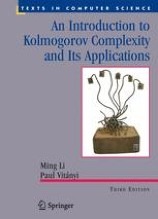
An Introduction to Kolmogorov Complexity and Its Applications
Written by two experts in the field, this book is ideal for advanced undergraduate students, graduate students, and researchers in all fields of science. It is self-contained: it contains the basic requirements from mathematics, probability theory, statistics, information theory, and computer science. Included are history, theory, new developments, a wide range of applications, numerous (new) problem sets, comments, source references, and hints to solutions of problems. This is the only comprehensive treatment of the central ideas of Kolmogorov complexity and their applications.
AI and UX : Why artificial intelligence needs user experience
Great effort has been put forth to continuously make AI “smarter.” But, will smarter always equal more successful AI? It is not just about getting a product to market, but about getting the product into a user’s hands in a form that will be embraced. This demands examining the product from the perspective of the user. Authors Gavin Lew and Robert Schumacher have written AI and UX to examine just how product managers and designers can best strike this balance. From exploring the history of the parallel journeys of AI and UX, to investigating past product examples and failures, to practical expert knowledge on how to best execute a positive user experience, AI and UX examines all angles of how AI can best be developed within a UX framework.

Agile processes in software engineering and extreme programming ; 20th International Conference, XP 2019, Montréal, QC, Canada, May 21–25, 2019, Proceedings
XP is the premier agile software development conference combining research and practice. It is a hybrid forum where agile researchers, academics, practitioners, thought leaders, coaches, and trainers get together to present and discuss their most recent innovations, research results, experiences, concerns, challenges, and trends. Following this history, for both researchers and seasoned practitioners XP 2019 provided an informal environment to network, share, and discover trends in Agile for the next 20 years.This volume presented agile adoption, agile practices; large-scale agile; agility beyond IT, and the future of agile.
Advances in computer games ; 11th International Conference, ACG 2005, Taipei, Taiwan, September 6-8, 2005. Revised Papers
Constitutes the thoroughly refereed post-proceedings of the 11th International Conference on Advances in Computer Games, ACG 2005, held in Taipei, Taiwan, in September 2005 in conjunction with the 10th Computer Olympiad. The 20 revised full papers presented were carefully selected during two rounds of reviewing and improvement from 32 submissions. The papers cover all aspects of artificial intelligence in computer-game playing. Reasearch topics addressed are automatic generation, optimization, opponent modelling, search, knowledge representation, and graph history interaction. Games covered are western chess, chinese and japanese chess, checkers, lose checkers, amazons, go, poker, loa, mastermind, awari, ataxx, pool, as well as the two theoretical games connect and sumbers.
Advances in Case-Based Reasoning ; 6th European Conference, ECCBR 2002 Aberdeen, Scotland, UK, September 4-7, 2002 Proceedings
The papers collected in this volume were presented at the 6th European C- ference on Case-Based Reasoning (ECCBR 2002) held at The Robert Gordon University in Aberdeen, UK. This conference followed a series of very succe- ful well-established biennial European workshops held in Trento, Italy (2000), Dublin, Ireland (1998), Lausanne, Switzerland (1996), and Paris, France (1994), after the initial workshop in Kaiserslautern, Germany (1993). These meetings have a history of attracting ?rst-class European and international researchers and practitioners in the years interleaving with the biennial international co- terpart ICCBR; the 4th ICCBR Conference was held in Vancouver, Canada in 2001.

Adaptive and natural computing algorithms ; Proceedings of the International Conference in Coimbra, Portugal, 2005
The ICANNGA series of Conferences has been organised since 1993 and has a long history of promoting the principles and understanding of computational intelligence paradigms within the scientific community and is a reference for established workers in this area.and this book about Proceedings of the International Conference in Coimbra, Portugal, 2005 including Topics Artificial Intelligence Simulation and Modeling / Mathematics of Computing / Computer Applications
Adaptive and Natural Computing Algorithms ; 8th International Conference, ICANNGA 2007, Warsaw, Poland, April 11-14, 2007, Proceedings, Part II
The ICANNGA series of conferences has been organized since 1993 and has a long history of promoting the principles and understanding of computational intelligence paradigms within the scientifc community. the ICANNGA series has established itself as a reference for scientists and practitioners in this area. The series has also been of value to young researchers wishing both to extend their knowledge and experience and to meet experienced professionals in their ?elds. In a rapidly advancing world, where technology and engineering change d- matically, new challenges in computer science compel us to broaden the c- ference scope in order to take into account new developments.
Active Lighting and Its Application for Computer Vision : 40 Years of History of Active Lighting Techniques
Computer vision entails both passive and active illumination techniques. Whereas passive techniques observe the scene statically and analyse it as is, by contrast active techniques give the scene some actions and try to facilitate the analysis. In particular, active illumination techniques project specific light, for which the characteristics are known beforehand, to a target scene to enable stable and accurate analysis of the scene.
A Brief History of Computing
This text provides a comprehensive introduction to the key topics in the history of computing, in an easy-to-follow and concise manner. It covers the significant areas and events in the field.
25 Years of Model Checking : History, Achievements, Perspectives
Model checking technology is among the foremost applications of logic to computer science and computer engineering. The model checking community has achieved many breakthroughs, bridging the gap between theoretical computer science and hardware and software engineering, and it is reaching out to new challenging areas such as system biology and hybrid systems. Model checking is extensively used in the hardware industry and has also been applied to the verification of many types of software. Model checking has been introduced into computer science and electrical engineering curricula at universities worldwide and has become a universal tool for the analysis of systems.
