



Page 32
Page 32

Graph-theoretic concepts in computer science ; 30th International workshop, WG 2004, Bad Honnef, Germany, June 21-23, 2004, Revised Papers
During its 30-year existence, the International Workshop on Graph-Theoretic Concepts in Computer Science has become a distinguished and high-quality computer science event. The workshop aims at uniting theory and practice by demonstrating how graph-theoretic concepts can successfully be applied to v- ious areas of computer science and by exposing new theories emerging from applications. In this way, WG provides a common ground for the exchange of information among people dealing with several graph problems and working in various disciplines. Thereby, the workshop contributes to forming an interdis- plinary research community. The original idea of the Workshop on Graph-Theoretic Concepts in C- puter Science was ingenuity in all theoretical aspects and applications of graph concepts, wherever applied. Within the last ten years, the development has strengthened in particular the topic of structural graph properties in relation to computational complexity.

Graphics Recognition. Recent Advances and New Opportunities ; 7th International Workshop, GREC 2007, Curitiba, Brazil, September 20-21, 2007. Selected Papers
This book constitutes the thoroughly refereed post-proceedings of the 7th International Workshop on Graphics Recognition, GREC 2007, held in Curitiba, Brazil in September 2007.The 30 revised full papers presented together with a panel discussion report were carefully selected and improved during two rounds of reviewing and revision. The papers are organized in topical sections on technical documents, maps and diagrams understanding; symbol and shape description and recognition; information retrieval, indexing and spotting; sketching interfaces and on-line processing; feature and primitive analysis and segmentation; performance evaluation and ground truthing.
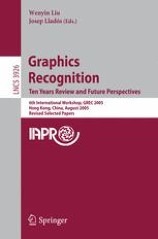
Graphics Recognition : TenYears Review and Future Perspectives ; 6th International Workshop, GREC 2005, Hong Kong, China, August 25-26, 2005, Revised Selected Papers
This book contains refereed and improved papers presented at the 6th IAPR Workshop on Graphics Recognition (GREC 2005). This year is the tenth anniversary of GREC, Graphics recognition is a particular field in the domain of document analysis, which combines pattern recognition and image processing techniques for the analysis of any kind of graphical information in documents from either paper or electronic formats. In its 10 year history, the graphics recognition community has extended its research topics from the analysis and understanding of graphic documents (including engineering drawings vectorization and recognition), to graphics-based information retrieval and symbol recognition, to new media analysis, and even stepped into research areas of other communities

Graph-based representations in pattern recognition ; 6th IAPR-TC-15 International Workshop, GbRPR 2007, Alicante, Spain, June 11-13, 2007, Proceedings
Constitutes the refereed proceedings of the 6th IAPR-TC-15 International Workshop on Graph-Based Representations in Pattern Recognition, GbRPR 2007, held in Alicante, Spain in June 2007.

Graph-based representations in pattern recognition ; 5th IAPR International Workshop, GbRPR 2005, Poitiers, France, April 11-13, 2005, Proceedings
Many vision problems have to deal with di?erent entities (regions, lines, line junctions, etc.) and their relationships. These entities together with their re- tionships may be encoded using graphs or hypergraphs. The structural inf- mation encoded by graphs allows computer vision algorithms to address both the features of the di?erent entities and the structural or topological relati- ships between them. Moreover, turning a computer vision problem into a graph problem allows one to access the full arsenal of graph algorithms developed in computer science. The Technical Committee (TC15, http://www.iapr.org/tcs.html) of the IAPR (International Association for Pattern Recognition) has been funded in order to federate and to encourage research work in these ?elds. Among its - tivities, TC15 encourages the organization of special graph sessions at many computer vision conferences and organizes the biennial workshop GbR.

Graph Transformations ; 4th International Conference, ICGT 2008, Leicester, United Kingdom, September 7-13, 2008. Proceedings
This book constitutes the refereed proceedings of the 4th International Conference on Graph Transformations, ICGT 2008, held in Leicester, UK, in September 2008.The 27 revised full papers presented together with 5 tutorial and workshop papers and 3 invited lectures were carefully selected from 57 submissions. All current aspects in graph drawing are addressed including hypergraphs and termgraph rewriting, applications of graph transformation, execution of graph transformations, compositional systems, validation and verification, graph languages and special transformation concepts, as well as patterns and model transformations.
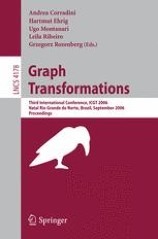
Graph Transformations ; 3rd International Conference, ICGT 2006, Rio Grande do Norte, Brazil, September 17-23, 2006, Proceedings
ICGT 2006 was the 3rd International Conference on Graph Transformation, following the previous two in Barcelona (2002) and Rome (2004), and a series of six international workshops between 1978 and 1998. The scope of the conference concerned graphical structures of various kinds (like graphs, diagrams and visual sentences) that are useful when describing complex structures and systems in a direct and intuitive way. These structures are often enriched with formalisms that model their evolution via suitable kinds of transformations. The ?eld of the conference was concerned with the theory, applications, and implementation issues of such formalisms. Particularemphasis wasputonmetamodelswhichcanaccommodateavarietyofgraphicalstructures within the same abstract theory.
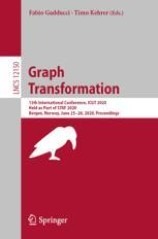
Graph Transformation ; 13th International Conference, ICGT 2020, Held as Part of STAF 2020, Bergen, Norway, June 25–26, 2020, Proceedings
This book constitutes the refereed proceedings of the 13th International Conference on Graph Transformation, ICGT 2020, in Bergen, Norway, in June 2020.* The 16 research papers and 4 tool paper presented in this book were carefully reviewed and selected from 40 submissions. One invited paper is also included. The papers deal with the following topics: theoretical advances; application domains; and tool presentations.

Graph structures for knowledge representation and reasoning ; 6th International Workshop, GKR 2020, virtual event, September 5, 2020, revised selected papers
This book constitutes the thoroughly refereed post-conference proceedings of the 6th International Workshop on Graph Structures for Knowledge Representation and Reasoning, GKR 2020, held virtually in September 2020, associated with ECAI 2020, the 24th European Conference on Artificial Intelligence.

Graph drawing ; Vol. 3383 ; 12th International symposium, GD 2004, New York, NY, USA, September 29-October 2, 2004, Revised Selected Papers
This book constitutes the thoroughly refereed post-proceedings of the 12th International Symposium on Graph Drawing, GD 2004, held in New York, NY, USA in September/October 2004. The 39 revised full papers and 12 revised short papers presented together with 4 posters and a report on the graph drawing context were carefully selected during two rounds of reviewing and improvement. All current aspects in graph drawing are addressed ranging from foundational and methodological issues to applications for various classes of graphs in a variety of fields.

Graph drawing ; 14th International symposium, GD 2006, Karlsruhe, Germany, September 18-20, 2006, Revised Papers
The 33 revised full papers and 5 revised short papers presented together with 2 invited talks, 1 system demo, 2 poster papers address all current aspects in graph drawing, ranging from foundational and methodological issues to applications for various classes of graphs in a variety of fields.
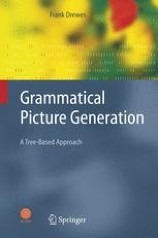
Grammatical Picture Generation : A Tree-Based Approach
The book presents important types of picture generators, using a tree-based approach to stress their common algorithmic basis, the treatment influenced by the theory of computation, and the theory of formal languages in particular. It guides the reader through the basics of the tree-based approach on to dedicated chapters on line-drawing languages, collage grammars, iterated function systems, grid picture languages, languages of fractals, and languages of coloured collages, while presenting results about (un)decidable, NP-complete, or efficiently solvable problems, normal forms, hierarchies of language classes, and related phenomena.

Grammatical Inference ; Algorithms and Applications : 9th International Colloquium, ICGI 2008 Saint-Malo, France, September 22-24, 2008 Proceedings
This book constitutes the refereed proceedings of the 9th International Colloquium on Grammatical Inference, ICGI 2008, held in Saint-Malo, France, in September 2008.The 21 revised full papers and 8 revised short papers presented were carefully reviewed and selected from 36 submissions. The topics of the papers presented vary from theoretical results of learning algorithms to innovative applications of grammatical inference, and from learning several interesting classes of formal grammars to applications to natural language processing.
Grammatical Inference : Algorithms and Applications ; 8th International Colloquium, ICGI 2006, Tokyo, Japan, September 20-22, 2006, Proceedings
The topics discussed range from theoretical results of learning algorithms to innovative applications of grammatical inference and from learning several interesting classes of formal grammars to applications to natural language processing.
Google Maps Mashups with Google Mapplets
Have a Google Maps mashup that you'd like to expose to millions of users on maps.google.com? New to the mapping craze, but have an idea for a killer map–based application? Want to learn how to create GeoRSS and KML feeds with your geotagged content, exposing your customer to new ways of exploring and navigating your content? Google Maps Mashups with Google Mapplets Is the first book to cover Google's Mapplet technology Shows you how to create Google Maps–based applications and publish to maps.google.com Provides a single–source resource and practical guide to Mapplets and mashups Teaches you how to mash up Mapplets using location–specific data

Global optimization and constraint satisfaction ; 2nd International Workshop, COCOS 2003, Lausanne, Switzerland, Nevember 18-21, 2003, Revised Selected Papers
Theformulationofmanypracticalproblemsnaturallyinvolvesconstraintsonthe variables entering the mathematical model of a real-life situation to be analyzed. It is of great interest to ?nd the possible scenarios satisfying all constraints, and, iftherearemanyofthem,eitherto?ndthebestsolution,ortoobtainacompact, explicit representation of the whole feasible set. The 2nd Workshop on Global Constrained Optimization and Constraint S- isfaction, COCOS 2003, which took place during November 18–21, 2003 in L- sanne, Switzerland, was dedicated to theoretical, algorithmic, and application oriented advances in answering these questions. Here global optimization refers to ?nding the absolutely best feasible point, while constraint satisfaction refers to?ndingallpossiblefeasiblepoints.AsinCOCOS2002,the?rstsuchworkshop (see the proceeedings [1]), the emphasis was on complete solving techniques for problems involving continuous variables that provide all solutions with full rigor, and on applications which, however, were allowed to have relaxed standards of rigor.
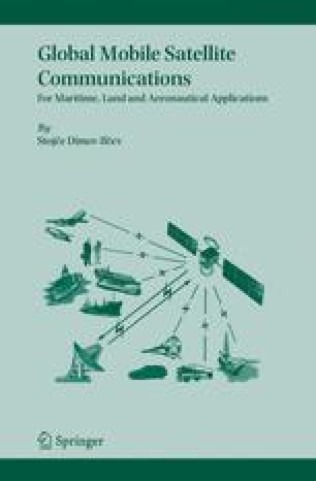
Global mobile satellite communications : For maritime, Land and aeronautical applications
This book is important for modern shipping, truck, train and aeronautical societies because GMSC in the present millennium provides more effective business and trade, with emphasis on safety and commercial communications. Global Mobile Satellite Communications is written to make bridges between potential readers and current GMSC trends, mobile system concepts and network architecture using a simple mode of style with understandable technical information, characteristics, graphicons, illustrations and mathematics equations
Global E-Security ; 4th International Conference, ICGeS 2008, London, UK, June 23-25, 2008. Proceedings
This book constitutes the refereed proceedings of the 4th International Conference on Global E-Security, ICGeS 2008, held in London, UK, in June 2008.The 36 revised full papers presented were carefully reviewed and selected from numerous submissions. The papers are organized in topical sections on cybercrime and digital forensics investigation, voice and video over internet protocols security, computer security, security architecture and authorisations, and IT governance.

Global Computing ; IST/FET International Workshop, GC 2004, Rovereto, Italy, March 9-12, 2004, Revised Selected Papers
This book constitutes the thoroughly refereed post-proceedings of the IST/FET International Workshop on Global Computing, GC 2004, held in Rovereto, Italy in March 2004. The 18 revised full papers presented were carefully selected during two rounds of reviewing and improvement from numerous submissions. Among the topics covered are programming environments, dynamic reconfiguration, resource guarantees, peer-to-peer networks, analysis of systems and resources, resource sharing, and security, as well as foundational calculi for mobility.

Gesture smart control
Nowadays actions are increasingly being handled in electronic ways, instead of physical interaction. From earlier times biometrics is used in the authentication of a person. It recognizes a person by using a human trait associated with it like eyes (by calculating the distance between the eyes) and using hand gestures, fingerprint detection, face detection etc. Advantages of using these traits for identification are that they uniquely identify a person and cannot be forgotten or lost. These are unique features of a human being which are being used widely to make the human life simpler. Hand gesture recognition system is a powerful tool that supports efficient interaction between the user and the computer.
