



Page 31
Page 31
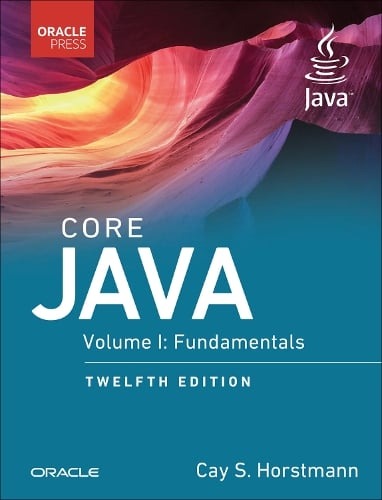
Core Java ; Vol. I : Fundamentals ; 12th ed.
The definitive guide to writing robust, maintainable code. Whatever version of Java you are using—up to and including Java 17—this book will help you achieve a deep and practical understanding of the language and APIs. With hundreds of realistic examples, Cay S. Horstmann reveals the most powerful and effective ways to get the job done.

Coordination models and languages ; Vol.4038 ; 8th International Conference, COORDINATION 2006, Bologna, Italy, June 14-16, 2006, Proceedings
This book constitutes the refereed proceedings of the 8th International Conference on Coordination Models and Languages, COORDINATION 2006, held in Bologna, Italy, June 2006. The 17 revised full papers presented were carefully reviewed and selected from 50 submissions. Among the topics addressed are component connectors, negotiation in service-oriented computing, process algebraic specification, workflow patterns, reactive XML, ubiquitous coordination, type systems, ad-hoc network coordination, choreography, communication coordination, and distributed embedded systems.

Coordination models and languages ; Vol.3454 : 7th international conference, COORDINATION 2005, Namur, Belgium, April 20-23, 2005, Proceedings
This book constitutes the refereed proceedings of the 7th International Conference on Coordination Models and Languages, COORDINATION 2005, held in Namur, Belgium in April 2005. The 19 revised full papers presented were carefully reviewed and selected from 88 submissions. Among the topics addressed are Web services, safe ambients, process calculus, abstract verification, role-based software, delegation modeling, distributed information flow, adaptive Web content provision, global computing, mobile agents, mobile computing, multithreaded code generation, shared data space coordination languages, automata specifications, time aware coordination, and service discovery.

Coordination models and languages ; 23rd IFIP WG 6.1 International Conference, COORDINATION 2021, Held as Part of the 16th International Federated Conference on Distributed Computing Techniques, DisCoTec 2021, Valletta, Malta, June 14–18, 2021, Proceedings
This book constitutes the refereed proceedings of the 23rd IFIP WG 6.1 International Conference on Coordination Models and Language, COORDINATION 2021, held in Valletta, Malta, in June 2021, as part of the 16th International Federated Conference on Distributed Computing Techniques, DisCoTec 2021. The 15 regular papers, 2 short papers, and 1 tutorial paper presented in this book were carefully reviewed and selected from 31 submissions. COORDINATION provides a well-established forum for the growing community of researchers interested in coordination models and languages, architectures, verification and implementation techniques necessary to cope with the complexity induced by the demands of today's software development.
Coordination models and languages ; 22nd IFIP WG 6.1 International Conference, COORDINATION 2020, Held as Part of the 15th International Federated Conference on Distributed Computing Techniques, DisCoTec 2020, Valletta, Malta, June 15–19, 2020, Proceedings
This book constitutes the proceedings of the 22nd International Conference on Coordination Models and Languages, COORDINATION 2020, which was due to be held in Valletta, Malta, in June 2020, as part of the 15th International Federated Conference on Distributed Computing Techniques, DisCoTec 2020. The conference was held virtually due to the COVID-19 pandemic. The 12 full papers and 6 short papers included in this volume were carefully reviewed and selected from 30 submissions. They are presented in this volume together with 2 invited tutorials and 4 tool papers. The papers are organized in the following topical sections: tutorials; coordination languages; message-based communication; communications: types & implementations; service-oriented computing; large-scale decentralized systems; smart contracts; modelling; verification & analysis.
Coordination models and languages ; 10th International Conference, COORDINATION 2008, Oslo, Norway, June 4-6, 2008. Proceedings
This book constitutes the refereed proceedings of the 10th International Conference on Coordination Models and Languages, COORDINATION 2008, held in Oslo, Norway, in June 2008, as one of the federated conferences on Distributed Computing Techniques, DisCoTec 2008.

Converged communications : Evolution from telephony to 5G mobile internet
The central theme of the book is to build deeper understanding about incremental technological progress by introducing both state of the art and their predecessor technologies. The book explores four main areas, including fixed telephone systems, data communication systems, mobile cellular systems, and IP multimedia systems. It clearly explains architectures, protocols, and functional procedures, and discusses a variety of topics ranging from physical layer processes to system level interactions. Converged Communications offers: In-depth treatments of fixed telephone and transmission systems, including operation of telephone exchanges and signaling systems Comprehensive explorations of data communication systems, including transmission of data over telephone lines and data network technologies, such as Ethernet and TCP/IP Incisive discussions of mobile cellular systems, including GSM, 3G, LTE, VoLTE and 5G Insightful analysis of incremental system evolution to justify various design choices made The book is supported with extensive online appendices, which covers communication system concepts, an overview of standardization, various technologies used in the past, state-of-the art technologies such as WLAN, cable modems, and FTTx, complementing the other systems described in the book which have evolved from the fixed telephone network.

Control problems for conservation laws with traffic applications: modeling, analysis, and numerical methods
Conservation and balance laws on networks have been the subject of much research interest given their wide range of applications to real-world processes, particularly traffic flow. This open access monograph is the first to investigate different types of control problems for conservation laws that arise in the modeling of vehicular traffic. Four types of control problems are discussed - boundary, decentralized, distributed, and Lagrangian control - corresponding to, respectively, entrance points and tolls, traffic signals at junctions, variable speed limits, and the use of autonomy and communication. Because conservation laws are strictly connected to Hamilton-Jacobi equations, control of the latter is also considered.

Control of nonlinear and hybrid process systems : Designs for uncertainty, constraints and time-delays
The book includes many detailed examples which can be easily modified by a control engineer to be tailored to a specific application. This book is useful for researchers in control systems theory, graduate students pursuing their degree in control systems and control engineers.

Contextual Process Digitalization: Changing Perspectives – Design Thinking – Value-Led Design
This book presents an overview and step-by-step explanation of process management. It starts with the individual participants’ perspectives on their work in a process and its structuring and harmonization, and then moves on to its specification in a model and how it is embedded in the organizational and IT environment of the company.

Contemporary Empirical Methods in Software Engineering
This book presents contemporary empirical methods in software engineering related to the plurality of research methodologies, human factors, data collection and processing, aggregation and synthesis of evidence, and impact of software engineering research. The individual chapters discuss methods that impact the current evolution of empirical software engineering and form the backbone of future research.

Constraint solving and language processing
Contains selected and thoroughly revised papers plus contributions from invited speakers presented at the First International Workshop on C- straint Solving and Language Processing, held in Roskilde, Denmark, September 1–3, 2004. Constraint Programming and Constraint Solving, in particular Constraint Logic Programming, appear to be a very promising platform, perhaps the most promising present platform, for bringing forward the state of the art in natural language processing, this due to the naturalness in speci?cation and the direct relation to e?cient implementation. Language, in the present context, may - fer to written and spoken language, formal and semiformal language, and even general input data to multimodal and pervasive systems, which can be handled in very much the same ways using constraint programming. The notion of constraints, with slightly differing meanings, apply in the characterization of linguistic and cognitive phenomena, in formalized linguistic m- els as well as in implementation-oriented frameworks. Programming techniques for constraint solving have been, and still are, in a period with rapid devel- ment of new eficient methods and paradigms from which language processing can prompt. A common metaphor for human language processing is one big c- straint solving process in which the differently specified linguistic and cognitive phases take place in parallel and with mutual cooperation, which ?ts quite well with current constraint programming paradigms.

Constituents of Modern System-safety Thinking
Constituents of Modern System-safety Thinking contains the invited papers presented at the Thirteenth annual Safety-critical Systems Symposium, held at Southampton, UK in February 2005. The papers included in this volume bring together topics that are of the utmost importance in current safety thinking. The core of modern safety thinking and practice is a risk-based approach, and, this is not only a common thread running throughout the papers, but is also explored in two of them. Other themes considered include the safety case, safety assessment, accident investigation, and the commonality between the processes and techniques employed in safety and security engineering. Papers contain extensive industrial experience as well as recent academic research and are presented under the headings: Independent Safety Assessment, Safety and Security, Accident Investigation, Risk and its Tolerability, Achieving and Arguing the Safety of Modular Systems, and Technologies for Dependability.

Concurrency Theory : Calculi an Automata for Modelling Untimed and Timed Concurrent Systems
Concurrency Theory is a synthesis of one of the major threads of theoretical computer science research focusing on languages and graphical notations for describing collections of simultaneously evolving components that interact through synchronous communication. The main specification notation focused on in this book is LOTOS. An extensive introduction to this particular process calculus is given, highlighting how the approach differs from competitor techniques, such as CCS and CSP.

CONCUR 2007 – Concurrency Theory ; 18th International Conference, CONCUR 2007, Lisbon, Portugal, September 3-8, 2007, Proceedings
This book includes model checking, process calculi, minimization and equivalence checking, types, semantics, probability, bisimulation and simulation, real time, and formal languages.

CONCUR 2006 - Concurrency Theory ; 17th International Conference, CONCUR 2006, Bonn, Germany, August 27-30, 2006
This volume contains the proceedings of the 17th International Conference on Concurrency Theory (CONCUR) held in Bonn, Germany, August 27–30, 2006. The scope of CONCUR covers all areas of semantics, logics, and verification techniques for concurrent systems.

Conceptual Modelling in Information Systems Engineering
Conceptual modeling has always been one of the cornerstones for information systems engineering as it describes the general knowledge of the system in the so-called conceptual schema.It contiant data modeling, goal-oriented modeling, agent-oriented modeling, and process-oriented modeling. Overall, the contributions reflect the most important developments and application areas of conceptual modeling in recent years, and they also pinpoint trends in conceptual modeling for the next decade.

Conceptual Modeling of Information Systems
When designing an information system, conceptual modeling is the activity that elicits and describes the general knowledge the system needs to know. This description, called the conceptual schema, is necessary in order to develop an information system.textbook explains in detail the principles of conceptual modeling independently from particular methods and languages and shows how to apply them in real-world projects. It covers all aspects of the engineering process from structural modeling over behavioral modeling to meta-modeling, and completes the presentation with an extensive case study based on the osCommerce system, an online store-management software program freely available under the GNU General Public License. His presentation is based on well-known industry standards like UML and OCL as a particular conceptual modeling language, yet also delivers the basics of the formal logical language background.

Conceptual Modeling - ER 2008 ; 27th International Conference on Conceptual Modeling, Barcelona, Spain, October 20-24, 2008. Proceedings
This book constitutes the refereed proceedings of the 27th International Conference on Conceptual Modeling, ER 2008, held in Barcelona, Spain, in October 2008.

Conceptual Modeling - ER 2006 ; 25th International Conference on Conceptual Modeling, Tucson, AZ, USA, November 6-9, 2006, Proceedings
The International Conference on Conceptual Modeling provides the premiere - rum for presenting and discussing current research and applications in which the - jor emphasis is on conceptual modeling. Topics of interest span the entire spectrum of conceptual modeling including research and practice in areas such as theories of c- cepts and ontologies underlying conceptual modeling, methods and tools for devel- ing and communicating conceptual models, and techniques for transforming conc- tual models into effective implementations.
