



Page 29
Page 29

Foundations of security analysis and design III : FOSAD 2004/2005 tutorial lectures
The increasing relevance of security to real-life applications, such as electronic commerce and Internet banking, is attested by the fast-growing number of - search groups, events, conferences, and summer schools that address the study of foundations for the analysis and the design of security aspects. The “Int- national School on Foundations of Security Analysis and Design” (FOSAD, see http://www.sti.uniurb.it/events/fosad/)has been one of the foremost events - tablishedwiththegoalofdisseminatingknowledgeinthiscriticalarea,especially for young researchers approaching the ?eld and graduate students coming from less-favoured and non-leading countries. The FOSAD school is held annually at the Residential Centre of Bertinoro (http://www.ceub.it/), in the fascinating setting of a former convent and ep- copal fortress that has been transformed into a modern conference facility with computing services and Internet access. Since the ?rst school, in 2000, FOSAD hasattractedmorethan250participantsand50lecturersfromallovertheworld.
Foundations of Security : What Every Programmer Needs to Know
Foundations of Security: What Every Programmer Needs to Know teaches new and current software professionals state-of-the-art software security design principles, methodology, and concrete programming techniques they need to build secure software systems.

Foundations of Popfly : Rapid Mashup Development
Author Eric Griffin shows you how to mix applications and share your hybrids with the world, using the Popfly Mashup Creator and Popfly Web Page Creator.
Foundations of Java for ABAP Programmers
The only beginning book of its kind, this book will teach you SAP/ABAP developers the skills you need for Java 5 programming. The book emphasizes the fundamentals of core Java SE 5 and Java EE 5, to get you up to speed with these technologies. You'll learn about the most important enterprise Java API found in the new Java EE 5 platform, which you can immediately use and integrate. Furthermore, the book elaborates on connecting to a database, SAP Java Connector, servlets, Java Server Pages, Enterprise JavaBeans, and Java Messaging.
Foundations of Intelligent Systems ; Vol. 4203 ; 16th International Symposium, ISMIS 2006, Bari, Italy, September 27-29, 2006, Proceedings
This book constitutes the refereed proceedings of the 16th International Symposium on Methodologies for Intelligent Systems, ISMIS 2006. The book presents 81 revised papers together with 3 invited papers. Topical sections include active media human-computer interaction, computational intelligence, intelligent agent technology, intelligent information retrieval, intelligent information systems, knowledge representation and integration, knowledge discovery and data mining, logic for AI and logic programming, machine learning, text mining, and Web intelligence.

Foundations of Intelligent Systems ; Vol. 3488 ; 15th International Symposium ISMIS 2005, Saratoga Springs, NY, USA, May 25-28, 2005, Proceedings
This volume contains the papers selected for presentation at the 15th International S- posiumonMethodologiesforIntelligentSystems, ISMIS2005, heldinSaratogaSprings, NewYork,25-28May,2005. ThesymposiumwasorganizedbySUNYatAlbany. Itwas sponsored by the Army Research Of?ce and by several units of the University at Albany including its Division for Research, College of Arts and Sciences, Department of C- puter Science, and Institute for Informatics, Logics, and Security Studies (formerly the Institute for Programming and Logics). The Program Committee selected the following major areas for ISMIS 2005: intelligent information systems, knowledge discovery and data mining, knowledge - formation and integration, knowledge representation, logic for arti?cial intelligence, soft computing, Web intelligence, Web services, and papers dealing with applications of intelligent systems in complex/novel domains. The contributed papers were selected from almost 200 full draft papers by the Program Committee members.
Foundations of Intelligent Systems ; 17th International Symposium, ISMIS 2008 Toronto, Canada, May 20-23, 2008 Proceedings
This book constitutes the refereed proceedings of the 17th International Symposium on Methodologies for Intelligent Systems, ISMIS 2008, held in Toronto, Canada, in May 2008.The 68 revised papers presented together with 3 plenary talks were carefully reviewed and selected from over 100 submissions. The papers are organized in topical sections on knowledge discovery and data mining: foundations, advances, mining changes and actional patterns; logic for artificial intelligence, autonomic and evolutionary computation, soft computing, databases and data warehouses, digital library, intelligent information retrieval.
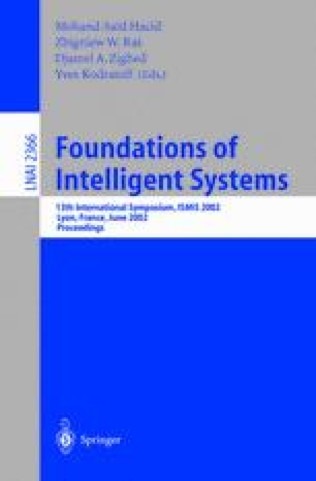
Foundations of Intelligent Systems ; 13th International Symposium, ISMIS 2002, Lyon, France, June 27-29, 2002. Proceedings
This volume contains the papers selected for presentation at the 13th International Symposium on Methodologies for Intelligent Systems ISMIS 2002, held in Lyon, France, 27-29 June, 2002. The symposium was organized by the UniversitØ ClaudThe program committee selected the following major areas for ISMIS 2002: Intelligent Multimedia, Intelligent Information Retrieval, Intelligent Information Systems, Knowledge Representation and Integration, Learning and Knowledge Discovery, Logic for Artificial Intelligence, Methodologies (modeling, design, validation, performance evaluation), and Soft Computing.

Foundations of information and knowledge systems ; 5th International Symposium, FoIKS 2008, Pisa, Italy, February 11-15, 2008. Proceedings
This book constitutes the refereed proceedings of the 5th International Symposium on Foundations of Information and Knowledge Systems, FoIKS 2008 held in Pisa, Italy, in February 2008. The 13 revised full papers presented together with 9 revised short papers and 3 invited lectures were carefully selected during two rounds of reviewing and improvement from from 79 submissions. The papers deal with any foundational aspect of information and knowledge systems, including submissions from researchers working in fields such as discrete mathematics, logic and algebra, model theory, information theory, complexity theory, algorithmics and computation, geometry, analysis, statistics and optimisation who are interested in applying their ideas, theories and methods to research on information and knowledge systems.

Foundations of information and knowledge systems ; 4th International Symposium, FoIKS 2006, Budapest, Hungary, February 14-17, 2006, Proceedings
This book constitutes the refereed proceedings of the 4th International Symposium on Foundations of Information and Knowledge Systems, held in February 2006. The 14 revised full papers presented together with three revised short papers and one invited paper were carefully reviewed and selected from 54 submissions. Among the topics covered are the theoretical foundations of information and knowledge systems, as well as mathematical fields such as discrete mathematics, combinatorics, logics and finite model theory, and applications thereof for research on database and knowledge base theory.

Foundations of genetic algorithms ; 8th International Workshop, FOGA 2005, Aizu-Wakamatsu City, Japan, January 5-9, 2005, Revised Selected Papers
The8thWorkshopontheFoundationsofGeneticAlgorithms,FOGA-8,washeld at the University of Aizu in Aizu-Wakamatsu City, Japan, January 5–9, 2005. This series of workshops was initiated in 1990 to encourage further research on the theoretical aspects of genetic algorithms, and the workshops have been held biennially ever since. The papers presented at these workshops are revised, edited and published as volumes during the year following each workshop. This series of (now eight) volumes provides an outstanding source of reference for the theoretical work in this ?eld. At the same time this series of volumes provides a clear picture of how the theoretical research has grown and matured along with the ?eld to encompass many evolutionary computation paradigms including evolution strategies (ES), evolutionary programming (EP), and genetic programming (GP), as well as the continuing growthininteractionswith other ?elds suchas mathematics,physics, and biology.

Foundations of generic optimization : Vol.1 : A combinatorial approach to epistasis
This is a comprehensive overview of the basics of fuzzy control, which also brings together some recent research results in soft computing, in particular fuzzy logic using genetic algorithms and neural networks. This book offers researchers not only a solid background but also a snapshot of the current state of the art in this field.

Foundations of fuzzy logic and soft computing ; 12th International Fuzzy Systems Association World Congress, IFSA 2007, Cancun, Mexico, Junw 18-21, 2007, Proceedings
This book comprises a selection of papers from IFSA 2007 on new methods and theories that contribute to the foundations of fuzzy logic and soft computing. methodologies. Soft computing consists of several computing paradigms which can be used to produce powerful intelligent systems for solving real-world problems.

Foundations of F#
F# is much more than just an FP language. Every professional .NET programmer needs to learn about FP, and there's no better way to do it than by learning F#, and no easier way to learn F# than from Foundations of F#, and this is the first book to bring F# to the world.

Foundations of Data Mining and Knowledge Discovery
This volume presents the results of investigations into the foundations of the discipline, and represents the state-of-the-art for much of the current research. This book will prove extremely valuable and fruitful for data mining researchers, no matter whether they would like to uncover the fundamental principles behind data mining, or apply the theories to practical applications.

Foundations of Atlas : Rapid Ajax Development with ASP.NET 2.0
This book introduces a fast-track path to understanding Atlas, and how this technology can increase the power and functionality of your code while conserving time and effort. The book begins with a bare-bones introduction that explains how Atlas relates to Ajax. Microsoft Atlas is a web-client framework that makes building Ajax-style applications easier. It provides a prewritten framework that gives you a structured environment in which to work. Atlas also provides you with an object model and standardized debugging to make development faster and simpler. Ajax is a way of combining a number of Web technologies including JavaScript, dynamic HTML, and a feature known as XMLHttp (which reduces the need for client browsers to constantly reconnect to the server every time new information is downloaded). But at the moment, people developing with Ajax have to write their code from the ground up, which is complex and time consuming.
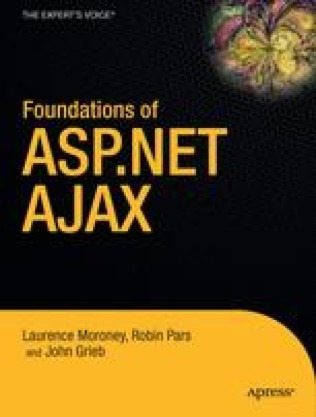
Foundations of ASP.NET AJAX
Foundations of ASP.NET AJAX gives you a detailed grounding in how ASP.NET AJAX works. It takes you swiftly through the basic principles of Ajax, then deep into the heart of the technology, where every namespace is discussed and every function considered. By the end of the book, you'll know all the essentials to confidently produce cutting-edge ASP.NET AJAX applications swiftly and professionally.
Foundations of AOP for J2EE Development
Foundations of AOP for J2EE Development covers a relatively new programming paradigm: aspect-oriented programming, or AOP. Presented are the core concepts of AOP: AspectJ 5, JBoss AOP, Spring AOP, and JAC. Specific features of these tools are compared. The book also explores the potential uses of AOP in everyday programming life, such as design patterns implementation, program testing, and application management. In the latter part of the book, the authors show how AOP can ease the task of J2EE application development (J2EE is known for being a rich and somewhat complicated framework).
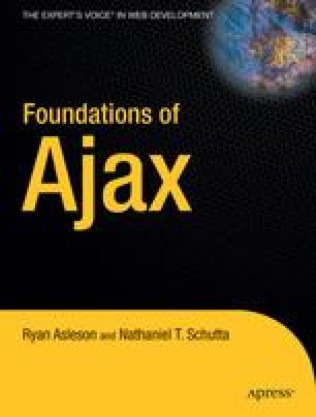
Foundations of Ajax
Ajax burst onto the Web development scene by offering highly interactive, desktop-like Web applications that can be deployed through any modern Web browser without the need for special plug-ins. Ajax is built on existing Web technologies such as JavaScript, HTML, and CSS, and it is used in conjunction with your favorite server-side language. Foundations of Ajax explains how to combine these technologies effectively to implement Ajax into your new or existing Web applications. Like you, we are developers who are in the trenches, tasked with building Web-enabled applications that provide real value to our customers. As the Web continues to grow, the demand for more expressive and engaging interfaces will continue to increase.

Foundations of Agile Python Development
You've long been enamored with the Python language, and have mastered its many nuances. Yet something seems to be missing—a productivity boost that you know is possible but you're not sure how to go about it. This was the sentiment of so many developers before discovering Agile programming paradigm, which embraces concepts such as automation, effective code management, and test–driven development. Foundations of Agile Python Development is the first book to apply these sought–after principles to Python developers, introducing both the tools and techniques built and supported by the Python community. Authored by Jeff Younker, a well–known member of Python's agile community who is perhaps best known for his creation of a popular Python testing framework
