



Page 21
Page 21

Human–computer interaction ; International Workshop, HCI 2007 Rio de Janeiro, Brazil, October 20, 2007 Proceedings
Constitutes the refereed proceedings of the International Workshop on Human Computer Interaction, HCI 2007, held in Rio de Janeiro, Brazil, October 20, 2007. This book covers such topics as: Affective detection and recognition, Smart interfaces, Human motion tracking, Gesture recognition, and Multimedia data modeling and visualization.

Human-computer interaction – INTERACT 2007 ; 11th IFIP TC 13 International Conference, Rio de Janeiro, Brazil, September 10-14, 2007, Proceedings, Part II
This book is part of a two-volume work that constitutes the refereed proceedings of the 11th IFIP TC13 International Conference on Human-Computer Interaction, INTERACT 2007, held in Rio de Janeiro, Brazil in September 2007. It covers tangible user interfaces and interaction; as well as software engineering and HCI.
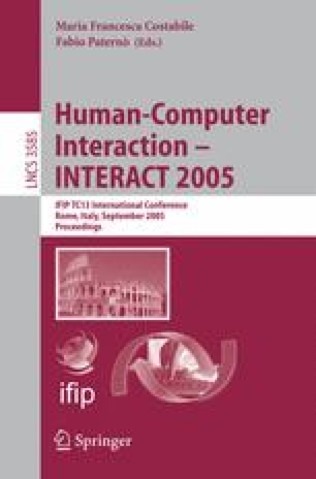
Human-computer interaction – INTERACT 2005 ; IFIP TC 13 International Conference, Rome, Italy, September 12-16, 2005, Proceedings
We will be, sooner or later, not only handling personal computers but also mul- purpose cellular phones, complex personal digital assistants, devices that will be context-aware, and even wearable computers stitched to our clothes…we would like these personal systems to become transparent to the tasks they will be performing. In fact the best interface is an invisible one, one giving the user natural and fast access to the application he (or she) intends to be executed. The working group that organized this conference (the last of a long row!) tried to combine a powerful scientific program (with drastic refereeing) with an entertaining cultural program, so as to make your stay in Rome the most pleasant one all round: I do hope that this expectation becomes true. July 2005 Stefano Levialdi, IEEE Life Fellow INTERACT 2005 General Chairman [1] Peter J. Denning, ACM Communications, April 2005, vol. 48, N° 4, pp. 27-31. Editors’ Preface INTERACT is one of the most important conferences in the area of Human-Computer Interaction at the world-wide level. We believe that this edition, which for the first time takes place in a Southern European country, will strengthen this role, and that Rome, with its history and beautiful setting provides a very congenial atmosphere for this conference. The theme of INTERACT 2005 is Communicating Naturally with Computers.

Human-computer interaction - HCI Intelligent Multimodal interaction environments ; 12th International Conference, HCI International 2007, Beijing, China, July 22-27, 2007, Proceedings, Part III
The 12th International Conference on Human-Computer Interaction, HCI Inter- tional 2007, was held in Beijing, P.R. This volume, edited by Julie A. Jacko, contains papers in the thematic area of Human-Computer Interaction, addressing the following major topics: • Multimodality and Conversational Dialogue • Adaptive, Intelligent and Emotional User Interfaces • Gesture and Eye Gaze Recognition • Interactive TV and Media.

Human-centered visualization environments : GI-Dagstuhl Research Seminar, Dagstuhl Castle, Germany, March 5-8, 2006, Revised Papers
This tutorial book features an augmented selection of the material presented at the GI-Dagstuhl Research Seminar on Human-Centered Visualization Environments, HCVE 2006, held in Dagstuhl Castle, Germany in March 2006. It presents eight tutorial lectures that are the thoroughly cross-reviewed and revised versions of the summaries and findings presented and discussed at the seminar.

Human motion : Understanding, modeling, capture and animation ; 2nd Workshop, HumanMotion 2007, Rio de Janeiro, Brazil, October 20, 2007, Proceedings
This LNCS volume contains the papers presented at the second Workshop on Human Motion Understanding, Modeling, Capture and Animation. The accepted papers re?ect the state of the art in the ?eld and cover various topicsrelatedto humanmotiontrackingandanalysis.Thepapersinthisvolume have been classi?ed into three categories based on the topics they cover: human motion capture and pose estimation, body and limb tracking and segmentation, and activity recognition.

Human motion : Understanding, modeling, capture and animation
Edward Muybridge (1830–1904) is known as the pioneer in motion capt- ing with his famous experiments in 1887 called “Animal Locomotion”. Since then, the feld of animal or human motion analysis has grown in many dir- tions. However, research and results that involve human-like animation and the recovery of motion is still far from being satisfactory. Progress in human motion analysis depends on empirically anchored and grounded research in computer vision, computer graphics, and biomechanics. This book is based on a June 2006 workshop held in Dagstuhl, Germany. This workshop brought together for the frst time researchers from the afo- mentioned disciplines.

How to engineer software : A model-based approach
The book promotes development scalability through domain partitioning and subdomain partitioning. It also explores software documentation that specifically and intentionally adds value for development and maintenance. Contains many illustrative examples of model-based software engineering, from semantic model all the way to executable code Explains how to derive verification (acceptance) test cases from a semantic model Describes project estimation, along with alternative software development and maintenance processes Shows how to develop and maintain cost-effective software that solves real-world problems

How to Code .NET : Tips and Tricks for Coding .NET 1.1 and .NET 2.0 Applications Effectively
How to Code .NET: Tips and Tricks for Coding .NET 1.1 and .NET 2.0 Applications Effectively provides solutions to certain problems. That is, specific problems. This book provides detailed, authoritative explanations of good .NET coding techniques.

How Data Quality Affects our Understanding of the Earnings Distribution
This book demonstrates how data quality issues affect all surveys and proposes methods that can be utilised to deal with the observable components of survey error in a statistically sound manner. This book begins by profiling the post-Apartheid period in South Africa's history when the sampling frame and survey methodology for household surveys was undergoing periodic changes due to the changing geopolitical landscape in the country. This book profiles how different components of error had disproportionate magnitudes in different survey years, including coverage error, sampling error, nonresponse error, measurement error, processing error and adjustment error.

Hosting server management
At a high level, this project involves building and configuring a hosting server to provide website, email, and FTP hosting services to customers. The project also includes building a website where customers can register an account, choose hosting packages, and manage their hosting plan by linking the website to the hosting server's control panel using APIs. To effectively manage the hosting server and provide reliable hosting services to customers, it is important to have a deep understanding of the technologies and protocols involved in web hosting. This includes knowledge of web server software, email protocols, FTP protocols, and security best practices.

Hop Integrity in the Internet
Hop Integrity in the Internet introduces a new security defense, hop integrity, that can be used against denial-of-service attacks in the Internet. A suite of protocols for providing hop integrity in the Internet is discussed in great detail. In particular, each protocol in this suite is specified and verified using an abstract and formal notation, called the Secure Protocol Notation. There are five protocols in this suite: - A secure address resolution protocol - A light-weight key update protocol - A protocol for computing and verifying message digests - An anti-replay protocol that uses soft sequence numbers - An anti-replay protocol that uses hard sequence numbers In addition, other benefits of hop integrity extend to secure routing, mobile IP, and IP multicast.

Honeypots for Windows
Installing a honeypot inside your network as an early warning system can significantly improve your security. Currently, almost every book and resource about honeypots comes from a Unix background, which leaves Windows administrators still grasping for help. But Honeypots for Windows is a forensic journeyhelping you set up the physical layer, design your honeypot, and perform malware code analysis. You'll discover which Windows ports need to be open on your honeypot to fool those malicious hackers, and you'll learn about numerous open source tools imported from the Unix world. Install a honeypot on your DMZ or at home and watch the exploits roll in! Your honeypot will capture waves of automated exploits, and youll learn how to defend the computer assets under your control.

Holonic and multi-agent systems for manufacturing ; 3rd International Conference on industrial applications of holonic and multi-agent systems, HoloMAS 2007, Regensburg, Germany, September 3-5, 2007, Proceedings
The research of holonic and agent-based systems is developing rapidly, as is the community around this R&D topic. Despite the fact that real-life practical implementations of such systems remain surprisingly rare, the leaders in different branches of industry feel that the holonic and agent-based systems represent the only way to manage and control very complex, highly distributed systems in the future.

Holonic and multi-agent systems for manufacturing ; 2nd International conference on industrial applications of holonic and multi-agent systems, HoloMAS 2005, Copenhagen, Denmark, August 22-24, 2005, Proceedings
The challenge faced in today’s manufacturing and business environments is the question of how to satisfy increasingly stringent customer requirements while managing growing system complexity. For example, customers expect high-quality, customizable, low-cost products that can be delivered quickly. The systems that deliver these expectations are by nature distributed, concurrent, and stochastic, and, as a result, increasingly difficult to manage. Unfortunately, the traditional hierarchical, strictly centralized approach to control used in these domains is characteristically inflexible, fragile, and difficult to maintain. These shortcomings have led to the development of a new class of manufacturing and supply-chain decision-making approaches in recent years. Solutions based on these approaches usually explore a set of highly distributed decision-making units that are capable of autonomous operations while cooperating interactively to resolve larger problems. The units, referred to as agents in classical computer science and software engineering, or holons if physically integrated with the manufacturing hardware, interact by exchanging information. These units are motivated by arriving at local solutions as well as collaborating and sharing resources and goals in solving the overall problem in question collectively.

History of Nordic computing ; IFIP WG9.7 ; 1st Working conference on the history of Nordic computing (HiNC1), June 16-18, 2003, Trondheim, Norway
The IFIP series publishes state-of-the-art results in the sciences and technologies of information and communication. The scope of the series includes: foundations of computer science; software theory and practice; education; computer applications in technology; communication systems; systems modeling and optimization; information systems; computers and society; computer systems technology; security and protection in information processing systems; artificial intelligence; and human-computer interaction. Proceedings and post-proceedings of referred international conferences in computer science and interdisciplinary fields are featured. These results often precede journal publication and represent the most current research. The principal aim of the IFIP series is to encourage education and the dissemination and exchange of information about all aspects of computing.

History of computing and education 2 (HCE2) ; IFIP 19th World Computer Congress, WG 9.7, TC 9: History of computing, Proceedings of the 2nd Conference on the history of computing and education, August 21-24, Santiago, Chile
International Federation for Information Processing The IFIP series publishes state-of-the-art results in the sciences and technologies of information and communication. The scope of the series includes: foundations of computer science; software theory and practice; education; computer applications in technology; communication systems; systems modeling and optimization; information systems; computers and society; computer systems technology; security and protection in information processing systems; artificial intelligence; and human-computer interaction. Proceedings and post-proceedings of referred international conferences in computer science and interdisciplinary fields are featured. These results often precede journal publication and represent the most current research. The principal aim of the IFIP series is to encourage education and the dissemination and exchange of information about all aspects of computing.

High-Performance Computing ; 6th International Symposium, ISHPC 2005, Nara, Japan, September 7-9, 2005, First International Workshop on Advanced Low Power Systems, ALPS 2006, Revised Selected Papers
This is the joint post-proceedings of the 6th International Symposium on High Performance Computing (ISHPC-VI) and the First International Workshop on Advanced Low Power Systems 2006 (ALPS2006). The post-proceedings also contain the papers presented at the Second HPF International Workshop: - periences and Progress (HiWEP2005) and the Workshop on Applications for PetaFLOPS Computing (APC2005), which are workshops of ISHPC-VI. ISHPC-VI, HiWEP2005 and APC2005 were held in Nara, Japan during September 7–9, 2005. Fifty-eight papers from 11 countries were submitted to ISHPC-VI. After the reviews of the submitted papers, the ISHPC-VI Program Committee selected 15 regular (12-page) papers for oral presentation. In ad- tion, several other papers with favorable reviews were recommended for poster presentation, and 14 short (8-page) papers were also selected.

High-Linearity CMOS RF Front-End Circuits
High-Linearity CMOS RF Front-End Circuits presents some unique techniques to enhance the linearity of both the receiver and transmitter. For example, using harmonic cancellation techniques, the linearity of the receiver front-end can be increased by few tens of dB with only minimal impact on the other circuit parameters. The new parallel class A&B power amplifier can not only increase the transmitter's output power in the linear range, but can also result in significant savings in power consumption. High-Linearity CMOS RF Front-End Circuits can be used as a textbook for graduate courses in RF CMOS design and will also be useful as a reference for the practicing engineer.

High-Frequency Oscillator Design for Integrated Transceivers
High-Frequency Oscillator Design for Integrated Transceivers covers the analysis and design of all high-frequency oscillators required to realize integrated transceivers for wireless and wired applications.
