



Page 20
Page 20
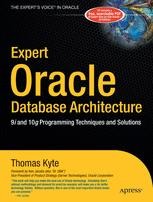
Expert Oracle Database Architecture : 9i and 10g Programming Techniques and Solutions
This is a defining book on the Oracle database for any developer or database administrator who works with Oracle-driven database applications. Tom Kyte has a simple philosophy: you can treat Oracle as a black box and just stick data into it or you can understand how it works and exploit it as a powerful computing environment. If you choose the latter, then you will find that there are few information management problems that you cannot solve quickly and elegantly. Expert Oracle Database Architecture is the first of a three-book series that completely explores and defines the Oracle database. It covers all of the most important Oracle architecture features, including: Files, memory structures and processes / Locking and latching / Transactions, concurrency and multi-versioning / Tables and Indexes / Datatypes / Partitioning and parallelism Each feature is taught in a proof-by-example manner, not only discussing what it is, but also how it works, how to implement software using it, and the common pitfalls associated with it.
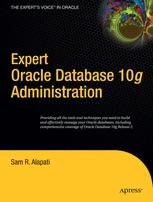
Expert Oracle Database 10g Administration
This book covers the new 10g management and performance tools and provides essential primers on Unix, Linux and Windows NT administration and on core SQL and PL/SQL programming techniques. And it provides everything the new and aspring Oracle database administrator needs to build and administer complex Oracle 10g databases.
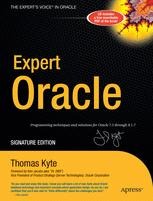
Expert Oracle
Thomas Kyte has a simple philosophy: You can treat Oracle as a black box and shove data inside of it, or you can learn how Oracle works and exploit it as a powerful computing environment. If you choose the latter, you will see there are few information management problems you cannot solve quickly and elegantly. Kyte has selected the most important features and techniques to discuss in Expert One-on-One Oracle, which he teaches in a proof-by-example manner. He discusses available features, implementing software using these features, and avoiding potential pitfalls.
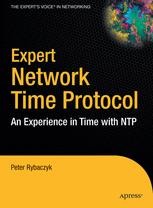
Expert Network Time Protocol : An Experience in Time with NTP
Have you ever tried to figure out why your computer clock is off, or why your emails somehow have the wrong timestamp? Most likely, it's due to an incorrect network time synchronization, which can be reset using the Network Time Protocol. Until now, most network administrators have been too paranoid to work with this, afraid that they would make the problem even worse. However, Expert Network Time Protocol: An Experience in Time with NTP takes the mystery out of time, and shows the network administrator how to regain the upper hand. This book is a fascinating look into NTP, and the stories behind the science. Written by Peter Rybaczyk, one of the foremost experts on NTP, this book will show the network administrator how to become more comfortable working with time.
Expert F#
Expert F# is about practical programming in a beautiful language that puts the power and elegance of functional programming into the hands of .NET developers. In combination with .NET, F# achieves unrivaled levels of programmer productivity and program clarity. This books serves as: The authoritative guide to F# by the designer of F#. A comprehensive reference of F# concepts, syntax, and features. A treasury of expert F# techniques for practical, real–world programming.
Expert Clouds and Applications ; Proceedings of ICOECA 2021
Features original papers from International Conference on Expert Clouds and Applications (ICOECA 2021), organized by GITAM School of Technology, Bangalore, India during February 18–19, 2021. It covers new research insights on artificial intelligence, big data, cloud computing, sustainability, and knowledge-based expert systems. The book discusses innovative research from all aspects including theoretical, practical, and experimental domains that pertain to the expert systems, sustainable clouds, and artificial intelligence technologies.
Expert C++/CLI : .NET for Visual C++ Programmers
C++/CLI is Microsofts latest extension to C++ that targets the heart of .NET 2.0, the common language runtime. Expert Visual C++/CLI is written by visual C++ MVP Marcus Heege, who examines the core of the C++/CLI language. He explains both how the language elements work and how Microsoft intends them to be used.
Expert C# 2005 Business Objects
Rockford Lhotka started writing his Business Objects books in 1996, and over the years, he's become one of the world's foremost authorities on building distributed object-oriented systems. His industry-standard VB .NET Business Objects book not only addresses changes in .NET 2.0 and Visual Studio 2005, but also reflects substantial enhancements and improvements to the CSLA .NET Framework and how it can be used to create enterprise-level .NET applications. The depth of Rockford's thinking now influences developers across language boundaries. With this book, you can learn directly from the expert whose framework has become universally accepted and respected.
Expert ASP.NET 2.0 Advanced Application Design
Expert ASP.NET 2.0 Advanced Application Design will help you derive maximum performance and reliability from the distributed applications you create with ASP.NET 2.0. The book first looks at some of the non-functional requirements that impact the design of a distributed application. It then relates them to the servers and services available in the .NET 2.0 Framework. ASP.NET 2.0 is the central process for use in distributed .NET applications, and the book closely examines the ASP.NET 2.0 Framework and its hosting environment, Internet Information Server (IIS). The book looks at how ASP.NET 2.0 is used by different packages within .NET (like Web Services), and explores how it can be extended to meet your own custom requirements.
Expert .NET Delivery Using NAnt and CruiseControl.NET
This book is a guide to the implementation of good processes in a .NET environment. Author Marc Holmes focuses on actual implementation, and details patterns and anti-patterns to watch out for. He also provides a practical and in-depth look at NAnt and CruiseControl.NET, and solutions to common problem scenarios.

Excel PivotTables Recipe Book : A Problem-Solution Approach
Excel Pivot Tables Recipe Book: A Problem-Solution Approach is for anyone who uses Excel frequently. This book follows a problem-solution format that covers the entire breadth of situations you might encounter when working with PivotTables—from planning and creating, to formatting and extracting data, to maximizing performance and troubleshooting. The author presents tips and techniques in this collection of recipes that cannot be found in Excel's Help section, and she carefully explains the most confusing features of PivotTables.

Excel 2007 PivotTables Recipes : A Problem-Solution Approach
You'll find this book when facing any new or difficult problem in PivotTables, covering the entire breadth of situations you could ever encounter, from planning and creating, to formatting and extracting data, to maximizing performance and troubleshooting.

Excel 2007 : Beyond the Manual
Excel 2007: Beyond the Manual will introduce those who are already familiar with Excel basics to more advanced features, like consolidation, what-if analysis, PivotTables, sorting and filtering, and some commonly used functions.

Evolvable systems : From biology to hardware ; 7th International Conference, ICES 2007, Wuhan, China, September 21-23, 2007, Proceedings
The 41 revised full papers collected in this volume are organized in topical sections on digital hardware evolution, analog hardware evolution, bio-inspired systems, mechanical hardware evolution, evolutionary design, evolutionary algorithms in hardware design, and hardware implementation of evolutionary algorithms.

Evolvable systems : From biology to hardware ; 6th International Conference, ICES 2005, Sitges, Spain, September 12-14, 2005, Proceedings
The flying machines proposed by Leonardo da Vinci in the fifteenth century, the se- reproducing automata theory proposed by John von Neumann in the middle of the twentieth century and the current possibility of designing electronic and mechanical systems using evolutionary principles are all examples of the efforts made by humans to explore the mechanisms present in biological systems that permit them to tackle complex tasks. These initiatives have recently given rise to the emergent field of b- inspired systems and evolvable hardware. The inaugural workshop, Towards Evolvable Hardware, took place in Lausanne in October 1995, followed by the successive events of the International Conference on Evolvable Systems: From Biology to Hardware, held in Tsukuba (Japan) in October 1996, in Lausanne (Switzerland) in September 1998, in Edinburgh (UK) in April 2000, in Tokyo (Japan) in October 2001, and in Trondheim (Norway) in March 2003. Following the success of these past events the sixth international conference was aimed at presenting the latest developments in the field, bringing together researchers who use biologically inspired concepts to implement real systems in artificial intelligence, artificial life, robotics, VLSI design, and related domains. The sixth conference consolidated this biennial event as a reference meeting for the community involved in bio-inspired systems research. All the papers received were reviewed by at least three independent reviewers, thus guaranteeing a high-quality bundle for ICES 2005.

Evolutionary Computation in Data Mining
This carefully edited book reflects and advances the state of the art in the area of Data Mining and Knowledge Discovery with Evolutionary Algorithms. It emphasizes the utility of different evolutionary computing tools to various facets of knowledge discovery from databases, ranging from theoretical analysis to real-life applications. "Evolutionary Computation in Data Mining" provides a balanced mixture of theory, algorithms and applications in a cohesive manner, and demonstrates how the different tools of evolutionary computation can be used for solving real-life problems in data mining and bioinformatics.
Evolutionary computation in combinatorial optimization ; 8th European Conference, EvoCOP 2008, Naples, Italy, March 26-28, 2008. Proceedings
Metaheuristics have been shown to be e?ective for di?cult combinatorial - timization problems appearing in various industrial, economical, and scientifc domains. Prominent examples of metaheuristics are evolutionary algorithms, tabu search, simulated annealing, scatter search, memetic algorithms, variable neighborhood search, iterated local search, greedy randomized adaptive search procedures, ant colony optimization and estimation of distribution algorithms. Problems solved successfully include scheduling, timetabling, network design, transportation and distribution, vehicle routing, the travelling salesman pr- lem, packing and cutting, satisfability and general mixed integer programming.

Event-Based Programming : Taking Events to the Limit
This book teaches you how to develop software based on parts that interact primarily through an event mechanism. You'll learn how to use events in many different situations, to solve recurring development problems without coupling. The book introduces Signal Wiring Diagram, a novel form of software diagram similar to the circuit diagrams used by hardware designers. The book concludes with a series of case studies, incorporating all featured concepts.
Euro-Par 2020 : Parallel Processing ; 26th International Conference on Parallel and Distributed Computing, Warsaw, Poland, August 24–28, 2020, Proceedings
This book constitutes the proceedings of the 26th International Conference on Parallel and Distributed Computing, Euro-Par 2020, held in Warsaw, Poland, in August 2020. The conference was held virtually due to the coronavirus pandemic. The 39 full papers presented in this volume were carefully reviewed and selected from 158 submissions. They deal with parallel and distributed computing in general, focusing on support tools and environments; performance and power modeling, prediction and evaluation; scheduling and load balancing; high performance architectures and compilers; data management, analytics and machine learning; cluster, cloud and edge computing; theory and algorithms for parallel and distributed processing; parallel and distributed programming, interfaces, and languages; multicore and manycore parallelism; parallel numerical methods and applications; and accelerator computing.

Euro-Par 2019 : Parallel Processing Workshops ; Euro-Par 2019 International Workshops, Göttingen, Germany, August 26–30, 2019, Revised Selected Papers
Euro-Par is an annual, international conference in Europe, covering all aspects of parallel and distributed processing. These range from theory to practice, from small to the largest parallel and distributed systems and infrastructures, from fundamental computational problems to full-edged applications, from architecture, compiler, language and interface design and implementation to tools, support infrastructures, and application performance aspects.
