



Page 19
Page 19
Forecasting Oracle Performance
Forecasting Oracle Performance is the first book to focus squarely on the problem of forecasting the future performance of an Oracle database. Other Oracle performance books are good for putting out fires; Craig's book helps you avoid all the heat in the first place.
Flex solutions : Essential techniques for Flex 2 and 3 developers
Flex Solutions: Essential Techniques for Flex 2 and Flex 3 Developers faces problems and provides solutions that can be applied to any project, from the most simple to the most complex. Solutions are also provided for enhancing the security of Flex applications, and techniques are offered for optimizing the actual work environment by increasing the performance of Flex Builder, adding video content, and creating an AIR project to bring your web application onto the desktop.
Flash Application Design Solutions : The Flash Usability Handbook
In this book, you’ll find a number of concrete Flash usability solutions that use elements such as navigation menus, data filtering, forms, content loaders, Flash liquid layouts, help tips, and many other features. You’ll learn how each of these solutions actually improves on what is possible with HTML and JavaScript. In each case, you’ll see how users interact with the website feature, and how it gives users the most intuitive, enjoyable experience possible while using your application. You’ll get a step-by-step analysis of how to program and build each solution, and how to make it scalable, maintainable, and reusable.
Flash 8 Essentials
As a creative professional or interactive developer, you’ll be amazed at the exciting possibilities presented to you by the features available in Flash 8; but as a busy designer, we know you won't have as much time as you’d like to explore these new additions. Never fear; this book wastes no time looking at timeline basics, tweens, or movie-publishing options—it focuses exclusively on the new Flash 8 features, getting you quickly up to speed with a combination of illustrative tutorials, handy references, and inspirational examples. By the end of the book, you’ll know that there’s no shortage of new tools to enhance and inspire your Flash development; and since this book is written by some of the community's leading Flash experts, you’ll know you’re in good hands.
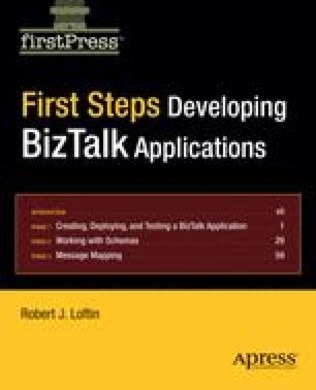
First Steps : Developing BizTalk Applications
First Steps: Developing BizTalk Applications is a primer to most other introductory BizTalk books. If you feel like traditional beginning books are too abstract, and that you are mired in detail and missing the “big picture,” check out this book. It's a jumpstart to learning BizTalk. You'll learn about the product in a phased approach.

First course on fuzzy theory and applications
This basic textbook gives an easily accessible introduction to Fuzzy theory and its applications. It provides basic and concrete concepts of the field in a self-contained, condensed and understandable style. This "First Course on Fuzzy Theory and Applications" includes numerous examples, descriptive illustrations and figures of the basic concepts, as well as exercises at the end of each chapter. The author has long time experience in teaching on fuzzy theory and its applications and continuously developed and summarized his didactic lecture notes into this book. This book can be used in introductory graduate and undergraduate courses in Fuzziness and Soft Computing and is recommendable to students, scientists, engineers, or professionals in the field for self-study.
Finite Difference Computing with PDEs : A Modern Software Approach
This easy-to-read book introduces the basics of solving partial differential equations by means of finite difference methods. Unlike many of the traditional academic works on the topic, this book was written for practitioners. Accordingly, it especially addresses: the construction of finite difference schemes, formulation and implementation of algorithms, verification of implementations, analyses of physical behavior as implied by the numerical solutions, and how to apply the methods and software to solve problems in the fields of physics and biology.
Finite Difference Computing with Exponential Decay Models
This text provides a very simple, initial introduction to the complete scientific computing pipeline: models, discretization, algorithms, programming, verification, and visualization. The pedagogical strategy is to use one case study – an ordinary differential equation describing exponential decay processes – to illustrate fundamental concepts in mathematics and computer science. The book is easy to read and only requires a command of one-variable calculus and some very basic knowledge about computer programming. Contrary to similar texts on numerical methods and programming, this text has a much stronger focus on implementation and teaches testing and software engineering in particular.
Financial cryptography and data security ; 12th International Conference, FC 2008, Cozumel, Mexico, January 28-31, 2008. Revised Selected Papers
This book constitutes the thoroughly refereed post-conference proceedings of the 12th International Conference on Financial Cryptography and Data Security, FC 2008, held in Cozumel, Mexico, in January 2008.The 16 revised full papers and 9 revised short papers presented together with 5 poster papers, 2 panel reports, and 1 invited lecture were carefully reviewed and selected from 86 submissions. The papers are organized in topical sections on attacks and counter measures, protocols, theory, hardware, chips and tags, signatures and encryption, as well as anonymity and e-cash.

Finance 4.0 - towards a socio-ecological finance system : A participatory framework to promote sustainability
The first is Bitcoin that infamously pursues a state-independent, decentralized conception of money. The second is Finance 4.0, a system that proposes a participatory multi-dimensional money system with built-in incentives for sustainable behavior
Fifth IFIP International Conference On Theoretical Computer Science - Tcs 2008 ; IFIP 20th World Computer Congress, TC 1, Foundations of Computer Science, September 7-10, 2008, Milano, Italy
Includes: foundations of computer science; software theory and practice; education; computer applications in technology; communication systems; systems modeling and optimization; information systems; computers and society; computer systems technology; security and protection in information processing systems; artificial intelligence; and human-computer interaction. Proceedings and post-proceedings of refereed international conferences in computer science and interdisciplinary fields are featured. These results often precede journal publication and represent the most current research. The principal aim of the IFIP series is to encourage education and the dissemination and exchange of information about all aspects of computing.
Fieldwork for Design : Theory and Practice
Fieldwork for Design looks at why ethnographic approaches have been turned to in the design of computing devices for the workplace, for the home and elsewhere. It presents a history of ethnography, both as it was practiced before computer science picked it up and since, most especially in the CSCW and HCI domains. It examines, further, the various ethnographic or ‘fieldwork’ frameworks currently popular, explaining and examining what each claims and entails. The focus of the book throughout is on the practical relationship between theory and practice, a relationship that is often misunderstood yet fundamental to successful design.
Federation over the Web ; International Workshop, Dagstuhl Castle, Germany, May 1-6, 2005, Revised Selected Papers
The lives of people all around the world, especially in industrialized nations, continue to be changed by the presence and growth of the Internet. Its in?uence is felt at scales ranging from private lifestyles to national economies, boosting thepaceatwhichmoderninformationandcommunicationtechnologiesin?uence personal choices along with business processes and scienti?c endeavors. In addition to its billions of HTML pages, the Web can now be seen as an open repository of computing resources. These resources provide access to computational services as well as data repositories, through a rapidly growing variety of Web applications and Web services.
Facelets Essentials : Guide to JavaServer™ Faces View Definition Framework
Facelets is a templating language developed from the ground up with JavaServer Faces in mind. Created in response to the many concerns involving JavaServer Pages (JSP) when building JavaServer Faces (JSF) views, Facelets steps outside of the JSP specification and provides a highly performant, JSF–centric view technology. Facelets' top properties, templating, reuse, and ease of development, allow it to help making JSF a technology suitable for large–scale projects. One of the first things a developer using Facelets finds is that it immediately leads to a reduction in user interface code.
Facebook API Developers Guide
The Facebook API allows web developers to create Facebook applications and access Facebook data from other applications. Facebook API Developers Guide covers the use and implementation of the Facebook API—what the key features are and how you can access them. You will learn, through practical examples, the main features of the Facebook API including an introduction to the API–specific languages FQL and FBML. These examples are further supported by the introduction of other technologies like language libraries, relational database management systems, and XML. Covers all key features of the Facebook API Explains the API languages FQL and FBML Teaches by example, with useful code and tips you can use in your own applications
Extreme NXT : Extending the LEGO MINDSTORMS NXT to the Next Level
Extreme NXT: Extending the LEGO MIDSTORMS NXT to the Next Level is for intermediate-level users of NXT who would like to advance their capabilities by learning some of the basics of electronics. Plenty of examples are provided, and easy-to-follow instructions are included for building over 15 different sensors.
Expert VB 2005 Business Objects
Rockford Lhotka started writing his Business Objects books in 1996, and over the years, he’s become one of the world's foremost authorities on building distributed object-oriented systems. This second edition of his industry-standard VB .NET Business Objects book not only addresses changes in .NET 2.0 and Visual Studio 2005, but also reflects substantial enhancements and improvements to the CSLA .NET Framework and how it can be used to create enterprise-level .NET applications.
Expert SQL Server 2005 Development
This book starts by reintroducing the database as a integral part of the software development ecosystem. You'll learn how to think about SQL Server development as you would any other software development.
Expert Spring MVC and Web Flow
Expert Spring MVC and Web Flow provides in-depth coverage of Spring MVC and Spring Web Flow, two highly customizable and powerful web frameworks brought to you by the developers and community of the Spring Framework. Spring MVC is a modern web application framework built upon the Spring Framework, and Spring Web Flow is a new project that compliments Spring MVC for building reusable web controller modules that encapsulate rich page navigation rules. Along with detailed analysis of the code and functionality, plus the first-published coverage of Spring Web Flow, this book includes numerous tips and tricks to help you get the most out of Spring MVC, Spring Web Flow, and web development in general.
Expert Oracle JDBC Programming
JDBC is the most commonly used API in Java to access and manipulate data in a database. Oracle is one of the most popular and scalable databases in the world. This book is a must-have for any developer building an application that employs JDBC on Oracle database. Unlike other JDBC books, this book has been written to complement not rehash the contents of Oracle JDBC documentation and the JDBC specification. The book teaches you not just how to write JDBC code, but how to write effective JDBC code in a step-by-step fashion. This book does not assume any prior knowledge of JDBC, though it does assume basic knowledge of SQL and PL/SQL. It covers JDBC with a focus on writing high-performing, scalable and secure applications for Oracle 10g and 9i.
