



Page 14
Page 14
Knowledge Cartography : Software Tools and Mapping Techniques
The authors see mapping software as a set of visual tools for reading and writing in a networked age. In an information ocean, the primary challenge is to find meaningful patterns around which we can weave plausible narratives. Maps of concepts, discussions and arguments make the connections between ideas tangible and disputable.With 17 chapters from the leading researchers and practitioners, the reader will find the current state–of-the-art in the field. Part 1 focuses on educational applications in schools and universities, before Part 2 turns to applications in professional communities.
Kernel Methods for Machine Learning with Math and Python: 100 Exercises for Building Logic
Addresses the fundamentals of kernel methods for machine learning by considering relevant math problems and building Python programs. The book’s main features are as follows: Includes 100 exercises, which have been carefully selected and refined. As their solutions are provided in the main text, readers can solve all of the exercises by reading the book. / The mathematical premises of kernels are proven and the correct conclusions are provided, helping readers to understand the nature of kernels. / Source programs and running examples are presented to help readers acquire a deeper understanding of the mathematics used. / Once readers have a basic understanding of the functional analysis topics covered in Chapter 2, the applications are discussed in the subsequent chapters. Here, no prior knowledge of mathematics is assumed. / Considers both the kernel for reproducing kernel Hilbert space (RKHS) and the kernel for the Gaussian process; a clear distinction is made between the two.

Job Scheduling Strategies for Parallel Processing ; 13th International Workshop, JSSPP 2007, Seattle, WA, USA, June 17, 2007. Revised Papers
Constitutes the thoroughly refereed post-workshop proceedings of the 13th International Workshop on Job Scheduling Strategies for Parallel Processing, JSSPP 2007, held in Seattle, WA, USA, in June 2007, in conjunction with the 21st ACM International Conference on Supercomputing, ICS 2007.The 10 revised full research papers presented went through the process of strict reviewing and subsequent improvement. The papers cover all current issues of job scheduling strategies for parallel processing from the supercomputer-centric viewpoint but also address many nontraditional high-performance computing and parallel environments that cannot or need not access a traditional supercomputer.

Job Scheduling Strategies for Parallel Processing ; 12th International Workshop, JSSPP 2006, Saint-Malo, France, June 26, 2006, Revised Selected Papers
Constitutes the thoroughly refereed post-proceedings of the 12th International Workshop on Job Scheduling Strategies for Parallel Processing, JSSPP 2006, held in Saint-Malo, France in June 2006 in conjunction with the Joint International Conference on Measurement and Modeling of Computer Systems SIGMETRICS/Performance 2006.
JDBC Recipes : A Problem-Solution Approach
JDBC Recipes provides easy-to-implement, usable solutions to problems in relational databases that use JDBC. You will be able to integrate these solutions into your web-based applications, such as Java servlets, JavaServer Pages, and Java server-side frameworks. This handy book allows you to cut and paste the solutions without any code changes. This book focuses on topics that have been ignored in most other JDBC books, such as database and result set metadata. It will help you develop database solutions, like adapters, connectors, and frameworks using Java/JDBC. The insightful solutions will enable you to handle all data types, including large binary objects. A unique feature of the book is that it presents JDBC solutions (result sets) in XML.
Java Methods for Financial Engineering : Applications in Finance and Investment
This book is structured around the main theories and models used by practitioners to engineer finance and investment tools. The methods developed and implemented in the text are organized as chapters which cover the core areas.
Java Design Patterns : A Hands-On Experience with Real-World Examples
Covers classical design patterns with the latest editions of Java and Eclipse Includes implementation of the Java design patterns in real-world applications Each chapter has a Q&A section to help you understand the pros and cons of each design pattern
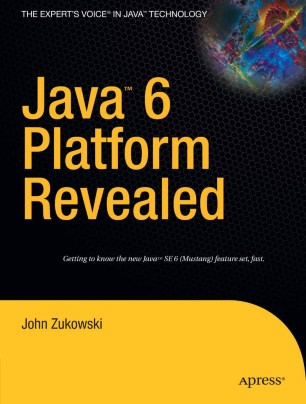
Java 6 Platform Revealed
New editions of the platform don't happen that frequently, but when they do, there is a lot to learn about quickly. If you want to come up to speed on the feature set as quickly as possible, Java 6 Platform Revealed will place you well ahead of the pack. You'll find 10 chapters of how to use the JSR implementations and library improvements that are now a part of Mustang. You'll learn about the scripting features of AWT and Swing, like splash screens, system tray access, and table sorting and filtering and lots more. What you won't find in Java 6 Platform Revealed is a "getting started with Java" tutorial. Come prepared with a good working knowledge of Java 5 platform for best results.
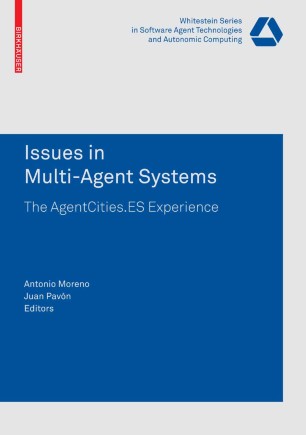
Issues in Multi-Agent Systems : The AgentCities.ES Experience
The purpose of this book is to present current status of this technology by looking at its application in different domains, such as electronic markets, e-tourism, ambience intelligence, and complex system analysis.It starts by discussing software engineering issues for the development of multi-agent systems, how much it costs to build a multi-agent system, and which methods and tools are currently available. Next chapters present some of the most relevant aspects that are considered for the development of multi-agent systems.
Component-based software engineering ; 11th International Symposium, CBSE 2008, Karlsruhe, Germany, October 14-17, 2008. Proceedings
This book constitutes the refereed proceedings of the 11th International ACM SIGSOFT Symposium on Component-Based Software Engineering, CBSE 2008, held in Karlsruhe, Germany in October 2008.
Component models and systems for grid applications ; Proceedings of the Workshop on Component Models and Systems for Grid Applications held June 26, 2004 in Saint Malo, France.
This first volume of the CoreGRID series addresses such vital issues as the architecture of the Grid, the way software will influence the development of the Grid, and the practical applications of Grid technologies for individuals and businesses alike. Part I of the book, Application-Oriented Designs, focuses on development methodology and how it may contribute to a more component-based use of the Grid. Middleware Architecture, the second part, examines portable Grid engines, hierarchical infrastructures, interoperability, as well as workflow modeling environments. The final part of the book, Communication Frameworks, looks at dynamic self-adaptation, collective operations, and higher-order components. With Component Models and Systems for Grid Applications, editors Vladimir Getov and Thilo Kielmann offer the computing professional and the computing researcher the most informative, up-to-date, and forward-looking thoughts on the fast-growing field of Grid studies.
Component Deployment; 3rd International Working Conference, CD 2005, Grenoble, France, November 28-29, 2005, Proceedings
his volume of Lecture Notes in Computer Science contains the proceedings of the rd 3 Working Conference on Component Deployment (CD 2005), which took place 2005 in Grenoble, France, and co-located with Middleware 2005. CD 2005 is the third international conference in the series, the first two being held in Berlin and Edinburgh in 2002 and 2004, respectively. The proceedings of both these conferences were also published by Springer in the Lecture Notes in Computer Science series and may be found in volumes 2370 and 3083. Component deployment addresses the tasks that need to be performed after components have been developed and addresses questions such as: • What do we do with components after they have been built? • How do we deploy them into their execution environment? • How can we evolve them once they have been deployed?

Communities and Technologies 2005 ; Proceedings of the Second Communities and Technologies Conference, Milano 2005
This book includes 23 papers dealing with the impact of modern information and communication technologies that support a wide variety of communities: local communities, virtual communities, and communities of practice, such as knowledge communities and scientific communities. The volume is the result of the second multidisciplinary "Communities and Technologies Conference", a major event in this emerging research field. The various chapters discuss how communities are affected by technologies, and how understanding of the way that communities function can be used in improving information systems design. This state of the art overview will be of interest to computer and information scientists, social scientists and practitioners alike.

Charting a new course : Natural language processing and information retrieval : Essays in Honour of Karen Spärck Jones
This book celebrates the life and work of Karen Spärck Jones in her seventieth year. she is one of the major figures of 20th century and early 21st Century computing and information processing. It book consists of fifteen new and original chapters written by leading international authorities reviewing the state of the art and her influence in the areas in which Karen Spärck Jones has been active. Although she has a publication record which goes back over forty years, it is clear even the very early work reviewed in the book can be read with profit by those working on recent developments in information processing like bioinformatics and the semantic web.
Challenges for next generation network operations and service management : 11th Asia-Pacific network operations and management symposium, APNOMS 2008, Beijing, China, October 22-24, 2008. Proceedings
This book constitutes the refereed proceedings of the 11th Asia-Pacific Network Operations and Management Symposium, APNOMS 2008, held in Beijing, China, in October 2008.

Case-Based Reasoning Research and Development ; 7th International Conference on Case-Based Reasoning, ICCBR 2007 Belfast Northern Ireland, UK, August 13-16, 2007 Proceedings
It presented along with three invited talks. The sections address all aspects of case-based reasoning, featuring original theoretical research, applied research, and applications with practical, social, environmental, and economic significance.

Case-based reasoning research and development ; 6th International conference on case-based reasoning, ICCBR 2005, Chicago, IL, USA, August 23-26, 2005, Proceedings
This book constitutes the refereed proceedings of the 6th International Conference on Case-Based Reasoning, ICCBR 2005, held in Chicago, IL, USA, in August 2005. The 19 revised full research papers and 26 revised poster papers presented together with the abstracts of 3 invited talks were carefully reviewed and selected from 74 submissions. The papers address all current foundational, theoretical and research aspects of case-based reasoning as well as advanced applications either with innovative commercial deployment or practical, social, environmental or economic significance.
C++ /CLI : The Visual C++ Language for .NET
C++/CLI: The Visual C++ Language for .NET introduces Microsoft's extensions to the C++ syntax that allow you to target the common language runtime the key to the heart of the .NET 3.0 platform. In 12 no-fluff chapters, Microsoft insider Gordon Hogenson takes you into the core of the C++/CLI language and explains both how the language elements work and how Microsoft intends them to be used.

Business agility and information technology diffusion ; IFIP TC8 WG 8.6 International working Conference, May 8-11, 2005, Atlanta, Georgia, USA
Addresses issues related to business agility and the diffusion of Information Technology (IT). Success, even survival, in today's business environment has been made complex and difficult by technologically-based competitive pressure. One promising strategy is to be agile and ready to adapt quickly to changes in the environment or market. Such strategy takes shape as an agile software development, agile manufacturing, agile modeling and agile iterations. In contrast, successful IT diffusion is known to be a process that takes time and careful effort. Many IT projects that succeeded in developing a product have subsequently failed in changing the behavior of the target group when diffusion just didn't happen. Therefore this volume responds to the question: What is the relationship between agility and IT diffusion? The book's scope will cover information systems and technology issues, as well as organizational and managerial issues, related to agility and IT diffusion. The planned perspectives include topics such as diffusion of agile methods, enabling business agility with IT, creating agile environments that facilitate diffusion of IT, theories and frameworks for understanding diffusion and agility issues, best practices relating to business agility and IT diffusion, software process improvement and agility, diffusion studies of specific agile technologies, and impacts of diffusion of IT agile methods.
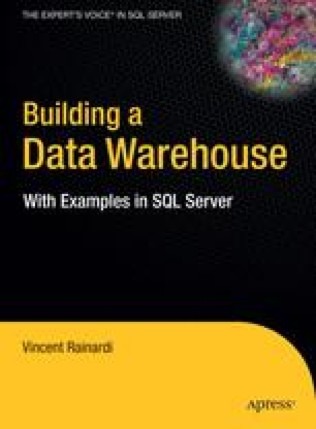
Building a Data Warehouse : With Examples in SQL Server
The book is organized as follows. In the beginning of this book (chapters 1 through 6), you learn how to build a data warehouse, for example, defining the architecture, understanding the methodology, gathering the requirements, designing the data models, and creating the databases. Then in chapters 7 through 10, you learn how to populate the data warehouse, for example, extracting from source systems, loading the data stores, maintaining data quality, and utilizing the metadata. After you populate the data warehouse, in chapters 11 through 15, you explore how to present data to users using reports and multidimensional databases and how to use the data in the data warehouse for business intelligence, customer relationship management, and other purposes. Chapters 16 and 17 wrap up the book: After you have built your data warehouse, before it can be released to production, you need to test it thoroughly. After your application is in production, you need to understand how to administer data warehouse operation.
