



Page 10
Page 10

Implementation and application of functional languages ; 18th International Symposium, IFL 2006, Budapest, Hungary, September 4-6, 2006, Revised Selected Papers
This volume constitutes the post-proceedings of the 18th International Workshop on Implementation and Applications of Functional Languages. Each one was submitted to two rounds of reviews to ensure accuracy, thoroughness, and readability. The papers address all current theoretical and methodological issues in functional and function-based languages.

Image recognition : progress, trends and challenges
Focuses on research trends in image processing and recognition and corresponding developments. Among them, the book focuses on recent research, especially in the field of advanced human-computer interaction and intelligent computing. Given the existing interaction and recognition of the station, some novel topics are proposed, including how to establish a cognitive model in human-computer interaction and how to express and transfer human knowledge into human-machine image recognition. In an interactive implementation, how to implement user experience through image recognition during machine interaction

Image and video retrieval ; Vol. 3568 ; 4th International conference, CIVR 2005, Singapore, July 20-22, 2005, Proceedings
It was our great pleasure to host the 4th International Conference on Image and Video Retrieval (CIVR) at the National University of Singapore on 20–22 July 2005. CIVR aims to provide an international forum for the discussion of research challenges and exchange of ideas among researchers and practitioners in image/video retrieval technologies. It addresses innovative research in the broad ?eld of image and video retrieval. A unique feature of this conference is the high level of participation by researchers from both academia and industry. Another unique feature of CIVR this year was in its format – it o?ered both the traditional oral presentation sessions, as well as the short presentation cum poster sessions. The latter provided an informal alternative forum for animated discussions and exchanges of ideas among the participants.After a rigorous review process, 20 papers were accepted for oral presentations, and 42 papers were accepted for poster presentations. In addition to the accepted submitted papers, the program also included 4 invited papers, 1 keynote industrial paper, and 4 invited industrial papers. Altogether, we o?ered a diverse and interesting program, addressing the current interests and future trends in this area.

Image and Signal Processing ; 3rd International Conference, ICISP 2008. Cherbourg-Octeville, France, July 1 - 3, 2008. Proceedings
This book constitutes the refereed proceedings of the Third International Conference on Image and Signal Processing, ICISP 2008, held in Cherbourg-Octeville, France, in July 2008.The 48 revised full papers and 22 revised poster papers presented were carefully reviewed and selected from 193 submissions. The papers are organized in topical sections on image filtering, image segmentation, computer vision, feature extraction, pattern recognition, graph-based representations, motion detection and estimation, new interfaces, document processing, and signal processing.

Image Analysis and Recognition ; Vol. 4142 ; 3rd International Conference, ICIAR 2006, Póvoa de Varzim, Portugal, September 18-20, 2006, Proceedings, Part II
ICIAR 2006, the International Conference on Image Analysis and Recognition, was the third ICIAR conference, and was held in P´ ovoa de Varzim, Portugal. ICIARisorganizedannually,andalternatesbetweenEuropeandNorthAmerica. ICIAR 2004 was held in Porto, Portugal and ICIAR 2005 in Toronto, Canada. The idea of o?ering these conferences came as a result of discussion between researchers in Portugal and Canada to encourage collaboration and exchange, mainlybetweenthesetwocountries,butalsowiththeopenparticipationofother countries, addressing recent advances in theory, methodology and applications. The response to the call for papers for ICIAR 2006 was higher than the two previous editions. From 389 full papers submitted, 163 were ?nally accepted (71 oral presentations, and 92 posters). The review process was carried out by the Program Committee members and other reviewers; all are experts in various image analysis and recognition areas. Each paper was reviewed by at least two reviewers, and also checked by the conference Co-chairs. The high quality of the papers in these proceedings is attributed ?rst to the authors, and second to the quality of the reviews provided by the experts.

Image Analysis and Recognition ; Vol. 4141 ; 3rd International Conference, ICIAR 2006, Póvoa de Varzim, Portugal, September 18-20, 2006, Proceedings, Part I
ICIAR 2006, the International Conference on Image Analysis and Recognition, was the third ICIAR conference, and was held in P´ ovoa de Varzim, Portugal. ICIARisorganizedannually,andalternatesbetweenEuropeandNorthAmerica. ICIAR 2004 was held in Porto, Portugal and ICIAR 2005 in Toronto, Canada. The idea of o?ering these conferences came as a result of discussion between researchers in Portugal and Canada to encourage collaboration and exchange, mainlybetweenthesetwocountries,butalsowiththeopenparticipationofother countries, addressing recent advances in theory, methodology and applications. The response to the call for papers for ICIAR 2006 was higher than the two previous editions. From 389 full papers submitted, 163 were ?nally accepted (71 oral presentations, and 92 posters). The review process was carried out by the Program Committee members and other reviewers; all are experts in various image analysis and recognition areas. Each paper was reviewed by at least two reviewers, and also checked by the conference Co-chairs. .

Image Analysis and Recognition ; Vol. 3656 ; 2ond International Conference, ICIAR 2005, Toronto, Canada, September 28-30, 2005, Proceedings
ICIAR 2005, the International Conference on Image Analysis and Recognition, was the second ICIAR conference, and was held in Toronto, Canada. ICIAR is organized annually, and alternates between Europe and North America. ICIAR 2004 was held in Porto, Portugal. The idea of o?ering these conferences came as a result of discussion between researchers in Portugal and Canada to encourage collaboration and exchange, mainly between these two countries, but also with the open participation of other countries, addressing recent advances in theory, methodology and applications. TheresponsetothecallforpapersforICIAR2005wasencouraging.From295 full papers submitted, 153 were ?nally accepted (80 oral presentations, and 73 posters). The review process was carried out by the Program Committee m- bers and other reviewers ; all are experts in various image analysis and recognition areas. Each paper was reviewed by at least two reviewers, and also checked by the conference co-chairs. The high quality of the papers in these proceedings is attributed ?rst to the authors,and second to the quality of the reviews provided by the experts. We would like to thank the authors for responding to our call, andwewholeheartedlythankthe reviewersfor theirexcellentwork,andfortheir timely response. It is this collective e?ort that resulted in the strong conference program and high-quality proceedings in your hands.

Image Analysis and Recognition ; 5th International Conference, ICIAR 2008, Póvoa de Varzim, Portugal, June 25-27, 2008. Proceedings
The 110 revised full papers presented together with 2 invited papers were carefully reviewed and selected from 226 submissions. The papers are organized in topical sections on image restoration and enhancement, image and video segmentation, non-linear image processing, image and video coding and encryption, indexing and retrieval, computer vision, feature extraction and classification, shape representation and matching, object recognition, character recognition, texture and motion analysis, tracking, biomedical image analysis, biometrics, face recognition, and a special session on recent advances in multimodal biometric systems and applications.

Image Analysis ; 14th Scandinavian Conference, SCIA 2005, Joensuu, Finland, June 19-22, 2005, Proceedings
This proceedings volume collects the scienti?c presentations of the Scandinavian Conference on Image Analysis, SCIA 2005, which was held at the University of Joensuu, Finland, June 19–22, 2005. The conference was the fourteenth in the series of biennial conferences started in 1980. The name of the series re?ects the fact that the conferences are organized in the Nordic (Scandinavian) countries, following the cycle Sweden, Finland, Denmark, and Norway. The event itself has always been international in its participants and presentations. Today there are many conferences in the ?elds related to SCIA. In this s- uation our goal is to keep up the reputation for the high quality and friendly environment of SCIA. We hope that participants feel that it’s worth attending the conference. Therefore, both the scienti?c and social program were designed to support the best features of a scienti?c meeting: to get new ideas for research and to have the possibility to exchange thoughts with fellow scientists.

Illustrated C# 2008
The unique, visual format of Illustrated C# 2008 has been specially created by author and teacher of development methods, Daniel Solis. The concise text, use of tables to clarify language features, frequent figures and diagrams, as well as focused code samples all combine to create a unique approach that will help you understand and get to work with C# fast. It was while teaching numerous seminars on various programming languages that the author realized the immense power that diagrams have in explaining programming language concepts. Most people learn quicker and retain information better when the material is presented in a clean, simple, visual format. To achieve this result in his book, Solis uses concise text and bulleted lists, tables to clarify and summarize language features, as well as his renowned and ubiquitous figures and diagrams.

Illustrated C# 2005
Illustrated C# 2005 presents the C# programming language in a unique visual manner. The book uses three techniques to achieve this: concise text, tables that clarify and summarize language features, and frequent figures and diagrams. Each feature is also illustrated with concise, focused code samples.

ICCS 2007 ; Proceedings of the 15th International Workshops on Conceptual Structures
The 15th International Conference on Conceptual Structures (ICCS 2007) is the latest in a series of annual conferences that have been held in Europe, Australia, and North America since 1993. Some of the world's best minds in information technology, arts, humanities and social science converged to explore novel ways that information and communications technology (ICT) can augment human intelligence.

Hybrid Systems: Computation and Control ; 10th International Workshop, HSCC 2007, Pisa, Italy, April 3-5, 2007, Proceedings
Constitutes the refereed proceedings of the 10th International Conference on Hybrid Systems: Computation and Control, HSCC 2007, held in Pisa, Italy in April 2007.

Hybrid Systems : Computation and Control ; 11th International Workshop, HSCC 2008, St. Louis, MO, USA, April 22-24, 2008. Proceedings
Contains the proceedings ofthe 11th Workshop on Hybrid Systems: Computation and Control (HSCC 2008) held in St. Louis, Missouriduring April 22–24,2008.The annual workshop on hybrid systems focuses on research inbedded ,reactive systems in volving theinterplay between symbolic/switchingand continuous dynamical behaviors. HSCC attracts academic as well as industrial researchers to exchange information on the latest developments of applications and theoretical advancements in the design, analysis, control, optimization, and implementation of hybrid systems, with particular attention to embedded and networked control systems. We would like to thank the Program Committee members and the reviewers for an excellent job of evaluating the submissions and participating in the online Program Committee discussions.

Hybrid Systems : Computation and Control ; Vol. # 3414 ; 8th International Workshop, HSCC 2005, Zurich, Switzerland, March 9-11, 2005, Proceedings
Contains the proceedings of the 8th Workshop on Hybrid S- tems: Computation and Control(HSCC2005)heldinZurich, Switzerlandduring March 9-11, 2005. The annual workshop on hybrid systems attracts researchers from academia and industry interested in modeling, analysis, and implemen- tion of dynamic and reactive systems involving both discrete and continuous - haviors. This year's HSCC was technically co-sponsored by the IEEE Control Systems Society. The program consisted of 3 invited talks and 40 regular papers selected from 91 regular submissions. The program covered topics such as tools for analysis and verification, control and optimization, modeling, engineering applications, and emerging directions in programming language support and implementation. We would like to thank the Program Committee members and reviewers for an excellent job of evaluating the submissions and participating in the online Program Committee discussions.

Hybrid metaheuristics ; Vol. 4030 ; 3rd International Workshop, HM 2006, Gran Canaria, Spain, October 13-14, 2006, Proceedings
The selection of papers for HM 2006 consolidated some of the mainstream issues that have emerged from the past editions. Firstly, there are prominent examples of e?ective hybrid techniques whose design and implementation were motivated by challenging real-world applications. We believe this is particularly important for two reasons: on the one hand, researchers are conscious that the primary goal of developing algorithms is to solve relevant real-life problems; on the other hand, the path towarde?cient solving methods for practical problems is a source of new outstanding ideas and theories. A second important issue is that the research community on metaheur- tics has become increasingly interested in and open to techniques and methods known from arti?cial intelligence (AI) and operations research (OR). So far, the most representative examples of such integration have been the use of AI/OR techniques as subordinates of metaheuristic methods. As a historical and - ymological note, this is in perfect accordance with the original meaning of a metaheuristic as a “general strategy controlling a subordinate heuristic. ” The awareness of the need for a sound experimental methodology is a third keypoint.

Hybrid metaheuristics ; 5th International Workshop, HM 2008, Málaga, Spain, October 8-9, 2008. Proceedings
This book constitutes the refereed proceedings of the 5th International Workshop on Hybrid Metaheuristics, HM 2008, held in Malaga, Spain, in October 2008.The 14 revised full papers presented were carefully reviewed and selected from 33 submissions. The papers discuss specific aspects of combinations of metaheuristics and other solving techniques for tackling particular relevant constrained optimization problems, such as fiber optic networks, time tabling and freight train scheduling problems.

Hybrid metaheuristics ; 4th International Workshop,HM 2007, Dortmund, Germany, October 8-9, 2007, Proceedings
This book constitutes the refereed proceedings of the 4th International Workshop on Hybrid Metaheuristics, HM 2007, held in Dortmund, Germany. The 14 revised full papers discuss specific aspects of hybridization of metaheuristics, hybrid metaheuristics design, development and testing.

Human-Computer Interaction : Interaction design and usability ; 12th International Conference, HCI International 2007, Beijing, China, July 22-27, 2007, Proceedings, Part I
The 12th International Conference on Human-Computer Interaction, HCI Inter- tional 2007, was held in Beijing, P.R. This volume, edited by Julie A. Jacko, contains papers in the thematic area of Human-Computer Interaction, addressing the following major topics: • Interaction Design: Theoretical Issues, Methods, Techniques and Practice • Usability and Evaluation Methods and Tools • Understanding Users and Contexts of Use • Models and Patterns in HCI
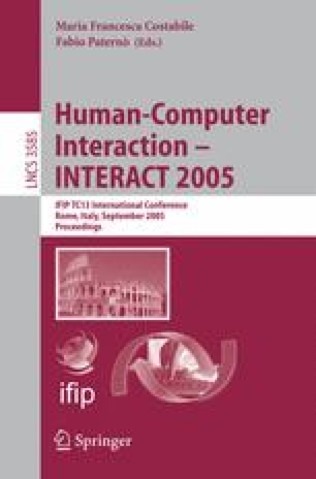
Human-computer interaction – INTERACT 2005 ; IFIP TC 13 International Conference, Rome, Italy, September 12-16, 2005, Proceedings
We will be, sooner or later, not only handling personal computers but also mul- purpose cellular phones, complex personal digital assistants, devices that will be context-aware, and even wearable computers stitched to our clothes…we would like these personal systems to become transparent to the tasks they will be performing. In fact the best interface is an invisible one, one giving the user natural and fast access to the application he (or she) intends to be executed. The working group that organized this conference (the last of a long row!) tried to combine a powerful scientific program (with drastic refereeing) with an entertaining cultural program, so as to make your stay in Rome the most pleasant one all round: I do hope that this expectation becomes true. July 2005 Stefano Levialdi, IEEE Life Fellow INTERACT 2005 General Chairman [1] Peter J. Denning, ACM Communications, April 2005, vol. 48, N° 4, pp. 27-31. Editors’ Preface INTERACT is one of the most important conferences in the area of Human-Computer Interaction at the world-wide level. We believe that this edition, which for the first time takes place in a Southern European country, will strengthen this role, and that Rome, with its history and beautiful setting provides a very congenial atmosphere for this conference. The theme of INTERACT 2005 is Communicating Naturally with Computers.
