




Ontologies for Agents : Theory and Experiences
On the other hand, ontologies have established themselves as a powerful tool to enable kno- edge sharing, and a growing number of applications have bene?ted from the use of ontologies as a means to achieve semantic interoperability among heterogeneous, distributed systems. In principle ontologies and agents are a match made in heaven, that has failed to happen. What makes a simple piece of software an agent is its ability to communicate in a ”social” environment, to make autonomous decisions, and to be proactive on behalf of its user. Communication ultimately depends on und- standing the goals, preferences, and constraints posed by the user. Autonomy is theabilitytoperformataskwithlittleornouserintervention,whileproactiveness involves acting autonomously with no need for user prompting. Communication, but also autonomy and proactiveness, depend on knowledge. The ability to c- municate depends on understanding the syntax (terms and structure) and the semantics of a language. Ontologies provide the terms used to describe a domain and the semantics associated with them. In addition, ontologies are often comp- mented by some logical rules that constrain the meaning assigned to the terms. These constraints are represented by inference rules that can be used by agents to perform the reasoning on which autonomy and proactiveness are based.
Related Books

Scalable data management for future hardware
Presents the results of the DFG priority program on scalable data management for future hardware. It details requirements and solutions of how modern and future hardware architectures can be leveraged to address the challenges in modern data management.the nine chapters of the book present a wide range of data management architectures in conjunction with current hardware developments, often related to applications in data analytics or machine learning. they cover topics such as hardware-accelerated query or event processing on FPGA, GPU, and multicore CPUs, scalable data management in data center networks or on modern memory and storage technologies, and operating system support.

New challenges in software engineering ; Vol 1
Explores the key challenges shaping the future of software development, including automation, AI-driven development, security-focused engineering, resilient and autonomous architectures, business process optimization, cloud computing, microservices, high-performance distributed systems, and sustainable technologies. Software engineering is undergoing a constant transformation, driven by rapid technological advances and evolving market demands. additionally, it delves into the ethical considerations of AI, the evolution of intuitive user interfaces, and the importance of multidisciplinary collaboration.

Fundamentals of manufacturing engineering using digital visualization
Offers a guide to core principles and practices of manufacturing engineering. It covers the design of, together with technological and measurement issues for, technical systems. Locating charts and setup schemes describing different machining processes are included. Concepts of product quality, with a focus on accuracy indicators, machining accuracy, roughness, and the impact of surface quality on exploitation properties are also explained. Furthermore, key machining methods, including turning, milling, hole machining, grinding, and gear machining, are analyzed in depth, covering their principles, applications, and techniques. The book is enriched by QR codes, linking to a mobile application presenting additional information about the content, for an interactive and extended learning experience. It also uses illustrations visualized with digital tools to promote a better understanding of the concepts.
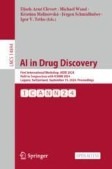
AI in drug discovery
Constitutes the refereed proceedings of the First international workshop on ai in Drug Discovery, AIDD 2024, held as a part of the 33rd International Conference on Artificial Neural Networks, ICANN 2024, in Lugano, Switzerland, on September 19, 2024. These papers focus on various aspects of the rapidly evolving field of Artificial Intelligence (AI)-driven drug discovery in chemistry, including Big Data and advanced Machine Learning, eXplainable AI (XAI), Chemoinformatics, Use of deep learning to predict molecular properties, Modeling and prediction of chemical reaction data and Generative models.
