



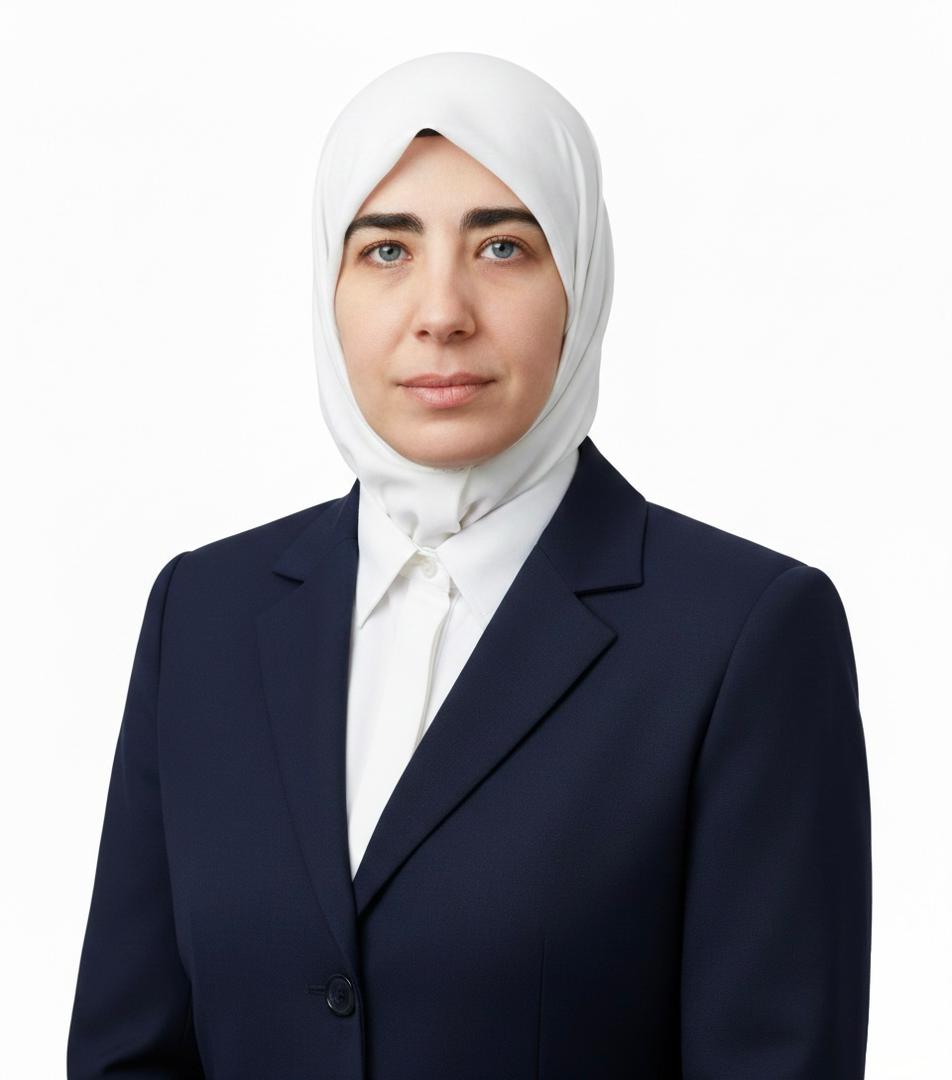
Dr. Nada Ghneim
A distinguished academic and researcher in the fields of language sciences, Arabic natural language processing, artificial intelligence, and speech processing, with an outstanding academic record exceeding 950 citations and an H-index of 16.
She earned her Ph.D. in Language Sciences – Speech Communication from Université Stendhal Grenoble III in France, in addition to two higher diplomas in Informatics, Robotics, and Computer Vision from both ENSIMAG and the Higher Institute for Applied Sciences and Technology (HIAST), as well as a degree in Information Technology Engineering from the Higher Institute for Applied Sciences and Technology – Damascus.
Currently, she serves as an Assistant Professor at the Arab International University and participates in teaching at both Damascus University and the Higher Institute for Applied Sciences and Technology, playing a pivotal role in developing artificial intelligence and natural language processing curricula in Syria. Previously, she held several academic and administrative positions, including Head of the Informatics Department at Al-Sham Private University, Head of the Artificial Intelligence Group at HIAST, and Head of the Software Systems Laboratory.
She has published over 39 peer-reviewed scientific papers in prestigious international and Arab journals and conferences, such as ACM, IEEE Access, Knowledge-Based Systems, Journal of Big Data, SemEval, ICNLSP, SAMSN, ICALP, and others. Her research covers multiple fields, including natural language processing, artificial intelligence, computer vision, sentiment analysis, speech recognition, and software engineering. She has contributed to developing advanced models in machine translation, Arabic dialect analysis, sentiment classification in texts and social networks, automatic diacritization, and Arabic question-answering systems, alongside pioneering research in deep learning, neural networks, and text representation to support requirements engineering tasks.
She has participated in more than 20 international and regional workshops and conferences, presenting advanced research and applications in natural language processing, artificial intelligence, automatic diacritization of Arabic texts, language and dialect recognition, and analysis of Arabic digital content. Among her notable participations are global workshops and conferences such as SemEval, CLEF, and LREC, as well as events organized by Arab and regional institutions like the King Abdulaziz City for Science and Technology (KACST), ALECSO, and HIAST.
She has also taken part in more than 19 international scientific conferences in countries such as France, Italy, Turkey, Taiwan, and South Korea, in addition to regional and Arab conferences in Egypt and Syria. She has had a notable academic presence at recent Arab conferences, including the Computational Linguistics and Arabic Language Conference at Mohamed Bin Zayed University.
In addition to her research activities, Dr. Nada Ghanem has made significant contributions to authoring and translating reference books adopted in Syrian and Arab universities. She has co-authored books on C++ and Java programming languages, natural language processing, and web application development, and contributed to the development of the Informatics Terminology Dictionary and the Arabic Encyclopedia. She has also translated and reviewed global reference books, including "Introduction to Algorithms" and works on artificial intelligence and e-commerce, and participated in preparing the Arabic version of the IEEE Guide to the Software Engineering Body of Knowledge (SWEBOK), in addition to translating and reviewing dozens of specialized scientific articles.
She has been involved in several major scientific projects at both the Arab and international levels, taking on leadership and advisory roles. Notable among these are managing joint Arab projects under the auspices of ALECSO, leading national research teams in strategic projects such as the Interactive Arabic Lexicon, and participating in Euro-Mediterranean projects under EU programs FP5 and FP6, such as ERA-Med, PROMED ACCESS, and MEDFORIST. She has also provided consultancy expertise to international entities like the German Agency for Technical Cooperation and participated in joint Arab projects with the International Telecommunication Union (ITU).
With over two decades of teaching experience, she has taught advanced courses in artificial intelligence, natural language processing, expert systems, machine learning, algorithms and data structures, and e-business management at several universities, including the Arab International University, the Higher Institute for Applied Sciences and Technology, Damascus University, the Syrian Virtual University, and Al-Sham Private University.
She has supervised a large number of master's and doctoral theses in the fields of artificial intelligence and Arabic language processing, addressing contemporary topics such as social media content analysis, machine translation, automatic diacritization, speech synthesis, relation extraction from texts, image captioning using deep learning, and business model development.
In terms of academic peer review, she has served on the review committees of prestigious international journals such as Expert Systems with Applications and Language Resources and Evaluation, as well as specialized Arab journals. She has been a member of the review committees for international conferences and workshops such as WANLP, ICNLSP, ICALP, AICCSA, and OSACT. She has also played a prominent role in judging the ESCWA Award for Arabic Digital Content from 2022 to 2024 and reviewing graduate theses at Syrian universities.
She actively participates in curriculum development committees and scientific boards at several academic and scientific institutions, including the Syrian Scientific Society for Informatics, the Arab International University, Damascus University, and the Higher Institute for Applied Sciences and Technology.
Email-address: aiu@aiu.edu.sy
