



الصفحة 1
الصفحة 1

Numerical Techniques for Chemical and Biological Engineers Using MATLAB® : A Simple Bifurcation Approach
This book addresses the bifurcation characteristics of chemical and biological processes as the general case and treats systems with a unique steady state as special cases. It uses a system approach which is the most efficient for knowledge organization and transfer. The book develops mathematical models for many commercial processes utilizing the mass-, momentum-, and heat-balance equations coupled to the rates of the processes that take place within the boundaries of the system. The models are solved numerically through MATLAB codes with emphasis on the design and optimization of the chemical and biological industrial equipment and plants.

Numerical Solution of Partial Differential Equations on Parallel Computers
The scientific fields of Ma- ematics and Physics provide a powerful vehicle for such descriptions in terms of Partial Differential Equations (PDEs). Formulated as such equations, physical laws can become subject to computational and analytical studies. In the computational setting, the equations can be discreti ed for ef?cient solution on a computer, leading to valuable tools for simulation of natural and man-made processes. Numerical so- tion of PDE-based mathematical models has been an important research topic over centuries, and will remain so for centuries to come. In the context of computer-based simulations, the quality of the computed results is directly connected to the model’s complexity and the number of data points used for the computations. Therefore, computational scientists tend to ?ll even the largest and most powerful computers they can get access to, either by increasing the si e of the data sets, or by introducing new model terms that make the simulations more realistic, or a combination of both. Today, many important simulation problems can not be solved by one single computer, but calls for parallel computing.

Number Theory ; Vol. II : Analytic and Modern Tools
The central theme of this graduate-level number theory textbook is the solution of Diophantine equations, i.e., equations or systems of polynomial equations which must be solved in integers, rational numbers or more generally in algebraic numbers. This theme, in particular, is the central motivation for the modern theory of arithmetic algebraic geometry. In this text, this is considered through three aspects.

Number Theory ; Vol. I : Tools and Diophantine Equations
The central theme of this graduate-level number theory textbook is the solution of Diophantine equations, i.e., equations or systems of polynomial equations which must be solved in integers, rational numbers or more generally in algebraic numbers. This theme, in particular, is the central motivation for the modern theory of arithmetic algebraic geometry. In this text, this is considered through three aspects.

Nonlinear Partial Differential Equations with Applications
This book primarily concerns quasilinear and semilinear elliptic and parabolic partial differential equations, inequalities, and systems. It balances the abstract functional-analysis approach based on nonlinear monotone, pseudomonotone, weakly continuous, or accretive mappings with concrete partial differential equations in their weak (or more general) formulation. Methods of Galerkin or of Rothe are exposed in a large generality. Other methods include various direct methods, regularization, or fixed points. The exposition leads general theory as fast as possible towards the analysis of concrete equations, which have specific applications in continuum (thermo-) mechanics of solids and fluids, electrically (semi-) conductive media, modelling of biological systems, or in mechanical engineering. Selected parts are rather an introduction into the subject while some others form an advanced textbook. The intended audience is graduate and PhD students and researchers in the theory of partial differential equations or in mathematical modelling of distributed parameter systems.
Nonlinear Oscillations of Hamiltonian PDEs
After introducing the reader to classical finite-dimensional dynamical system theory, including the Weinstein–Moser and Fadell–Rabinowitz resonant center theorems,the author develops the analogous theory for completely resonant nonlinear wave equations. Within this theory, both problems of small divisors and infinite bifurcation phenomena occur, requiring the use of Nash–Moser theory as well as minimax variational methods. These techniques are presented in a self-contained manner together with other basic notions of Hamiltonian PDEs and number theory.

New Trends in the Theory of Hyperbolic Equations
The present volume is dedicated to modern topics of the theory of hyperbolic equations such as evolution equations, multiple characteristics, propagation phenomena, global existence, influence of nonlinearities. It is addressed to beginners as well as specialists in these fields. The contributions are to a large extent self-contained.

Multi-scale Modelling for Structures and Composites
Numerous applications of rod structures in civil engineering, aircraft and spacecraft confirm the importance of the topic. On the other hand the majority of books on structural mechanics use some simplifying hypotheses; these hypotheses do not allow to consider some important effects, In this connection the asymptotic analysis of equations of mathematical physics, the equations of elasticity in rod structures (without these hypotheses and simplifying assumptions being imposed) is undertaken in the present book.
Modellistica numerica per problemi differenziali = Numerical modeling for differential problems
This text introduces the basic concepts for the numerical modeling of partial differential problems. We consider the classic elliptic, parabolic and hyperbolic linear equations, but also other equations, such as those of diffusion and transport, of Navier-Stokes, and the conservation laws, and we provide numerous physical examples underlying these equations. Then we analyze numerical resolution methods based on finite elements, finite differences, finite volumes, spectral methods and domain decomposition methods. In particular, the algorithmic and computer implementation aspects are discussed and various easy-to-use programs are provided.
Modellistica Numerica per Problemi Differenziali = Numerical Modeling for Differential Problems
This text introduces the fundamental concepts for the numerical modeling of partial differential problems. We consider the classic linear elliptic, parabolic and hyperbolic equations, but also other equations, such as those of diffusion and transport, of Navier-Stokes, and the conservation laws. Numerous physical examples underlying these equations are provided, their main mathematical properties are studied, then numerical resolution methods based on finite elements, finite differences, finite volumes and spectral methods are proposed and analyzed. In particular, the algorithmic and computer implementation aspects are discussed and some easy-to-use programs in C ++ language are provided. The text does not presuppose an advanced mathematical knowledge of partial differential equations: the strictly indispensable concepts in this regard are reported in the Appendix. The volume is therefore suitable for students of scientific degree courses (Engineering, Mathematics, Physics, Chemistry, Information Sciences) and recommended for researchers from the academic and extra-academic world who want to approach this interesting branch of applied mathematics.

Modelli Dinamici Discreti = Discrete Dynamic Models
Discrete mathematical modeling is one of the driving factors in modern mathematics research, and has played a role of synthesis between different disciplines, becoming a tool for qualitative and quantitative analysis in applied sciences. This volume provides an introduction to the analysis of discrete dynamic systems, following a modeling approach. An examination of a wide range of examples, models, and motivations drawn from Biology, Demography, Engineering and Economics, is followed by the presentation of the tools for the study of linear and non-linear scalar dynamical systems, with particular attention to stability analysis. The linear difference equations are studied in detail and an elementary introduction to the Z and DFT transforms is provided. One chapter is devoted to the study of bifurcations and chaotic dynamics. One-step vector dynamical systems and the applications of Markov chains are the subject of three chapters.

Modeling of Soft Matter
Soft matter plays a role in a wide variety of important processes and application. For example, gel swelling and dynamics are an essential part of many biological and individual processes, such as motility mechanisms in bacteria and the transport and absorption of drugs. Ferroelectrics, liquid crystals, and elastomers are being used to design ever faster switching devices. Experimental studies, such as scattering, optical and electron microscopy, have provided a great deal of detailed information on structures. But the integration of mathematical modeling and analysis with experimental approaches promises to greatly increase our understanding of structure-property relationships and constitutive equations. The workshop on Modeling of Soft Matter has taken such an integrated approach.

Modeling of Creep for Structural Analysis
"Creep Modeling for Structural Analysis" develops methods to simulate and analyze the time-dependent changes of stress and strain states in engineering structures up to the critical stage of creep rupture. The principal subjects of creep mechanics are the formulation of constitutive equations for creep in structural materials under multi-axial stress states; the application of structural mechanics models of beams, plates, shells and three-dimensional solids and the utilization of procedures for the solution of non-linear initial-boundary value problems. The objective of this book is to review some of the classical and recently proposed approaches to the modeling of creep for structural analysis applications as well as to extend the collection of available solutions of creep problems by new, more sophisticated examples.
Methods of Celestial Mechanics: Vol. I: Physical, Mathematical, and Numerical Principles
G. Beutler's Methods of Celestial Mechanics is a coherent textbook for students in physics, mathematics and engineering as well as an excellent reference for practitioners. This Volume I gives a thorough treatment of celestial mechanics and presents all the necessary mathematical details that a professional would need. After a brief review of the history of celestial mechanics, the equations of motion (Newtonian and relativistic versions) are developed for planetary systems (N-body-problem), for artificial Earth satellites, and for extended bodies (which includes the problem of Earth and lunar rotation). Perturbation theory is outlined in an elementary way from generally known mathematical principles without making use of the advanced tools of analytical mechanics. The variational equations associated with orbital motion - of fundamental importance for parameter estimation (e.g., orbit determination), numerical error propagation, and stability considerations - are introduced and their properties discussed in considerable detail. Numerical methods, especially for orbit determination and orbit improvement, are discussed in considerable depth. The algorithms may be easily applied to objects of the planetary system and to Earth satellites and space debris.

Methods and Applications of Singular Perturbations : Boundary Layers and Multiple Timescale Dynamics
Perturbation theory, one of the most intriguing and essential topics in mathematics, and its applications to the natural and engineering sciences.In a systematic introductory manner, this unique book deliniates boundary layer theory for ordinary and partial differential equations, multi-timescale phenomena for nonlinear oscillations, diffusion and nonlinear wave equations. The book provides analysis of simple examples in the context of the general theory, as well as a final discussion of the more advanced problems.

Mechatronics : Dynamics of Electromechanical and Piezoelectric Systems
Deals with Lagrange equations for electromechanical systems, including piezoelectric transducers and selected applications. Intended for the research community and graduate students at the MSc and PhD level, this book is an extension to piezoelectric systems of the work, ""Dynamics of Mechanical and Electromechanical Systems"", published in 1968.
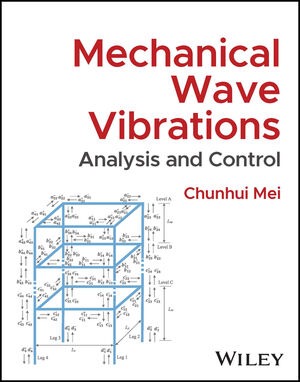
Mechanical Wave Vibrations: Analysis and Control
Delivers an expert discussion of the wave analysis approach (as opposed to the modal-based approach) to mechanical vibrations in structures. The book begins with deriving the equations of motion using the Newtonian approach based on various sign conventions before comprehensively covering the wave vibration analysis approach. It concludes by exploring passive and active feedback control of mechanical vibration waves in structures.

Introduzione al Calcolo Scientifico : Esercizi e problemi risolti con MATLAB = Introduction to scientific computing : Exercises and problem solved with MATLAB
Introduces the fundamental concepts for the numerical modeling of partial differential problems. We consider the classic linear elliptic, parabolic and hyperbolic equations, but also other equations, such as those of diffusion and transport, of Navier-Stokes, and the conservation laws. Numerous physical examples underlying these equations are provided, their main mathematical properties are studied, then numerical resolution methods based on finite elements, finite differences, finite volumes and spectral methods are proposed and analyzed. In particular, the algorithmic and computer implementation aspects are discussed and some easy-to-use programs in C ++ language are provided. The text does not presuppose an advanced mathematical knowledge of partial differential equations: the strictly indispensable concepts in this regard are reported in the Appendix. THE VOLUME is therefore suitable for students of scientific degree courses (Engineering, Mathematics, Physics, Chemistry, Information Sciences) and recommended for researchers from the academic and extra-academic world who want to approach this interesting branch of applied mathematics.

Introduction to Modern Number Theory: Fundamental Problems, Ideas and Theories
"Introduction to Modern Number Theory" surveys from a unified point of view both the modern state and the trends of continuing development of various branches of number theory. Motivated by elementary problems, the central ideas of modern theories are exposed. Some topics covered include non-Abelian generalizations of class field theory, recursive computability and Diophantine equations, zeta- and L-functions. This substantially revised and expanded new edition contains several new sections, such as Wiles' proof of Fermat's Last Theorem, and relevant techniques coming from a synthesis of various theories. Moreover, the authors have added a part dedicated to arithmetical cohomology and noncommutative geometry, a report on point counts on varieties with many rational points, the recent polynomial time algorithm for primality testing, and some others subjects.

Introduction à la résolution des systèmes polynomiaux = Introduction to solving polynomial systems
This book is an introduction to algebraic methods for solving this type of equations. We show how the geometry of algebraic varieties defined by these equations, their dimension, their degree, or their components can be deduced from the properties of the corresponding quotient algebras. For this, we approach methods of effective algebraic geometry, such as Grobner bases, resolution by eigenvalues and vectors, resultants, bezoutians, duality, Gorenstein algebras and algebraic residues.
