



الصفحة 1
الصفحة 1

Wind Turbine Control Systems : Principles, Modelling and Gain Scheduling Design
Modern wind turbines generally operate at variable speed in order to maximise the conversion efficiency below rated power and to reduce loading on the drive-train. In addition, pitch control of the blades is usually employed to limit the energy captured during operation above rated wind speed. The higher complexity of variable-speed variable-pitch turbines is offset by the benefits of control flexibility, namely, higher conversion efficiency, better power quality, longer useful life; because of the immediate impact of control on the cost of wind energy, reliable high-performance controllers are essential in making wind technology competitive.

Wind Energy Engineering : A Handbook for Onshore and Offshore Wind Turbines
Covering a wider spectrum of topics in the field of wind turbines (offshore and onshore), this new edition includes new intelligent turbine designs and optimization, current challenges and efficiencies, remote sensing and smart monitoring, and key areas of advancement, such as floating wind turbines. Each chapter includes a research overview with a detailed analysis and new case studies looking at how recent research developments can be applied.

Vector Control of Three-Phase AC Machines : System Development in the Practice
This monograph covers the area of vector control of three-phase AC machines, in particular induction motors with squirrel-cage rotor (IM), permanent excited synchronous motors (PMSM) and doubly-fed induction machines (DFIM), from the viewpoint of the practical design and development. Main focus is on the application of the IM and the PMSM in electrical drive systems, where the method of the field-orientated control has been successfully established in the practice, and on the use of the grid voltage orientated controlled DFIM in the wind power plants.

The Technological and Economic Future of Nuclear Power
Discusses the eroding economics of nuclear power for electricity generation as well as technical, legal, and political acceptance issues. The use of nuclear power for electricity generation is still a heavily disputed issue. Aside from technical risks, safety issues, and the unsolved problem of nuclear waste disposal, the economic performance is currently a major barrier. In recent years, the costs have skyrocketed especially in the European countries and North America. At the same time, the costs of alternatives such as photovoltaics and wind power have significantly decreased.

Physical Approach to Short-Term Wind Power Prediction
Offers an approach to the ultimate goal of the short-term prediction of the power output of winds farms. This book addresses scientists and engineers working in wind energy related R and D and industry, as well as graduate students and nonspecialists researchers in the fields of atmospheric physics and meteorology.

Optimal Control of Wind Energy Systems : Towards a Global Approach
Presents a thoroughgoing review of the main control issues in wind power generation, offering a unified picture of the issues in optimal control of wind power generation. A series of optimal control techniques are analyzed, assessed and compared, starting with the classical ones, like PI control, maximum power point strategies and gain-scheduling techniques, and continuing with some modern ones: sliding-mode techniques, feedback linearization control and robust control. Discussion is focused on a global dynamic optimization approach to wind power systems using a set of optimization criteria which comply with a comprehensive group of requirements including: energy conversion efficiency; mechanical reliability; and quality of the energy provided.

Hydropower Economics
HYDROPOWER ECONOMICS examines sustainable alternate energy sources beginning with modeling hydropower and extending the model to include thermal power and wind power. The book will use various econometric measures, equilibrium metrics, OR methods, and DEA/productivity analyses to analyze and model the optimal use of these alternate energy sources. Because these problems are dynamic in nature, dynamic methods are used to model the problems. The book derives results on the allocation of the amounts of alternate sources of energy (water, thermal, and wind) required to produce electricity at acceptable levels over time. Graphic illustrations of the analytical and mathematical modeling used to reach research conclusions are used throughout the book.
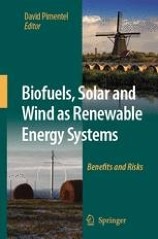
Biofuels, Solar and Wind as Renewable Energy Systems : Benefits and Risks
With shortages of fossil energy, especially oil and natural gas, and heavy biomass energy use occurring in both developed and developing countries, a major focus has developed worldwide on renewable energy systems. Renewable energy systems include wind power, biomass, photovoltaics, hydropower, solar thermal, thermal ponds, and biogas. Currently, a heavy focus is on biofuels made from crops, such as corn, sugarcane, and soybeans, for use as renewable energy sources. Wood and crop residues also are being used as fuel. Though it may seem beneficial to use renewable plant materials for biofuel, the use of crop residues and other biomass for biofuels raises many concerns about major environmental problems, including food shortages and serious destruction of vital soil resources.
