



الصفحة 1
الصفحة 1

Introducing Biological Rhythms : A Primer on the Temporal Organization of Life, with Implications for Health, Society, Reproduction, and the Natural Environment
Biological rhythms are a fundamental property of all life and encompass a wide range of frequencies, from seconds to a century or more. Introducing Biological Rhythms is a primer that serves to introduce individuals to the area of biological rhythms. It describes the major characteristics and discusses the implications and applications of these rhythms, while citing scientific results and references. Also, the primer includes essays that provide in-depth historic and other background information for those interested in more specific topics or concepts. Introducing Biological Rhythms covers a basic cross-section of the field of chronobiology clearly enough so that it can be understood by a novice, or an undergraduate student, but it is also sufficiently technical and detailed for the scientist.

Farewell to the Internal Clock : A contribution in the field of chronobiology
Nearly everything making up what we call the “environment” of a plant has an infuence on the way it grows. Sunlight, te- perature, moisture contents of soil and atmosphere and vib- tions are all obvious examples of environmental components, and transient variations in their amount or intensity lead the plant to manifest more or less immediate responses. Small changes in carbon dioxide level in the atmosphere can even have effects, but these take a longer time to be registered – at least those that are visible, albeit at the microscopic level. Plants meet the challenges of the environment by means of acclimation. In this respect, plants are notable for the pl- ticity of their development. However, where morphological or physiological plasticity is no longer an option, the responses would be by means of adaptations as a result of genetic - lection or genetic “assimilation” (Waddington 1957).
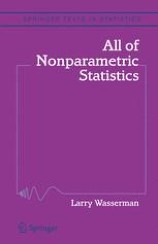
All of Nonparametric Statistics
The goal of this text is to provide the reader with a single book where they can find a brief account of many, modern topics in nonparametric inference. The book is aimed at Master's level or Ph.D. level students in statistics, computer science, and engineering. It is also suitable for researchers who want to get up to speed quickly on modern nonparametric methods.This text covers a wide range of topics including: the bootstrap, the nonparametric delta method, nonparametric regression, density estimation, orthogonal function methods, minimax estimation, nonparametric confidence sets, and wavelets. The book has a mixture of methods and theory.
