



الصفحة 1
الصفحة 1
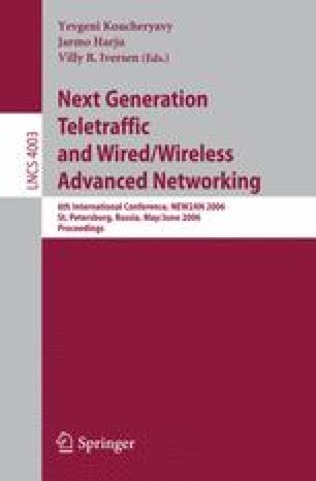
Next Generation Teletraffic and Wired ; 6th International Conference, NEW2AN 2006, St. Petersburg, Russia, May 29-June 2, 2006, Proceedings
This book constitutes the refereed proceedings of the 6th International Conference on Next Generation Teletraffic and Wired/Wireless Advanced Networking, NEW2AN 2006, held in St. Petersburg, Russia in May/June 2006. The book includes 49 revised full papers presented together with 2 keynote talks. The papers are organized in topical sections on teletraffic, traffic characterization and modeling, 3G/UMTS, sensor networks, WLAN, QoS, MANETs, lower layer techniques, PAN technologies, and TCP.
Network control and engineering for QoS, security and mobility, V ; IFIP 19th World Computer Congress,TC-6, 5th IFIP International conference on network control and engineering for QoS, security, and mobility, August 20-25, 2006, Santiago, Chile
International Federation for Information Processing The IFIP series publishes state-of-the-art results in the sciences and technologies of information and communication. The scope of the series includes: foundations of computer science; software theory and practice; education; computer applications in technology; communication systems; systems modeling and optimization; information systems; computers and society; computer systems technology; security and protection in information processing systems; artificial intelligence; and human-computer interaction. Proceedings and post-proceedings of referred international conferences in computer science and interdisciplinary fields are featured. These results often precede journal publication and represent the most current research. The principal aim of the IFIP series is to encourage education and the dissemination and exchange of information about all aspects of computing.
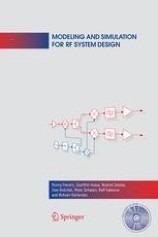
Modeling and Simulation for RF System Design
The focus of Modeling and Simulation for RF System Design lies on RF specific modeling and simulation methods and the consideration of system and circuit level descriptions. It contains application-oriented training material for RF designers which combines the presentation of a mixed-signal design flow.
Mobile and Wireless Communications Networks ; IFIP TC6 / WG6.8 Conference on Mobile and Wireless Communication Networks (MWCN 2004) October 25-27, 2004 Paris, France
Mobile Ad hoc NETworks (MANETs) has attracted great research interest in recent years. A Mobile Ad Hoc Network is a self-organizing multi-hop wireless network where all hosts (often called nodes) participate in the routing and data forwarding process. The dependence on nodes to relay data packets for others makes mobile ad hoc networks extremely susceptible to various malicious and selfish behaviors. This point is largely overlooked during the early stage of MANET research. Many works simply assume nodes are inherently cooperative and benign. However, experiences from the wired world manifest that the reverse is usually true; and many works [3] [10] [9] [8] [12] [19] have pointed out that the impact of malicious and selfish users must be carefully investigated. The goal of this research is to address the cooperation problem and related security issues in wireless ad hoc networks. As a rule of thumb, it is more desirable to include security mechanisms in the design phase rather than continually patching the system for security breaches. As pointed out in [2] [1], there can be both selfish and malicious nodes in a mobile ad hoc network. Selfish nodes are most concerned about their energy consumption and intentionally drop packets to save power. The purpose of malicious nodes, on the other hand, is to attack the network using various intrusive techniques. In general, nodes in an ad hoc network can exhibit Byzantine behaviors.
IP Networking over Next-Generation Satellite Systems ; International Workshop, Budapest, July 2007
Highlights the very latest research output of several EU satellite-related projects and addresses many unresolved issues in next-generation satellite systems, such as efficient deployment of IPv6 over satellites, working with WLAN and WiMax, QoS provisioning over multi-segment networks (including satellite networks), multicast networks and security.

Intermediate Dynamics : A Linear Algebraic Approach
As the name implies, Intermediate Dynamics: A Linear Algebraic Approach views "intermediate dynamics"--Newtonian 3-D rigid body dynamics and analytical mechanics--from the perspective of the mathematical field.

High performance computing - HiPC 2004 ; 11th International Conference, Bangalore, India, December 19-22, 2004, Proceedings
Keynote Addresses.- Rethinking Computer Architecture Research.- Event Servers for Crisis Management.- DIET: Building Problem Solving Environments for the Grid.- The Future Evolution of High-Performance Microprocessors.- Low Power Robust Computing.- Networks and Games.- Plenary Session - Best Papers.- An Incentive Driven Lookup Protocol for Chord-Based Peer-to-Peer (P2P) Networks.- A Novel Battery Aware MAC Protocol for Ad Hoc Wireless Networks, and other

High mountain conservation in a changing world
This book aims to provide case studies and a general view of the main processes involved in the ecosystem shifts occurring in the high mountains, and to analyse the implications for nature conservation. Although case studies from the Pyrenees are preponderant, conclusions are aimed at any mountain range surrounded by highly populated lowland areas. The chapters give emphasis to approaches from environmental geography, functional ecology, biogeography, and paleoenvironmental reconstructions. The introductory and closing chapters summarize the main challenges that nature conservation may face in mountain areas under the environmental shifting conditions.

Heterogeneous Wireless Access Networks : Architectures and Protocols
Heterogeneous Wireless Access Networks provides a unified view of the state-of-the-art protocols and architectures for heterogeneous wireless networking. The chapters cover both the theoretical concepts and system-level implementation issues related to design, analysis, and optimization of architectures and protocols for heterogeneous wireless access networks.

Environmental History of the Rhine-Meuse Delta : An ecological story on evolving human–environmental relations coping with climate change and sea-level rise
This book presents the environmental history of the Delta of the lowland rivers Rhine and Meuse, an ecological story on evolving human–environmental relations coping with climate change and sea-level rise. It offers a combination of in-depth ecology and environmental history, dealing with exploitation of land and water, the use of everything nature provided, the development of fisheries and agriculture, changes in biodiversity of higher plants, fish, birds, mammals and invasive exotics. It is the first comprehensive book written in English on the integrated environmental history of the Delta, from prehistoric times up to the present day. It covers the l- acy of human intervention, the inescapable fate of reclaimed, nevertheless subs- ing and sinking polders, ‘bathtubs’ attacked by numerous floods, reclaimed in the Middle Ages and unwittingly exposed to the rising sea level and the increasing amplitude between high and low water in the rivers. The river channels, constricted and regulated between embankments, lost their flood plains, silted up, degraded and incised. Cultivation of raised bog deposits led to oxidation and compacting of peat and clay, resulting in progressive subsidence and flooding; arable land had to be changed into grassland and wetland. For millennia muscular strength and wind and water powers moulded the country into its basic form. From 1800 onwards, acceleration and scaling up by steam power and electricity, and exponential popu- tion growth, resulted in the erection of human structures ‘fixed forever’, and severe pressure on the environment.

Embedded Software and Systems ; 3rd International Conference, ICESS 2007, Daegu, Korea, May 14-16, 2007, Proceedings
This book introduces sections on embedded architecture, embedded hardware, embedded software, HW-SW co-design and SoC, multimedia and HCI, pervasive/ubiquitous computing and sensor network, power-aware computing, real-time systems, security and dependability, and wireless communication.

Embedded computer systems : Architectures, modeling, and simulation ; Vol. 3553 ; 5th International Workshop, SAMOS 2005, Samos, Greece, July 18-20, Proceedings
The SAMOS workshop is an international gathering of highly quali?ed researchers from academia and industry, sharing in a 3-day lively discussion on the quiet and - spiring northern mountainside of the Mediterranean island of Samos. As a tradition, the workshop features workshop presentations in the morning, while after lunch all kinds of informal discussions and nut-cracking gatherings take place. The workshop is unique in the sense that not only solved research problems are presented and discussed but also (partly) unsolved problems and in-depth topical reviews can be unleashed in the sci- ti?c arena. Consequently, the workshop provides the participants with an environment where collaboration rather than competition is fostered. The earlier workshops, SAMOS I–IV (2001–2004), were composed only of invited presentations. Due to increasing expressions of interest in the workshop, the Program Committee of SAMOS V decided to open the workshop for all submissions. As a result the SAMOS workshop gained an immediate popularity; a total of 114 submitted papers were received for evaluation. The papers came from 24 countries and regions: Austria (1), Belgium (2), Brazil (5), Canada (4), China (12), Cyprus (2), Czech Republic (1), Finland (15), France (6), Germany (8), Greece (5), Hong Kong (2), India (2), Iran (1), Korea (24), The Netherlands (7), Pakistan (1), Poland (2), Spain (2), Sweden (2), T- wan (1), Turkey (2), UK (2), and USA (5). We are grateful to all of the authors who submitted papers to the workshop.

Dependable computing ; 2nd Latin-American symposium, LADC 2005, Salvador, Brazil, October 25-28, 2005 : proceedings
Contains the proceedings of the 'Second Latin-American Symposium' on Dependable Computing, LADC 2005. This book comprises 16 papers presented together with 3 invited talks. The papers are organized in topical sections on evaluation, certification, modelling, embedded systems, time, and distributed systems algorithms.
Data communications and network technologies
Aims to help readers master the basics of network communications and use Huawei network devices to set up enterprise LANs and WANs, wired networks, and wireless networks, ensure network security for enterprises, and grasp cutting-edge computer network technologies. The content of this book includes: network communication fundamentals, TCP/IP protocol, Huawei VRP operating system, IP addresses and subnetting, static and dynamic routing, Ethernet networking technology, ACL and AAA, network address translation, DHCP server, WLAN, IPv6, WAN PPP and PPPoE protocol, typical networking architecture and design cases of campus networks, SNMP protocol used by network management, operation and maintenance, network time protocol NTP, SND and NFV, programming, and automation.

Converged communications : Evolution from telephony to 5G mobile internet
The central theme of the book is to build deeper understanding about incremental technological progress by introducing both state of the art and their predecessor technologies. The book explores four main areas, including fixed telephone systems, data communication systems, mobile cellular systems, and IP multimedia systems. It clearly explains architectures, protocols, and functional procedures, and discusses a variety of topics ranging from physical layer processes to system level interactions. Converged Communications offers: In-depth treatments of fixed telephone and transmission systems, including operation of telephone exchanges and signaling systems Comprehensive explorations of data communication systems, including transmission of data over telephone lines and data network technologies, such as Ethernet and TCP/IP Incisive discussions of mobile cellular systems, including GSM, 3G, LTE, VoLTE and 5G Insightful analysis of incremental system evolution to justify various design choices made The book is supported with extensive online appendices, which covers communication system concepts, an overview of standardization, various technologies used in the past, state-of-the art technologies such as WLAN, cable modems, and FTTx, complementing the other systems described in the book which have evolved from the fixed telephone network.

Concrete floors and slabs ; Proceedings of the International Seminar held at the University of Dundee, Scotland, UK on 5–6 September 2002
Concrete is a global material that underwrites commercial wellbeing and social development. There is no substitute that can be used on the same engineering scale and its sustainability, expolitation and further development are imperatives to creating and maintaing a healthy economy and environment worldwide. The pressure for change and improvement of performance is relentless and necessary. Concrete must keep evolving to satisfy the increasing demands of all its users.

Computational Science - ICCS 2006 ; Vol. 3992 ; 6th International Conference, Reading, UK, May 28-31, 2006, Proceedings, Part II
The four-volume set LNCS 3991-3994 constitutes the refereed proceedings of the 6th International Conference on Computational Science, ICCS 2006, held in Reading, UK, in May 2006. The papers span the whole range of computational science.

Managing Next Generation Networks and Services ; 10th Asia-Pacific Network Operations and Management Symposium, APNOMS 2007, Sapporo, Japan, October 10-12, 2007, Proceedings
The 48 revised full papers and 30 revised short papers cover management of distributed networks, network configuration and planning, network security management, sensor and ad-hoc networks, network monitoring, routing and traffic engineering, management of wireless networks and security on wireless networks.

Management of Convergence Networks and Services ; 9th Asia-Pacific Network Operations and Management Symposium, APNOMS 2006, Busan, Korea, September 27-29, 2006, Proceedings
Constitutes the refereed proceedings of the 9th Asia-Pacific Network Operations and Management Symposium, APNOMS 2006. This book presents 50 revised full papers and 25 revised short papers, organized in topical sections on management of ad hoc and sensor networks, network measurements and monitoring, mobility management, QoS management, and more

Location- and Context-Awareness ; Vol. 3479 ; First International Workshop, LoCA 2005, Oberpfaffenhofen, Germany, May 12-13, 2005, Proceedings
The workshop was organized by the Institute of Communications and Navigation of the German Aerospace Center (DLR) in Oberpfa?enhofen, and the Mobile and Distributed Systems Group of the University of Munich. During the workshop, novel positioning algorithms and location sensing techniques were discussed, comprising not only enhancements of singular systems, like positioning in GSM or WLAN, but also hybrid technologies, such as the integration of global satellite systems with inertial positioning. Furthermore, improvements in sensor technology, as well as the integration and fusion of sensors, were addressed both on a theoretical and on an implementation level. Personal and confidential data, such as location data of users, have p- found implications for personal information privacy. Thus privacy protection, privacy-oriented location-aware systems, and how privacy aspects the feasibility and usefulness of systems were also addressed in the workshop.
