



الصفحة 1
الصفحة 1

Investigating the long-run relation between crypto-currencies and other assets
Crypto-currencies are financial assets with high volatility, which calls for an investigation of the long-run relation between crypto-currencies and other assets. The present study aims to explore the long-run relation between crypto-currencies and assets such as Gold and Oil Contracts For Differences (CFDs), the CBOE volatility index (VIX) and the Dow Jones Industrial Average Index. To this purpose, we analyze this relation using the Autoregressive Distributed Lag (ARDL) approach based on quarterly data for the period between first quarter of 2011 and first quarter of 2022, and monthly data for the period between Jan. 2018 and March 2022.

Introduction to Modern Time Series Analysis
This excellent textbook presents an introduction to the time series analysis. It provides a good source of information for graduate and master students in economics and statistics. It is a well-written and easy to read book, illustrated by 56 good examples. Also, many important references are listed at the end of each chapter.This book presents to beginners a readable and easily accessible introduction to modern developments in time series econometrics and financial time series with an emphasis on basic concepts and practical applications. The book is a textbook consisting of seven chapters the greatest merit of this textbook is that it enables readers to grasp the basic framework of time-series econometrics without relying on extensive reading

High Frequency Financial Econometrics : Recent Developments
This exciting volume presents cutting-edge developments in high frequency financial econometrics, spanning a diverse range of topics: market microstructure, tick-by-tick data, bond and foreign exchange markets and large dimensional volatility modelling. The chapters on market microstructure deal with liquidity, asymmetries of information, and limit order aggressiveness in pure limit order book markets. The chapters on tick-by-tick data present statistical techniques for the analysis of the discrete nature of price movements, the intraday seasonal patterns of financial durations, and the joint probability law of prices, volume and durations. Bond markets are brought into focus through the analysis of macroeconomic announcements in the future bond market as a function of the business cycle.

Food Price Volatility and Its Implications for Food Security and Policy
This book provides fresh insights into concepts, methods and new research findings on the causes of excessive food price volatility. It also discusses the implications for food security and policy responses to mitigate excessive volatility. The approaches applied by the contributors range from on-the-ground surveys, to panel econometrics and innovative high-frequency time series analysis as well as computational economics methods. It offers policy analysts and decision-makers guidance on dealing with extreme volatility.

Financial mathematics, derivatives and structured products
Introduces readers to the financial markets, derivatives, structured products and how the products are modelled and implemented by practitioners. In addition, it equips readers with the necessary knowledge of financial markets needed in order to work as product structurers, traders, sales or risk managers. As the book seeks to unify the derivatives modelling and the financial engineering practice in the market, it will be of interest to financial practitioners and academic researchers alike. Further, it takes a different route from the existing financial mathematics books, and will appeal to students and practitioners with or without a scientific background. The book can also be used as a textbook for the following courses: Financial Mathematics (undergraduate level) Stochastic Modelling in Finance (postgraduate level) Financial Markets and Derivatives (undergraduate level) Structured Products and Solutions (undergraduate/postgraduate level)
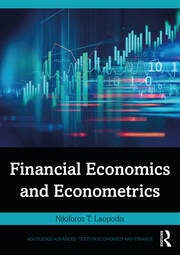
Financial economics and econometrics
Covers financial data and univariate models; asset returns; interest rates, yields and spreads; volatility and correlation; and corporate finance and policy. Each chapter begins with a theory in financial economics, followed by econometric methodologies which have been used to explore the theory. Next, the chapter presents empirical evidence and discusses seminal papers on the topic. Boxes offer insights on how an idea can be applied to other disciplines such as management, marketing and medicine, showing the relevance of the material beyond finance. Readers are supported with plenty of worked examples and intuitive explanations throughout the book, while key takeaways, ‘test your knowledge’ and ‘test your intuition’ features at the end of each chapter also aid student learning.

Estimation in Conditionally Heteroscedastic Time Series Models
ARCH (autoregressive conditionally heteroscedastic), is well-suited for the description of economic and financial price. Nowadays ARCH has been replaced by more general and more sophisticated models, such as GARCH (generalized autoregressive heteroscedastic). This monograph concentrates on mathematical statistical problems associated with fitting conditionally heteroscedastic time series models to data. This includes the classical statistical issues of consistency and limiting distribution of estimators. Particular attention is addressed to (quasi) maximum likelihood estimation and misspecified models, along to phenomena due to heavy-tailed innovations. The used methods are based on techniques applied to the analysis of stochastic recurrence equations. Proofs and arguments are given wherever possible in full mathematical rigour. Moreover, the theory is illustrated by examples and simulation studies.

Commodity derivatives : Markets and applications
The second edition includes discussions of critical new topics like dual curve swap valuation, option valuation within a negative price environment using the Bachelier model, volatility skews, smiles, smirks, term structures for major commodities, and more. You’ll find case studies on corporate failures linked to improper commodity risk management, as well as explorations of issues like the impact of growing interest in electric vehicles on commodity markets.
Mathematical Control Theory and Finance
This book highlights recent developments in mathematical control theory and its applications to finance. It presents a collection of original contributions by distinguished scholars, addressing a large spectrum of problems and techniques. Control theory provides a large set of theoretical and computational tools with applications in a wide range of fields, ranging from "pure" areas of mathematics up to applied sciences like finance. Stochastic optimal control is a well established and important tool of mathematical finance. Other branches of control theory have found comparatively less applications to financial problems, but the exchange of ideas and methods has intensified in recent years. This volume should contribute to establish bridges between these separate fields. The diversity of topics covered as well as the large array of techniques and ideas brought in to obtain the results make this volume a valuable resource for advanced students and researchers.
Martingale Methods in Financial Modelling
This book provides a comprehensive, self-contained and up-to-date treatment of the main topics in the theory of option pricing. The first part of the text starts with discrete-time models of financial markets, including the Cox-Ross-Rubinstein binomial model. The passage from discrete- to continuous-time models, done in the Black-Scholes model setting, assumes familiarity with basic ideas and results from stochastic calculus. However, an Appendix containing all the necessary results is included. This model setting is later generalized to cover standard and exotic options involving several assets and/or currencies. An outline of the general theory of arbitrage pricing is presented. The second part of the text is devoted to the term structure modelling and the pricing of interest-rate derivatives. The main emphasis is on models that can be made consistent with market pricing practice.
Long Memory in Economics
When applying the statistical theory of long range dependent (LRD) processes to economics, the strong complexity of macroeconomic and financial variables, compared to standard LRD processes, becomes apparent. In order to get a better understanding of the behaviour of some economic variables, the book assembles three different strands of long memory analysis: statistical literature on the properties of, and tests for, LRD processes; mathematical literature on the stochastic processes involved; models from economic theory providing plausible micro foundations for the occurence of long memory in economics. Each chapter of the book will give a comprehensive survey of the state of the art and the directions that future developments are likely to take. Taken as a whole the book provides an overview of LRD processes which is accessible to economists, econometricians and statisticians.
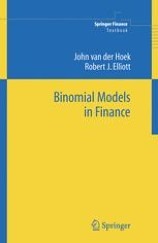
Binomial models in finance
This book deals with many topics in modern financial mathematics in a way that does not use advanced mathematical tools and shows how these models can be numerically implemented in a practical way. The book is aimed at undergraduate students, MBA students, and executives who wish to understand and apply financial models in the spreadsheet computing environment.The basic building block is the one-step binomial model where a known price today can take one of two possible values at the next time. In this simple situation, risk neutral pricing can be defined and the model can be applied to price forward contracts, exchange rate contracts, and interest rate derivatives.
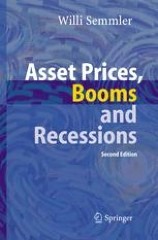
Asset prices, booms and recessions : Financial economics from a dynamic perspective
Studies the interaction of the financial market, economic activity and the macroeconomy from a dynamic perspective. The financial market to be studied here encompasses the money and bond market, credit market, stock market and foreign exchange market. Economic activity is described by the activity of firms, banks, households, governments and countries. The book shows how economic activity affects asset prices and the financial market and how asset prices and financial market volatility feed back to economic activity. The focus in this book is on theories, dynamic models and empirical evidence.
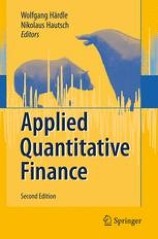
Applied Quantitative Finance
Applied Quantitative Finance (2nd edition) provides a comprehensive and state-of-the-art treatment of cutting-edge topics and methods. It provides solutions to and presents theoretical developments in many practical problems such as risk management, pricing of credit derivatives, quantification of volatility and copula modelling. The synthesis of theory and practice supported by computational tools is reflected in the selection of topics as well as in a finely tuned balance of scientific contributions on practical implementation and theoretical concepts. This linkage between theory and practice offers theoreticians insights into considerations of applicability and, vice versa, provides practitioners comfortable access to new techniques in quantitative finance.
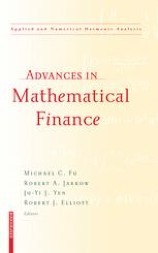
Advances in Mathematical Finance
This volume brings together a collection of chapters by some of the most distinguished researchers and practitioners in the fields of mathematical finance and financial engineering. Presenting state-of-the-art developments in theory and practice.
A Trading Desk View of Market Quality
"Market quality" is a complex, ambiguous term that means different things to different people. How should it be defined, measured, monitored, and improved? What is the evidence about the current state of our markets? How effective have recent innovations been? How can we better meet investor needs? These are some of the questions that we address in this book, along with a broad range of issues concerning equity market structure, regulation, and the quest for best execution. Throughout, particular attention is given to the perspective of front line participants on the buy-side and sell-side trading desks.

A Portrait of State-of-the-Art Research at the Technical University of Lisbon
This book contains the edited version of the invited lectures that were delivered by prominent researchers at UTL. This book brings together in a review manner a comprehensive summary of high quality research contri- tions across basic and applied sciences. The contributing papers are organized around the following major areas: – Emergent areas (Nanosciences, Quantic Computations and Infor- tion, Risk and Volatility in Financial Markets); – Basic Sciences (Mathematics, Physics, Chemistry and Materials); – Social Sciences, Economics and Management Sciences; – Life Sciences and Biotechnology; – Engineering and Technologies – Nature, Environment and Sustainability; – Public Health, Food Quality and Safety; – Health and Sport Sciences; – Urbanism, Transports, Architecture, Arts and Design.

A Course in Derivative Securities : Introduction to Theory and Computation
Aims at a middle ground between the introductory books on derivative securities and those that provide advanced mathematical treatments. It is written for mathematically capable students who have not necessarily had prior exposure to probability theory, stochastic calculus, or computer programming. It provides derivations of pricing and hedging formulas (using the probabilistic change of numeraire technique) for standard options, exchange options, options on forwards and futures, quanto options, exotic options, caps, floors and swaptions, as well as VBA code implementing the formulas. It also contains an introduction to Monte Carlo, binomial models, and finite-difference methods.
A Benchmark Approach to Quantitative Finance
The general framework is used to provide an understanding of the nature of stochastic volatility. The book is intended for a wide audience that includes quantitative analysts, postgraduate students and practitioners in finance, economics and insurance. It aims to be a self-contained, accessible but mathematically rigorous introduction to quantitative finance for readers that have a reasonable mathematical or quantitative background. Finally, the book should stimulate interest in the benchmark approach by describing some of its power and wide applicability.
