



الصفحة 1
الصفحة 1

Multibody Dynamics : Computational Methods and Applications
Multibody Dynamics is an area of Computational Mechanics which blends together various disciplines such as structural dynamics, multi-physics - chanics, computational mathematics, control theory and computer science, in order to deliver methods and tools for the virtual prototyping of complex mechanical systems. Multibody dynamics plays today a central role in the modeling, analysis, simulation and optimization of mechanical systems in a variety of ?elds and for a wide range of industrial applications.

Dynamic Modeling, Predictive Control and Performance Monitoring : A Data-driven Subspace Approach
A typical design procedure for model predictive control or control performance monitoring consists of: identification of a parametric or nonparametric model, derivation of the output predictor from the model and design of the control law or calculation of performance indices according to the predictor.

Coordination : Neural, Behavioral and Social Dynamics
One of the most striking features of Coordination Dynamics is its interdisciplinary character. The problems we are trying to solve in this field range from behavioral phenomena of interlimb coordination and coordination between stimuli and movements (perception-action tasks) through neural activation patterns that can be observed during these tasks to clinical applications and social behavior. It is not surprising that close collaboration among scientists from different fields as psychology, kinesiology, neurology and even physics are imperative to deal with the enormous difficulties we are facing when we try to understand a system as complex as the human brain.

MARE-WINT : New Materials and Reliability in Offshore Wind Turbine Technology
This book provides a holistic, interdisciplinary overview of offshore wind energy, and is a must-read for advanced researchers. Topics, from the design and analysis of future turbines, to the decommissioning of wind farms, are covered. The scope of the work ranges from analytical, numerical and experimental advancements in structural and fluid mechanics, to novel developments in risk, safety & reliability engineering for offshore wind. The core objective of the current work is to make offshore wind energy more competitive, by improving the reliability, and operations and maintenance (O&M) strategies of wind turbines.

Linearization Methods for Stochastic Dynamic Systems
The aim of this book is to give a systematic introduction to and overview of the relatively simple and popular linearization methods available. The scope is limited to models with continous external and parametric excitations, yet these cover the majority of known approaches. The book contains an application chapter with emphasis on vibration analysis of stochastic mechanical structures as well as a chapter devoted to the assessment of the accuracy of the theoretical methods presented, both with respect to numerical and to experimental studies.

Kinematics and Dynamics of Multibody Systems with Imperfect Joints : Models and Case Studies
The primary goal of this book is to present suitable methodologies for dynamic analysis of multibody mechanical systems with imperfect or real joints, that is, considering clearances, including their tribological characteristics and surface compliance properties. Two and three-dimensional methodologies for imperfect kinematic joints with and without lubrication are presented.
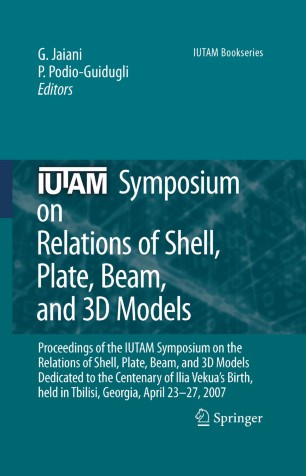
IUTAM symposium on relations of shell plate beam and 3D models ; Proceedings of the IUTAM Symposium on the relations of shell, plate, beam, and 3D models, Dedicated to the Centenary of Ilia Vekua’s Birth, held in Tbilisi, Georgia, April 23-27, 2007
Contains papers on the main topics reflecting the scientific programme of the symposium: hierarchical, refined mathematical and technical models of shells, plates, and beams; relation of 2D and 1D models to 3D linear, non-linear and physical models; junction problems. In particular, peculiarities of cusped shells, plates, and beams are emphasized and special attention is paid to junction, multibody and fluid-elastic shell (plate, beam) interaction problems and their applications.

Complex Nonlinearity : Chaos, Phase Transitions, Topology Change and Path Integrals
The book starts with a textbook-like expose on nonlinear dynamics, attractors and chaos, both temporal and spatio-temporal, including modern techniques of chaos–control. Chapter 2 turns to the edge of chaos, in the form of phase transitions (equilibrium and non-equilibrium, oscillatory, fractal and noise-induced), as well as the related field of synergetics. While the natural stage for linear dynamics comprises of flat, Euclidean geometry (with the corresponding calculation tools from linear algebra and analysis), the natural stage for nonlinear dynamics is curved, Riemannian geometry (with the corresponding tools from nonlinear, tensor algebra and analysis). The extreme nonlinearity – chaos – corresponds to the topology change of this curved geometrical stage, usually called configuration manifold. Chapter 3 elaborates on geometry and topology change in relation with complex nonlinearity and chaos. Chapter 4 develops general nonlinear dynamics, continuous and discrete, deterministic and stochastic, in the unique form of path integrals and their action-amplitude formalism.
Auralization : Fundamentals of acoustics, modelling, simulation, algorithms and acoustic virtual reality
"Auralization" is the technique of creation and reproduction of sound on the basis of computer data. With this tool is it possible to predict the character of sound signals which are generated at the source and modified by reinforcement, propagation and transmission in systems such as rooms, buildings, vehicles or other technical devices. This book is organized as a comprehensive collection of the basics of sound and vibration, acoustic modelling, simulation, signal processing and audio reproduction. Implementations of the auralization technique are described using examples drawn from various fields in acoustic’s research and engineering, architecture, sound design and virtual reality.

Advances in Control, Signal Processing and Energy Systems : Select Proceedings of CSPES 2018
Covers topics on both theoretical control systems and their applications across engineering domains such as automatic control, robotics, and adaptive controller design. It discusses several signal processing domains such as image, speech, biomedical signal processing and their applications in IOT, control, robotics, power and energy systems. The book emphasizes both conventional and non-conventional energy, environment, and green processes as related to energy and power systems engineering.
