



الصفحة 1
الصفحة 1

Matrix Algebra : Theory, Computations, and Applications in Statistics
Matrix algebra is one of the most important areas of mathematics for data analysis and for statistical theory. The first part of this book presents the relevant aspects of the theory of matrix algebra for applications in statistics. This part begins with the fundamental concepts of vectors and vector spaces, next covers the basic algebraic properties of matrices, then describes the analytic properties of vectors and matrices in the multivariate calculus, and finally discusses operations on matrices in solutions of linear systems and in eigenanalysis. This part is essentially self-contained.
Intégration : Chapitre 6 = Integration : Chapters 6
Nicolas BOURBAKI's Elements of Mathematics aim to provide a rigorous, systematic presentation without prerequisites of mathematics from their foundations.This sixth chapter of the Book of Integration, the sixth Book of the elements of mathematics, extends the notion of integration to values in locally convex Hausdorff vector spaces.

Frames and Bases : An Introductory Course
During the last several years, frames have become increasingly popular; they have appeared in a large number of applications, and several concrete constructions of frames of various types have been presented. Most of these constructions were based on quite direct methods rather than the classical sufficient conditions for obtaining a frame. Consequently, there is a need for an updated book on frames, which moves the focus from the classical approach to a more constructive one.

Espaces vectoriels topologiques : Chapitres 1à 5 = Topological vector spaces : Chapters 1 to 5
The Mathematics Elements of Nicolas BOURBAKI aim to provide a rigorous, systematic presentation without prerequisites of mathematics from their foundations. This book is the fifth of the treatise; it is devoted to the basics of functional analysis. It contains in particular the Hahn-Banach theorem and the Banach-Steinhaus theorem.

Eléments dhistoire des mathématiques = Elements of the history of mathematics
Brings together the historical notes published in the various books of mathematics elements by the author. They therefore concern all the matters covered in this treaty: set theory, algebra, topology, functions of a variable real, topological vector spaces, integration, commutative algebra, groups and Lie algebras. Composed of initially separate studies, this work does not claim to sketch a followed and complete history of development of mathematics. The interweaving of the different themes and the unity of the point of view ensure the deep consistency.

Eléments de Mathématique. Intégration : Chapitre 9 Intégration sur les espaces topologiques séparés
The Mathematics Elements of Nicolas BOURBAKI aim to provide a rigorous, systematic presentation without prerequisites of mathematics from their foundations. This ninth chapter of the Book of Integration, sixth Book of the elements of mathematics, is devoted to the integration in separate topological spaces not necessarily locally compact, which allows to extend the theory of the Fourier transformation to locally convex vector spaces .
Mathematical Analysis : Linear and Metric Structures and Continuity
The book is divided into three parts. The first part introduces the basic ideas of linear and metric spaces, including the Jordan canonical form of matrices and the spectral theorem for self-adjoint and normal operators. The second part examines the role of general topology in the context of metric spaces and includes the notions of homotopy and degree. The third and final part is a discussion on Banach spaces of continuous functions, Hilbert spaces and the spectral theory of compact operators.
Linear Algebra Thoroughly Explained
Linear Algebra Thoroughly Explained provides a comprehensive introduction to the subject suitable for adoption as a self-contained text for courses at undergraduate and postgraduate level. The clear and comprehensive presentation of the basic theory is illustrated throughout with an abundance of worked examples. The book is written for teachers and students of linear algebra at all levels and across mathematics and the applied sciences, particularly physics and engineering.
Algebraic Methods for Nonlinear Control Systems
A self-contained introduction to algebraic control for nonlinear systems suitable for researchers and graduate students.The most popular treatment of control for nonlinear systems is from the viewpoint of differential geometry yet this approach proves not to be the most natural when considering problems like dynamic feedback and realization. Professors Conte, Moog and Perdon develop an alternative linear-algebraic strategy based on the use of vector spaces over suitable fields of nonlinear functions. This algebraic perspective is complementary to, and parallel in concept with, its more celebrated differential-geometric counterpart.Algebraic Methods for Nonlinear Control Systems describes a wide range of results, some of which can be derived using differential geometry but many of which cannot.
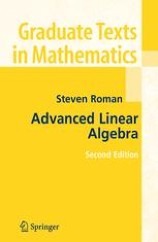
Advanced Linear Algebra
The first part of the book contains a careful but rapid discussion of the basics of linear algebra, including vector spaces, linear transformations, quotient spaces, and isomorphism theorems. The author then proceeds to modules, emphasizing a comparison with vector spaces. A thorough discussion of inner product spaces, eigenvalues, eigenvectors, and finite dimensional spectral theory follows, culminating in the finite dimensional spectral theorem for normal operators. The second part of the book is a collection of topics, including metric vector spaces, metric spaces, Hilbert spaces, tensor products, and affine geometry. The last chapter discusses the umbral calculus, an area of modern algebra with many important applications.
