



الصفحة 1
الصفحة 1

Multivariable Computer-controlled Systems : A Transfer Function Approach
Having established the ability of the parametric transfer function to solve this problem for single-input, single-output systems in previous work, the authors extend these methods, which incorporate time-dependence, to the idea of the parametric transfer matrix in a complete exposition of analysis and design methods for multiple-input, multiple-output (MIMO) sampled-data systems.

Moment Analysis for Subsurface Hydrologic Applications
This book deals with the concept of moments, and how they find application in subsurface hydrologic problems-particularly those dealing with solute transport. This book will be very valuable to researchers who are beginning to learn about moment analysis, and will also be of interest to advanced researchers as well. Both temporal and spatial moments are dealt with in some detail for a wide variety of problems. Several examples using experimental data, both from laboratory columns and field experiments, are provided to give the readers a clear idea about the scope of this method. Apart from conventional uses of moments for solute transport problems, this book contains chapters dealing with use of moments in interval computing, vapour phase transport applications, transfer functions to subsurface tile drains, and construction of breakthrough curves from knowledge of moments.
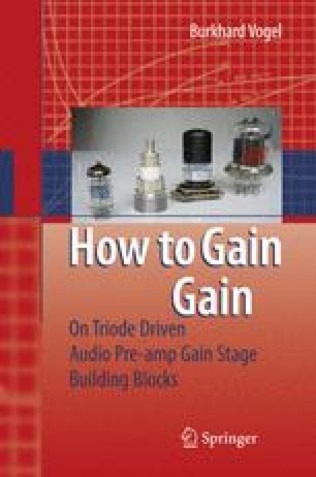
How to Gain Gain : A Reference Book on Triodes in Audio Pre-Amps
The 17 chapters of How to Gain Gain give a detailed insight into a collection of the most common gain producing and constant current generating possibilities (28) of triodes for audio pre-amplifier purposes. These chapters also offer complete sets of formulae to calculate gain, frequency and phase responses of certain building blocks built-up with this type of vacuum valve (tube).

Decoupling Control
Decoupling or non-interactive control has attracted considerable research attention since the 1960s when control engineers started to deal with multivariable systems. The theory and design techniques for decoupling control have now, more or less matured for linear time-invariant systems, yet there is no single book which focuses on such an important topic. The present monograph fills this gap by presenting a fairly comprehensive and detailed treatment of decoupling theory and relevant design methods. Decoupling control under the framework of polynomial transfer function and frequency response settings, is included as well as the disturbance decoupling problem. The emphasis here is on special or relatively new compensation schemes such as (true and virtual) feedforward control and disturbance observers, rather than use of feedback control alone. The results are presented in a self-contained way and only the knowledge of basic linear systems theory is assumed of the reader.
Linear Systems Control : Deterministic and Stochastic Methods
Modern control theory and in particular state space or state variable methods can be adapted to the description of many different systems because it depends strongly on physical modeling and physical intuition. The laws of physics are in the form of differential equations and for this reason, this book concentrates on system descriptions in this form. This means coupled systems of linear or nonlinear differential equations. The physical approach is emphasized in this book because it is most natural for complex systems. It also makes what would ordinarily be a difficult mathematical subject into one which can straightforwardly be understood intuitively and which deals with concepts which engineering and science students are already familiar.
